

Creating a timeline seems straightforward until you actually sit down to make one. Suddenly you are not sure what to include, how far back to go, whether to show tasks or milestones and which format makes sense for what you are presenting.
This guide covers 25 timeline examples across project planning, events, marketing campaigns, business reporting and historical storytelling. I’ll also share timelines templates for different use cases so you can get started quickly.
What is a timeline?
A timeline is visual representation of events, tasks, or milestones in a chronological order. Think of it as your go-to tool for making sense of how things connect over time. Timelines can show the past, present or future depending on what you are communicating.
Some people confuse timelines with calendars, roadmaps or Gantt charts. However, they all serve different purposes.
A calendar organizes time by date slots and a Gantt chart is used to track task dependencies and progress. You use a roadmap to show high-level strategic direction. Whereas a timeline focuses on showing sequence of events.
You can use a timeline for all sorts of things:
- Managing projects: Keep track of deadlines and make sure nothing slips through the cracks.
- Planning for business : Map out product launches, marketing campaigns or big-picture strategies.
- Learning and teaching: Break down history, case studies or even scientific discoveries so they’re easier to follow.
- Personal goals: Lay out career steps, life events or study plans.
- Sharing ideas: Present information in reports or presentations without overwhelming people.
What should a good timeline include
A timeline should clearly explain the sequence and timing of tasks and events without needing an explanation. Here is what a well-built timeline should have:
- Clear title: So anyone looking at it immediately knows what the timeline is about.
- Dates or time scale: The time scale needs to be consistent and visible, either in days, months or years.
- Events or tasks in order: This should be arranged chronologically from left to right or top to bottom.
- Milestones: Key moments or deadlines that mark progress or significant points in the sequence.
- Short labels: Each event or task should have a brief label.
- Visual hierarchy: Use size, color or placement to signal what is most important and explain the sequence correctly.
- Owners or dependencies: Optional but useful for project timelines where accountability matters
Here are a few common mistakes to avoid to create an effective timeline:
- Too much text: A timeline is a visual tool. It should have only necessary text including date, task/event and owner name. Cramming too much text makes it difficult to read.
- Inconsistent spacing or scale: Compressing three months into the same space as three days makes the timeline misleading
- Using a timeline when another format fits better: If you need to track task dependencies, use a Gantt chart. If you are organizing by date and time, use a calendar
How to choose the right timeline format
Before we get into the timeline examples, here is a quick overview of the different types of timelines and when to use them.
Project timeline examples
Project managers need to juggle multiple balls. The average number of concurrent projects that project managers are asked to manage is eight, which is considered high due to the size and importance of these projects.
Timeline slide examples are a perfect addition to your presentation, project plan, proposal, project management software or any document where you need to share project details with stakeholders and keep the team on track.
Project milestone timeline example
For long projects, a milestone timeline helps you track progress without getting lost in the details. Instead of mapping every task, it focuses on the key events and deliverables that signal the project is moving in the right direction.
This template organizes milestones month by month with dates so your team always knows what is coming up and whether the project is on track.
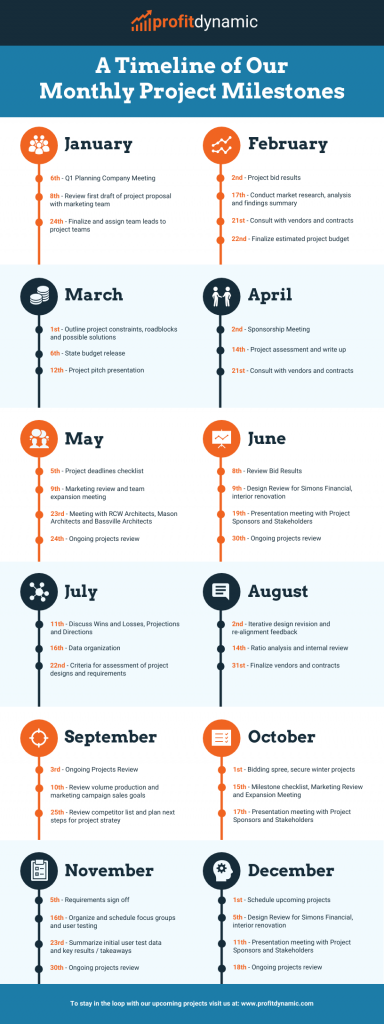
Monthly project timeline template
For shorter project sprint planning, a monthly project timeline example may be more useful. A timeline, like this example below, can be customized to make it weekly or even hourly:
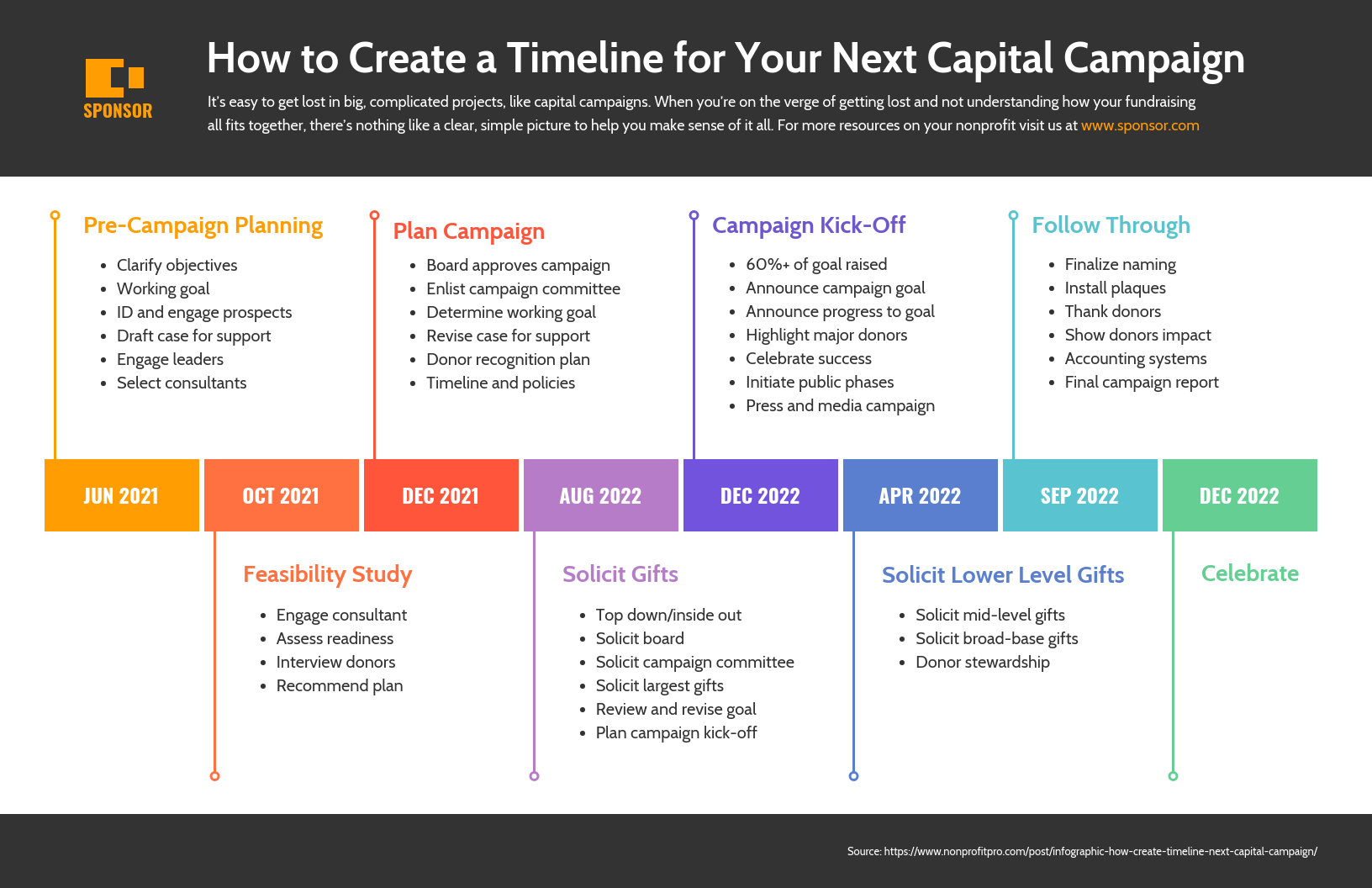
To make this a weekly or hourly timeline, simply click “Jun 2021” and change it to “Monday” or “9 a.m.”, for example. Note how, unlike the above timeline which uses different shades of blue, this one uses multiple colors to differentiate between time periods.
If you feel like this one uses too many colors and doesn’t coordinate well with your branding, you can always add your brand colors to My Brand Kit and apply them to the timeline in one click:
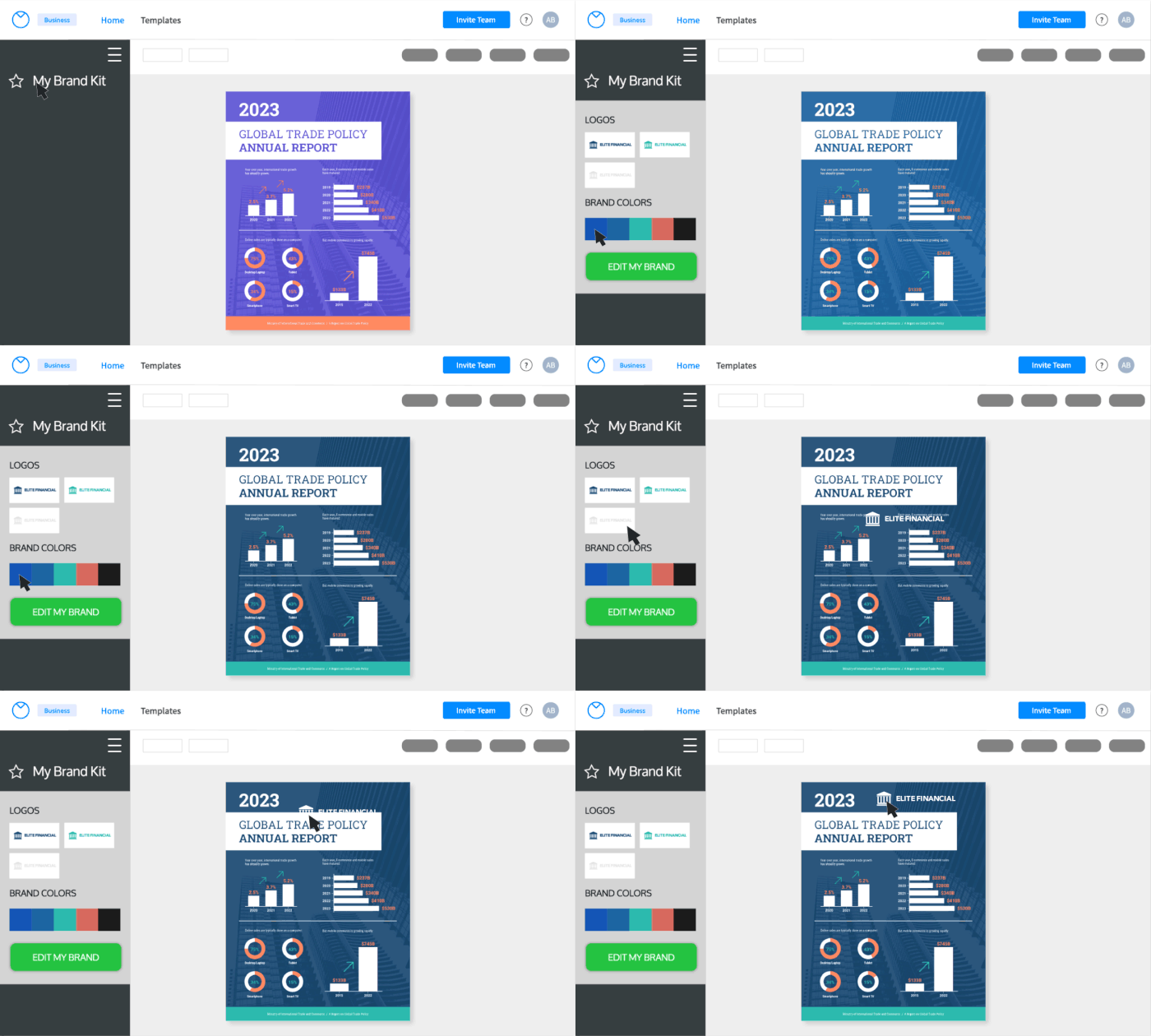
Consultants for projects can also add this free timeline template to their marketing plan to improve their workflow. A more efficient workflow will help the team effectively carry out your recommendations.
Pro Tip: Timeline infographics are great for nonprofits looking to become thought leaders. Pick a topic that shows the development of an idea in your industry. Plot it into a timeline template and insert it into your blog posts or guest posts or share it on social media. You can also add it to a white paper.
Real estate project timeline template
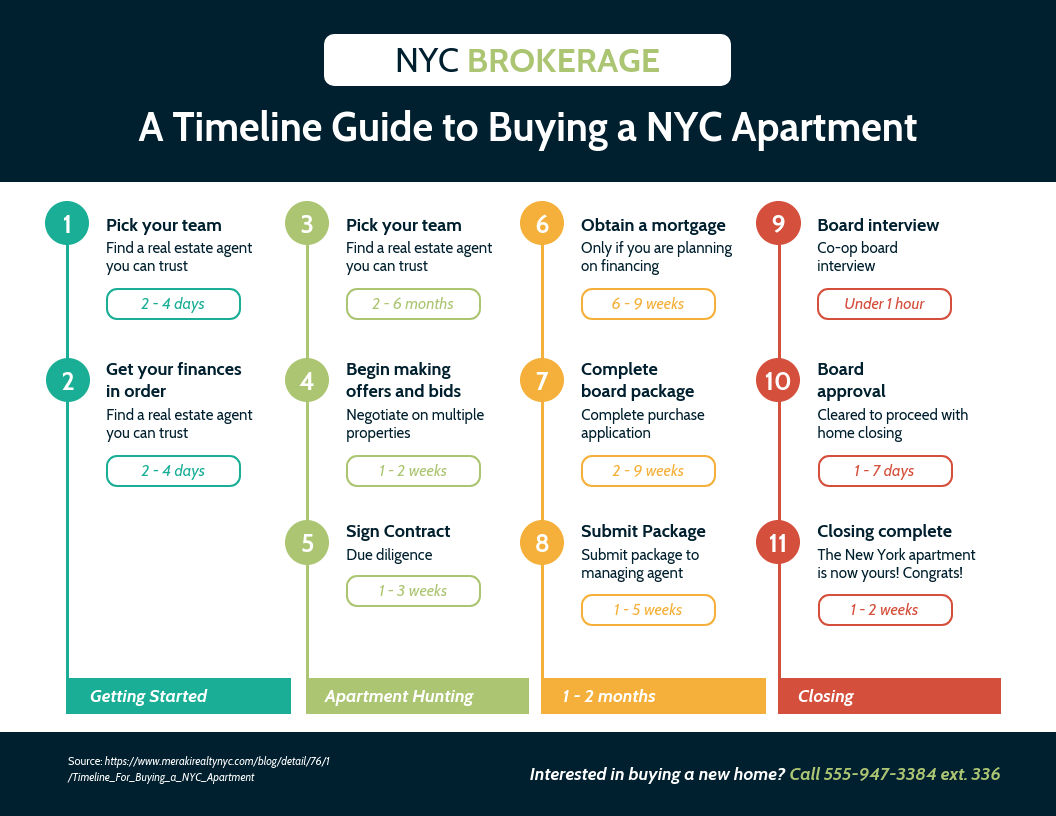
The home-buying process can be confusing for first-time buyers. Real estate companies can ease their customers’ concerns by using visual aids—like timeline poster examples—to guide first-time homebuyers through each stage of the buying process. It’s perfect for turning complex steps into a clear, easy-to-follow visual that builds trust and confidence.
Business timeline examples
Running a business is never easy, and the time crunches may be hard to manage.
Do you have short timeline and a short duration to get things done? I thought you’d say that. Try experimenting with two-week project timelines instead to manage your business needs.
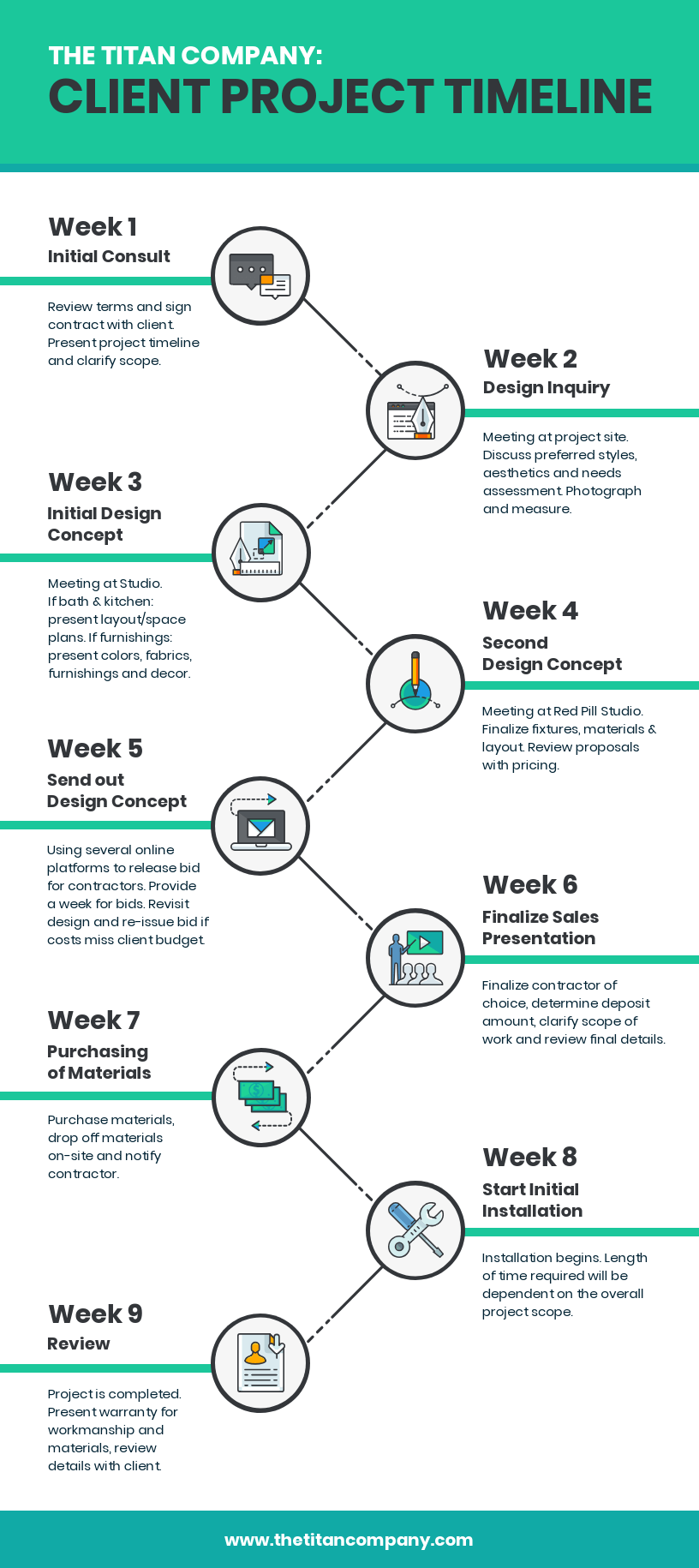
Vertical timeline example
This client project timeline template can help you clearly map out deliverables, deadlines and milestones, great for keeping clients informed and your team aligned throughout the entire project lifecycle.
Pro Tip: Learning how to complete projects by dividing up deliverables and underlying tasks is key to getting things done across a project’s entire life cycle. Our project life cycle guide will give you a handy framework to guide projects from inception to completion.
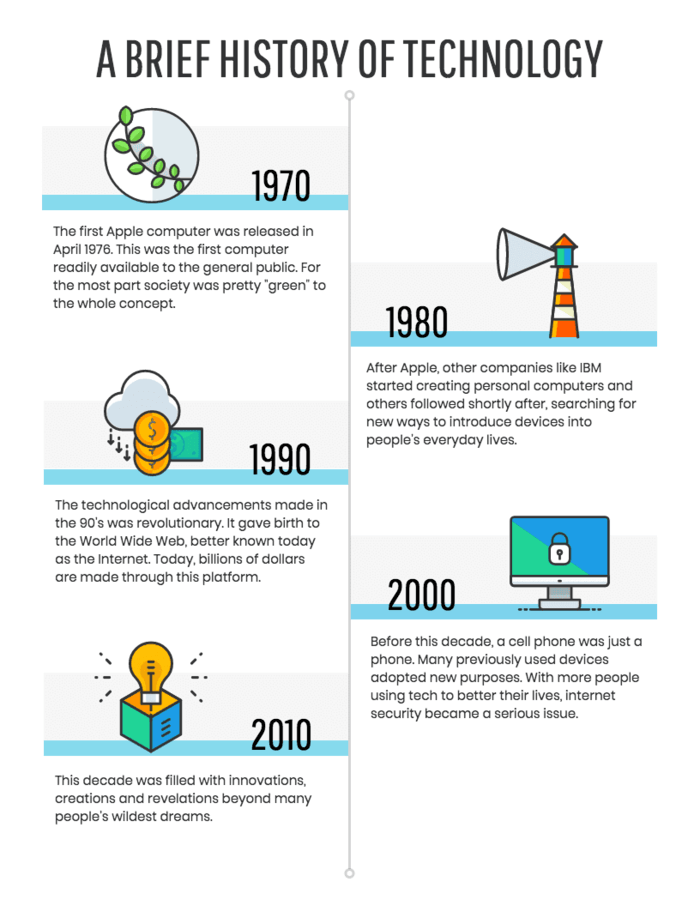
Simple business timeline example
Vertical timelines can look basic but they’ll help you communicate project timelines and deliverables to your potential clients. This technology timeline sample can be easily customized to reflect your business plan.
Related: 30+ Project Plan Templates & Examples to Visualize Your Strategy
PowerPoint timeline example
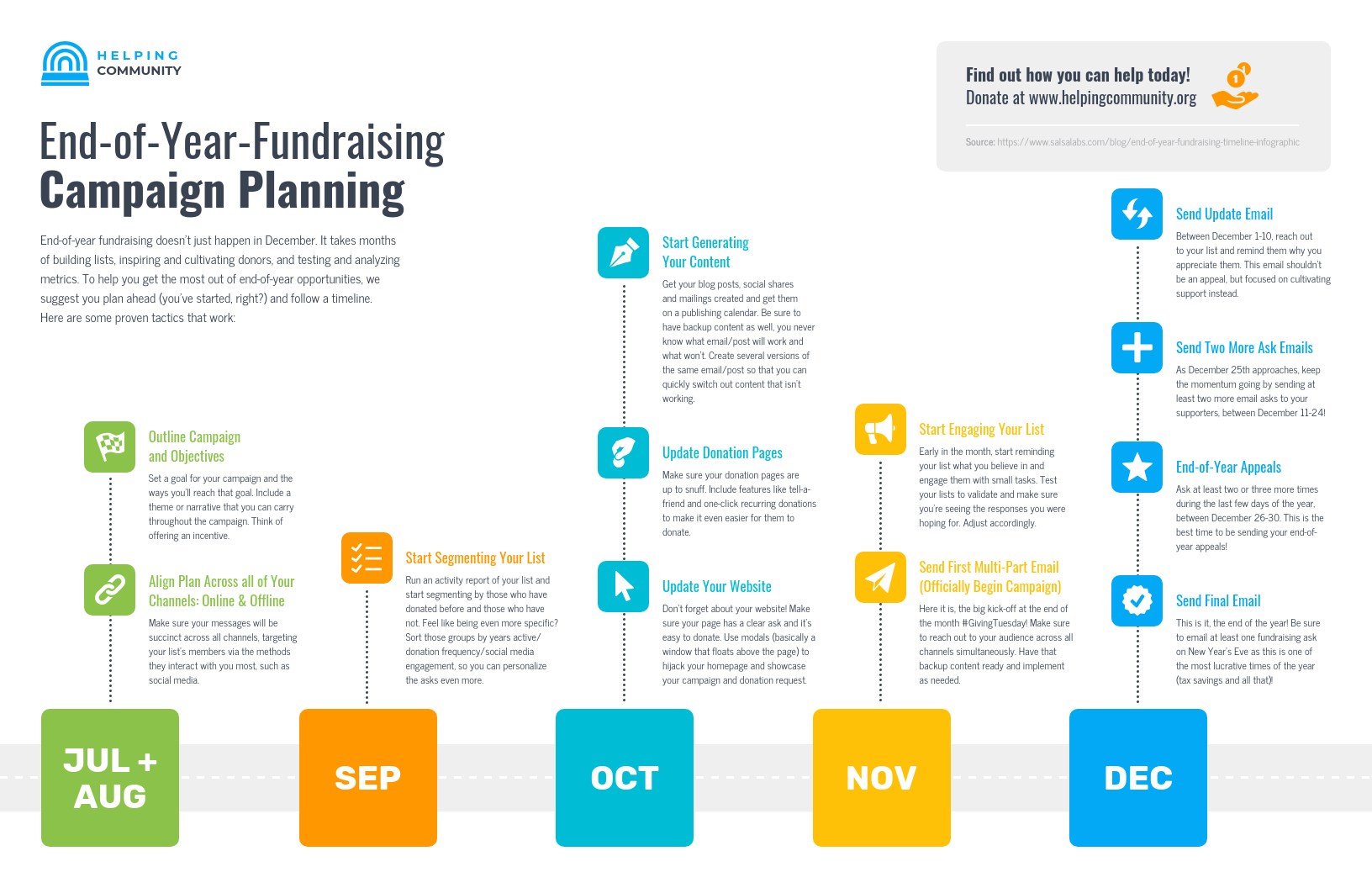
Text-only presentation slides are boring. Timeline slide templates are perfect for making information visually engaging and creating persuasive presentations. Optimize your timeline outline for PowerPoint, Google Slides or SlideDeck by using landscape orientation and big, bold text.
Use a gradient color scheme to create a flow from the beginning of your timeline slide to the end. This end-of-year campaign fundraising planning timeline template is perfect for nonprofits and organizations mapping out key fundraising activities, from outreach to donation deadlines, especially when clarity and momentum are crucial for year-end success.
For more examples of timelines and outlines you can use for PowerPoint and Google Slides, check out our collection of PowerPoint timeline templates and examples here.
Nonprofit timeline examples
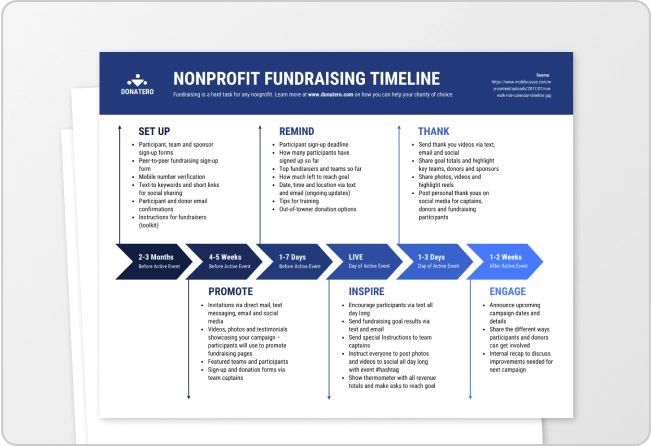
Nonprofits often rely solely on fundraising to keep their projects running. To make things easier for your team, and yourself a nonprofit timeline template helps to organize your processes. It is a great way to sum up the events and tasks for an important day.
Your tasks may consist of planning content, promotion, social media, etc. Use this nonprofit fundraising summary timeline template to highlight key activities and results.
Social impact timeline templates
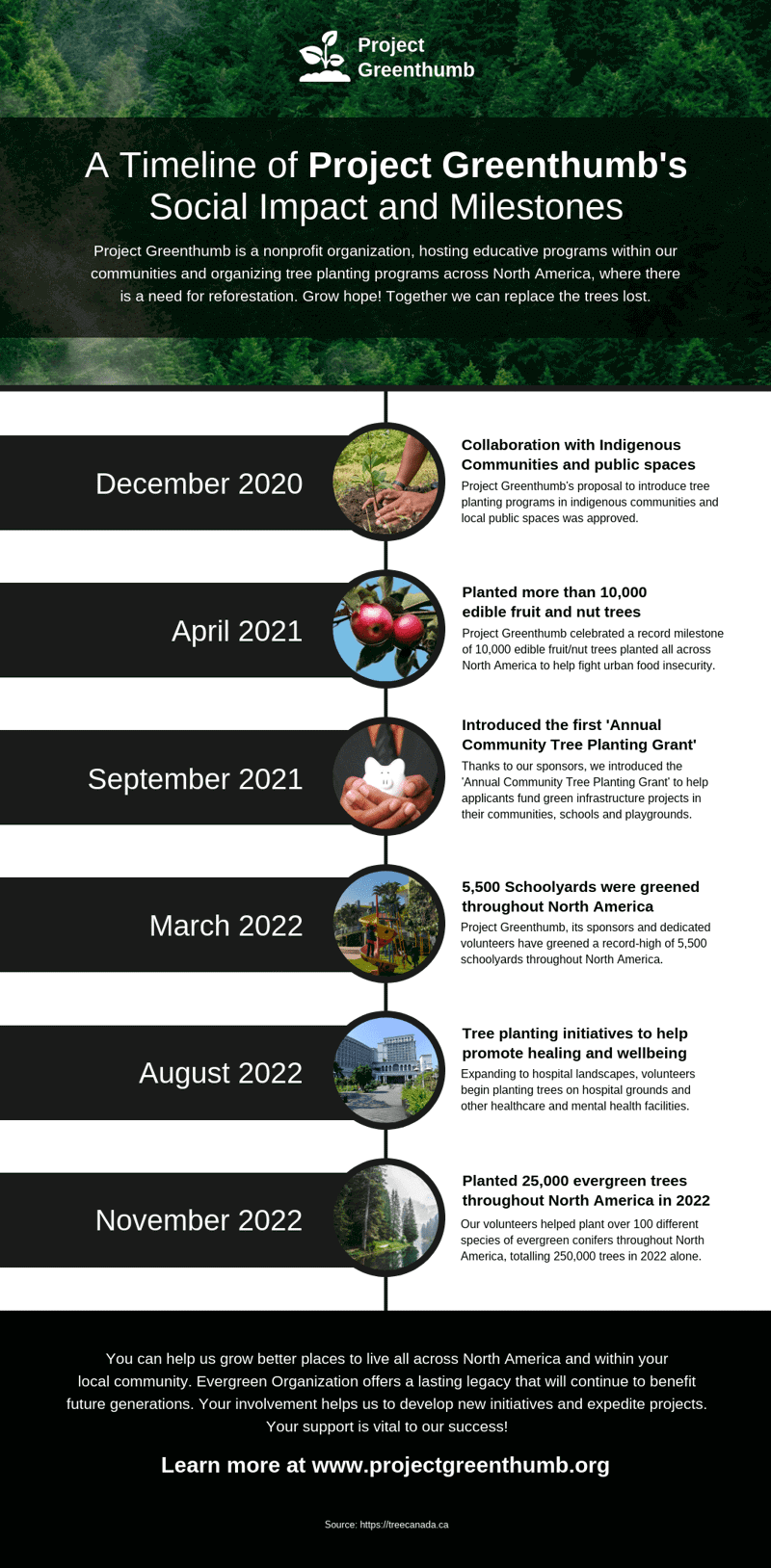
Nonprofits need to show that they are making an impact on the world. This is a great marketing tool to attract more investors.
But marketers are busy people. It isn’t possible to design an impactful document from a blank timeline template.
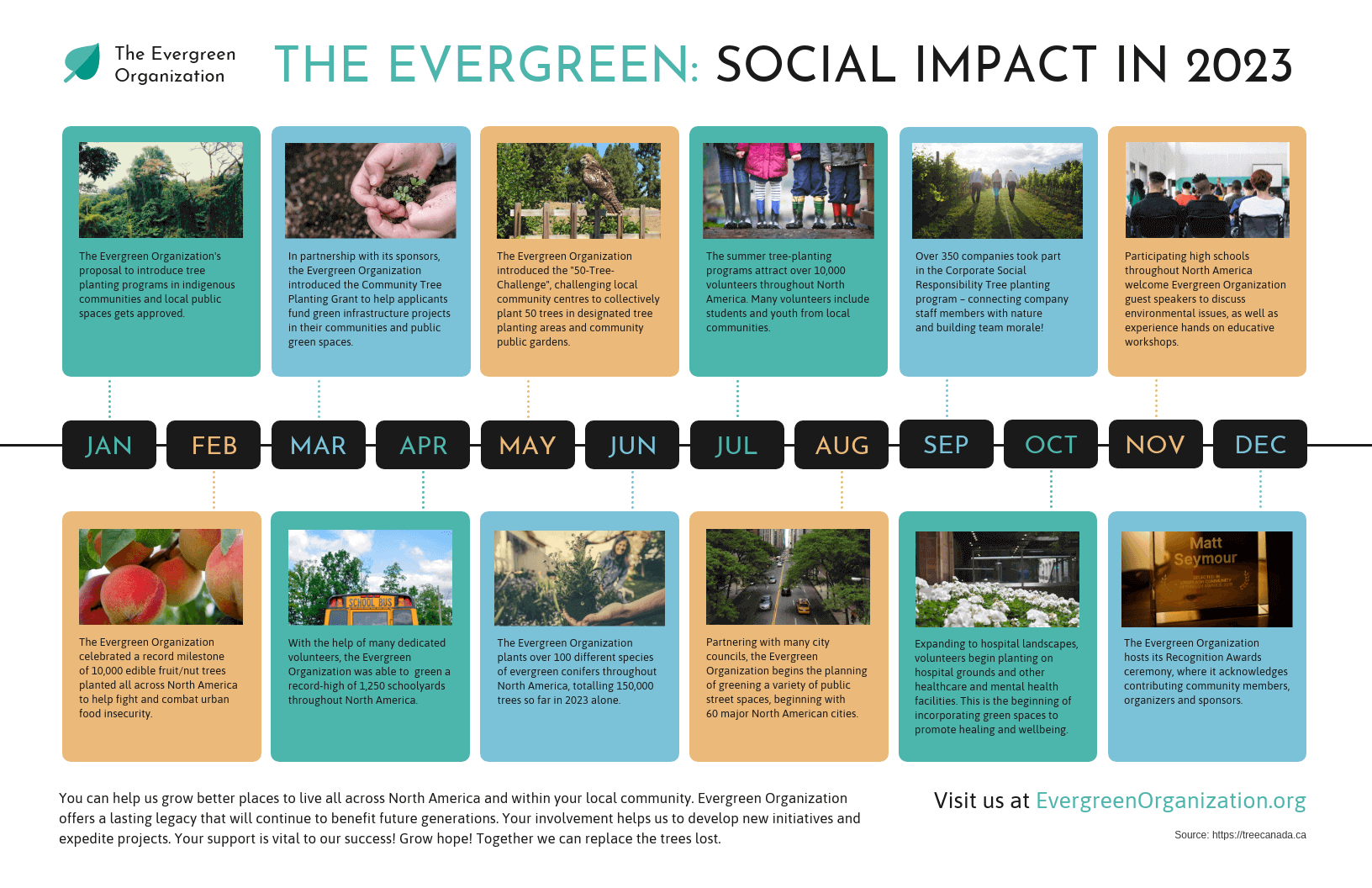
Reach for this social impact and milestones timeline template when you want to highlight meaningful achievements and build emotional connection. It’s great for showing how your work is making a difference over time.
If you want to use a horizontal timeline format instead, check out the example below:
Event timeline examples
A lot of event planning is virtual these days. As a marketer, you may feel overwhelmed by the changes. Using an event timeline template will help you block your hours, days, and weeks out so that you can visualize each step of the way.
Horizontal event timeline templates
Use color hues for each day, week, month, or even specific activities. This will help them stand out from each other on the timeline.
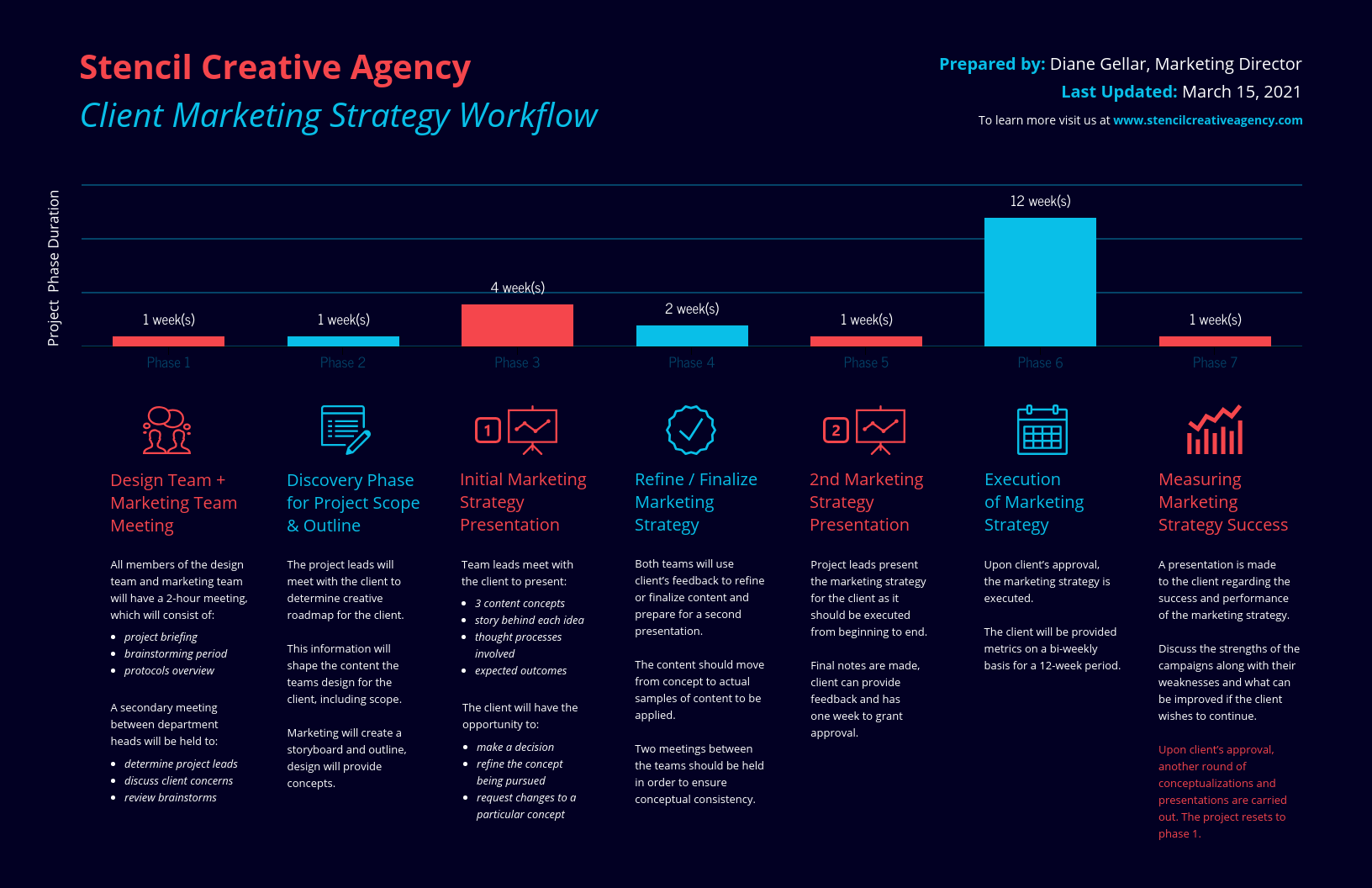
This client marketing strategy workflow timeline template works best when you assign different colors to key phases, tasks or timeframes, making it easier to visualize progress, track responsibilities and keep your marketing efforts organized and on schedule.
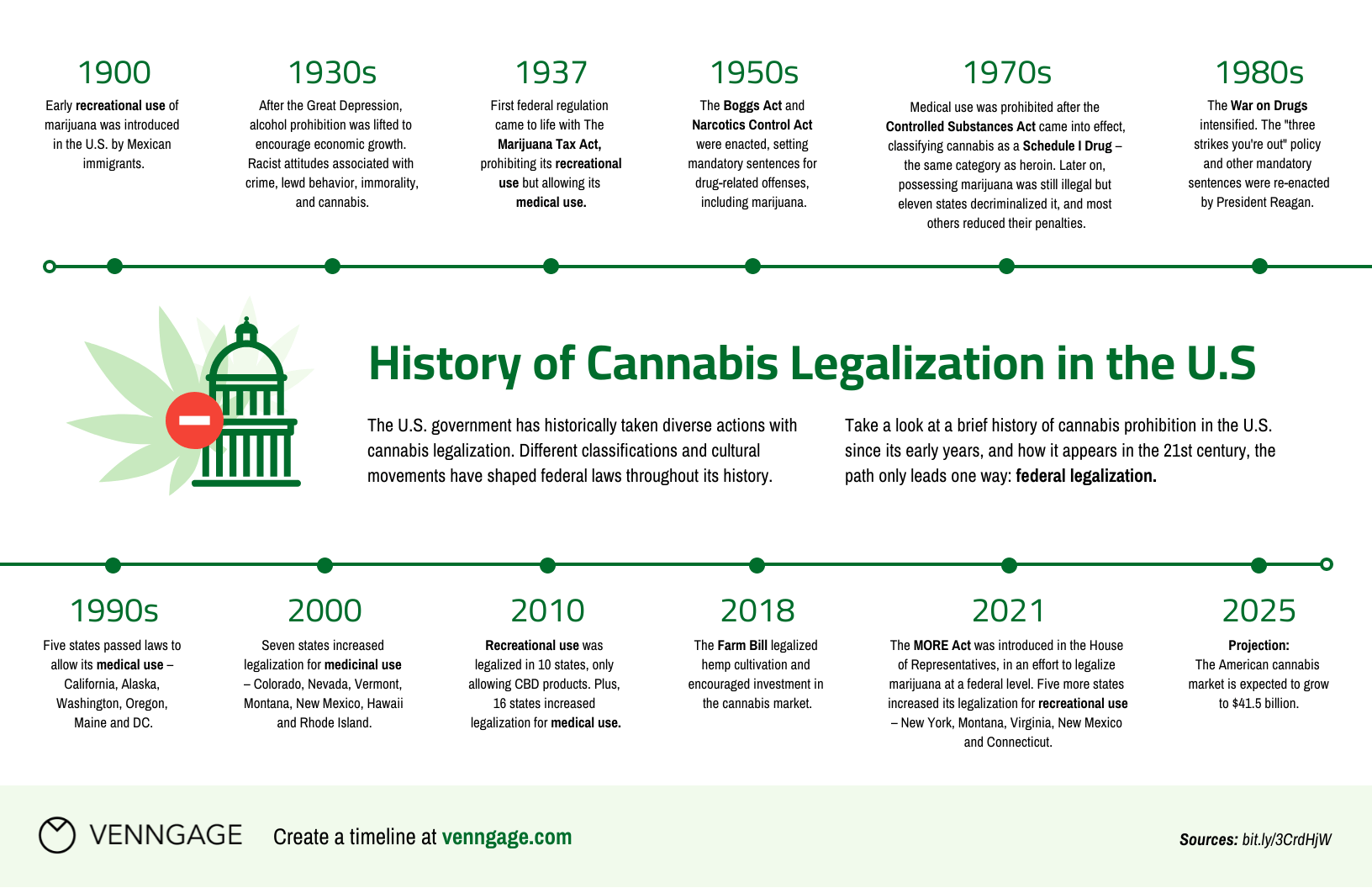
Here’s an example of a horizontal event timeline template — this case of the cannabis legalization history in the US:
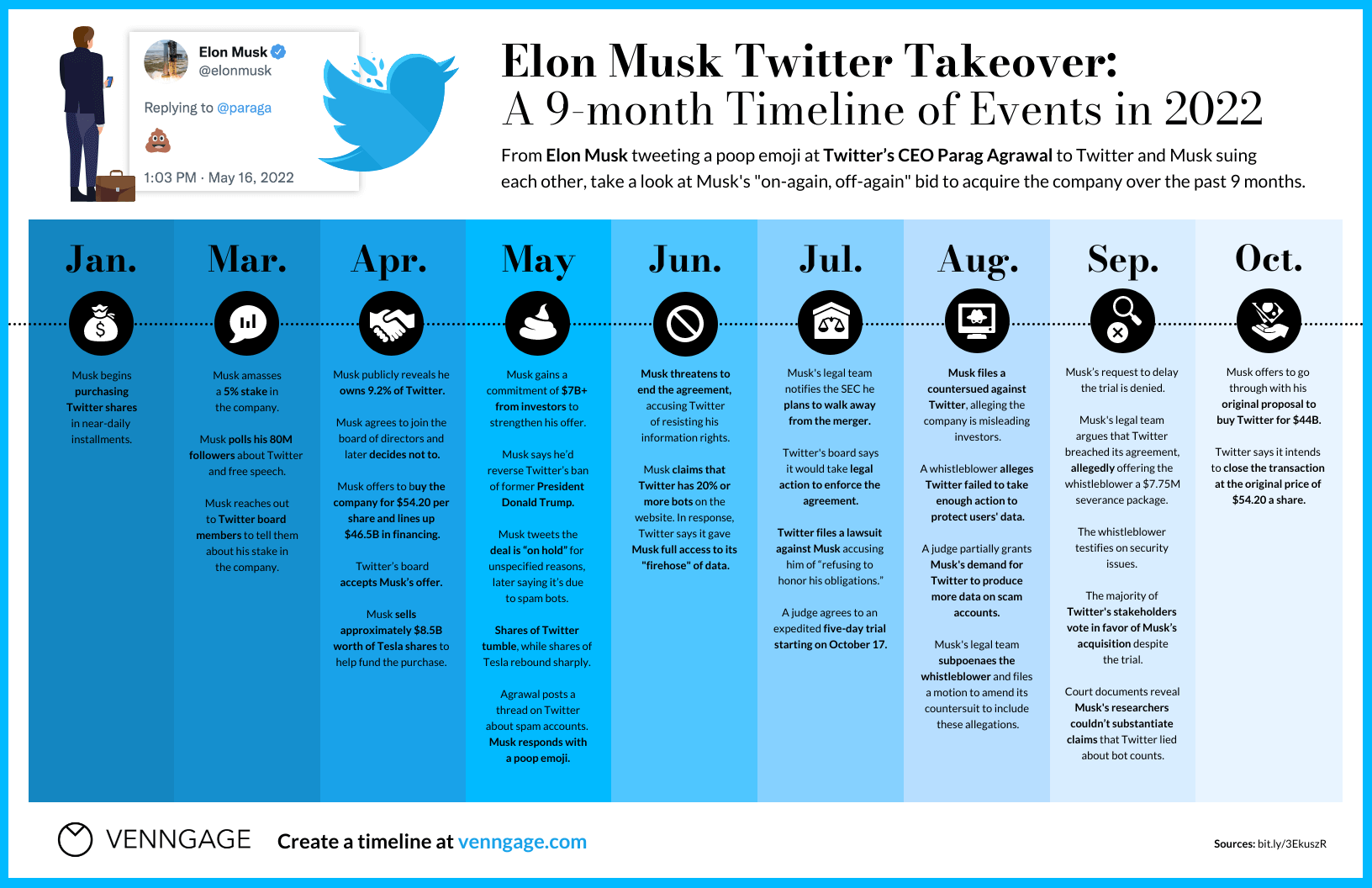
Use this 9-month timeline template to lay out major goals or checkpoints across a longer timeframe. It’s a great fit when you have fewer events to track but still need a clear, visual overview of your plan.
This event timeline template portrays the nine-month period of Elon Musk taking over Twitter in 2022. Not a lot of timeline milestones are added — the designer decides to use the given space to add more notes about each milestone instead.
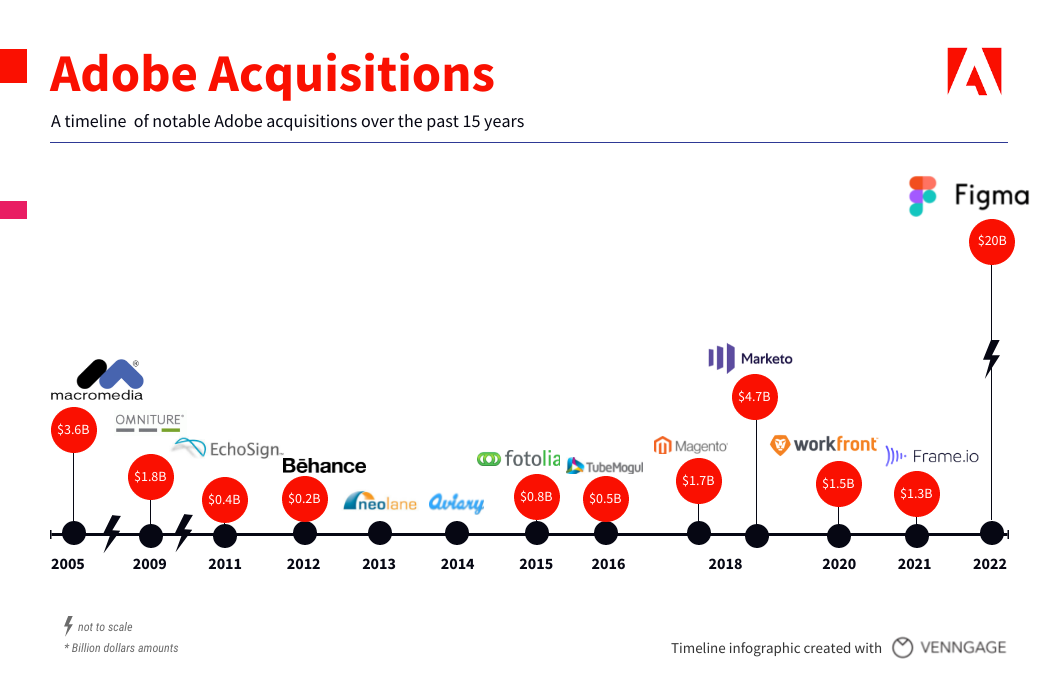
On the other hand, this Adobe acquisition timeline infographic is perfect if you don’t need to add lots of background info to your timeline events:
Vertical event timeline templates
Scheduling your days in time blocks can be an effective way to organize and prioritize your tasks. Try using different color blocks for different types of tasks or appointments. Map each block to appointment scheduling software, like Booksy, so clients can self-book services, with buffers and reminders to reduce no-shows.
This is an opportunity where icons can help you code information and make your timeline scannable.
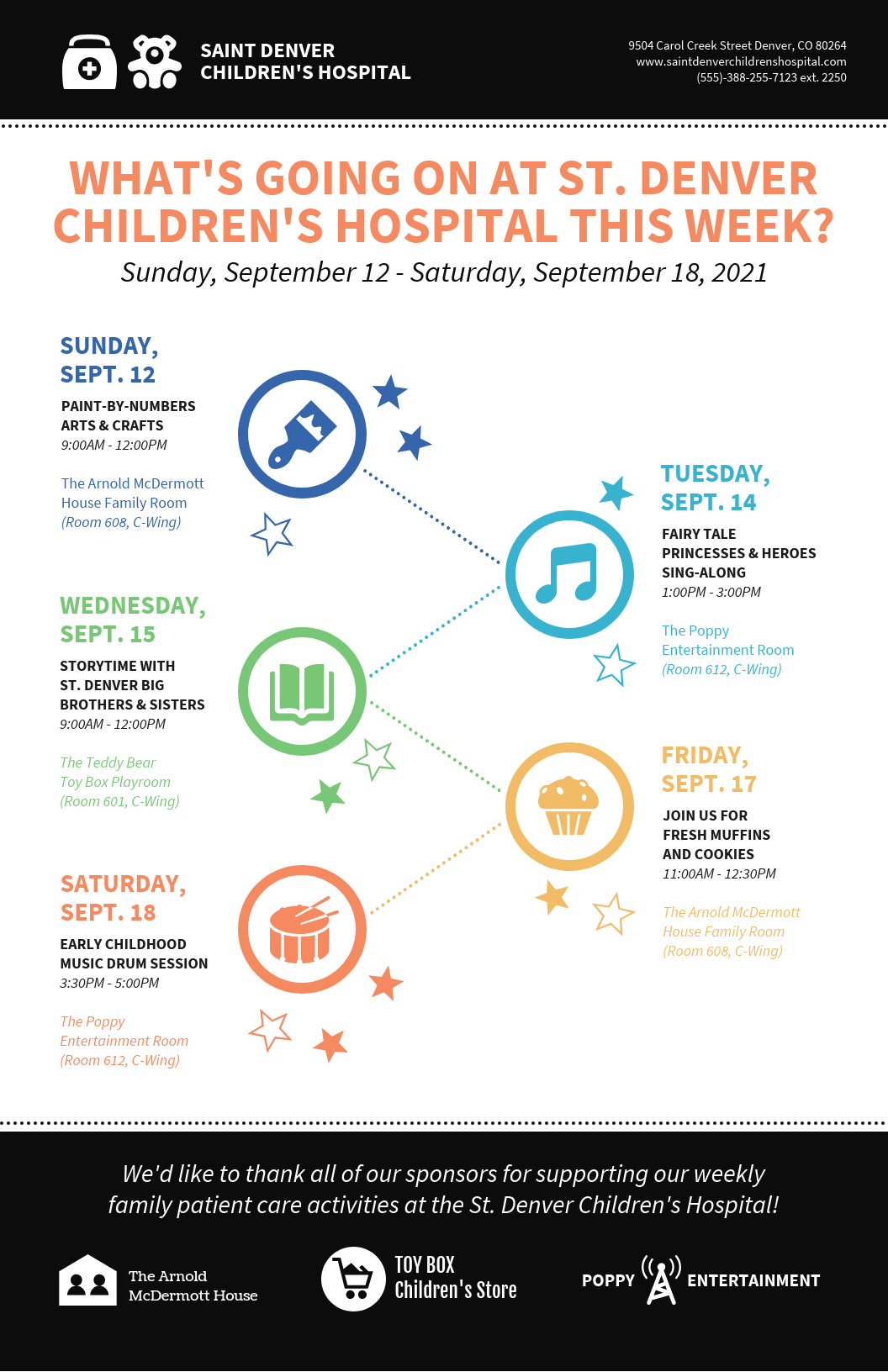
This vertical timeline template, for example, can make sharing an event planning schedule a breeze:
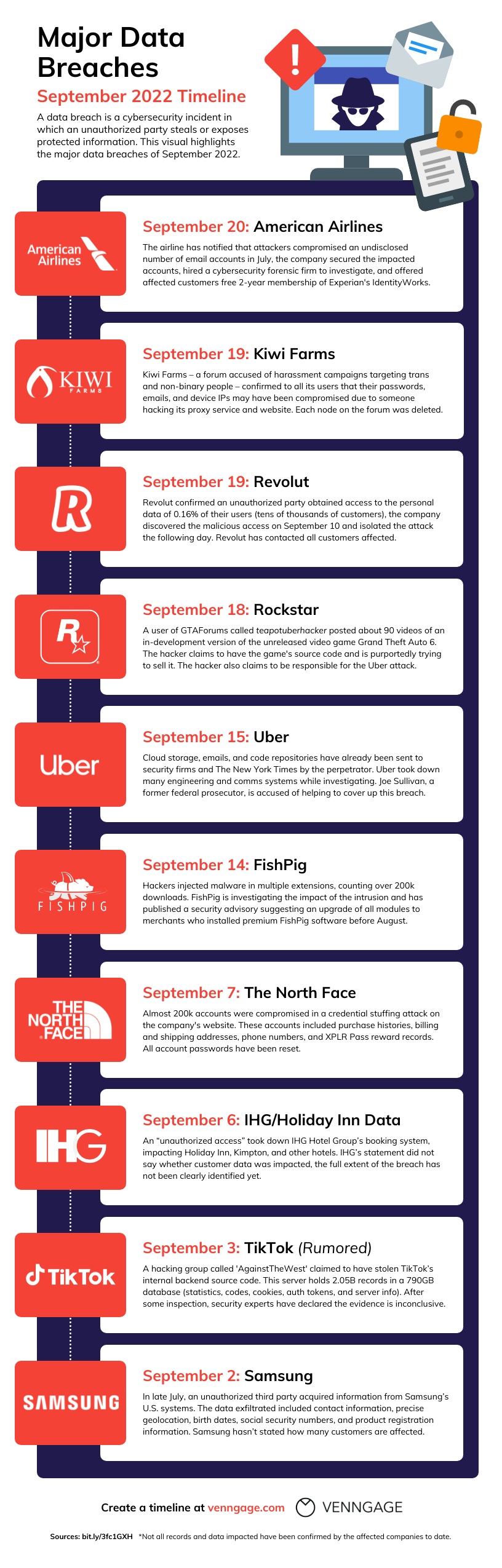
Or this vertical timeline template which depicts the major data breaches in September 2022:
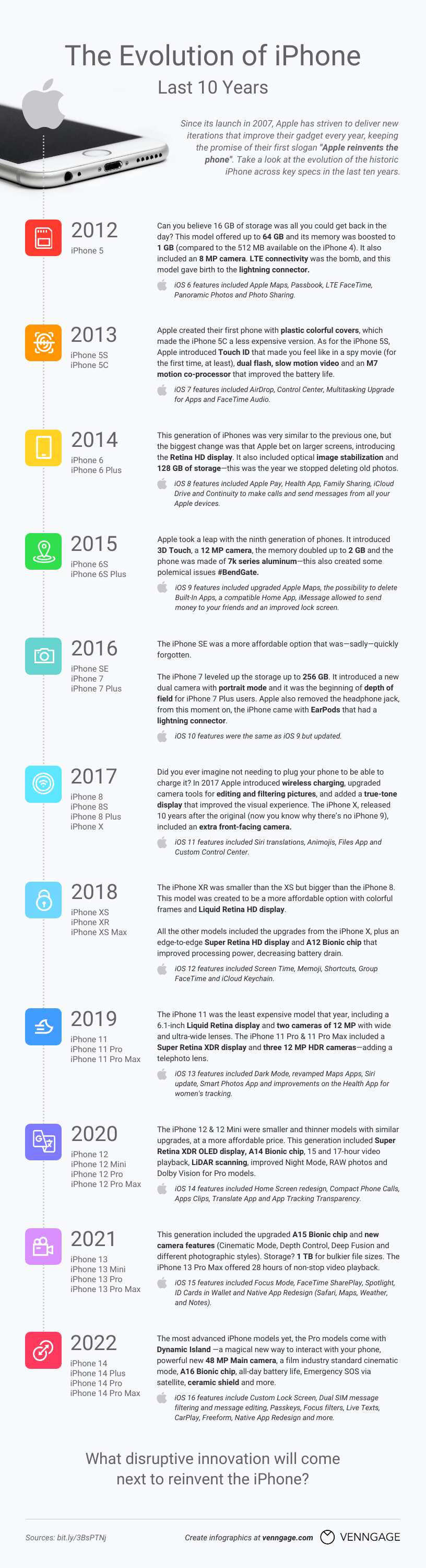
If you need to add lots of background info to your event timeline, this iPhone evolution infographic is a great choice:
Fundraising event timeline template
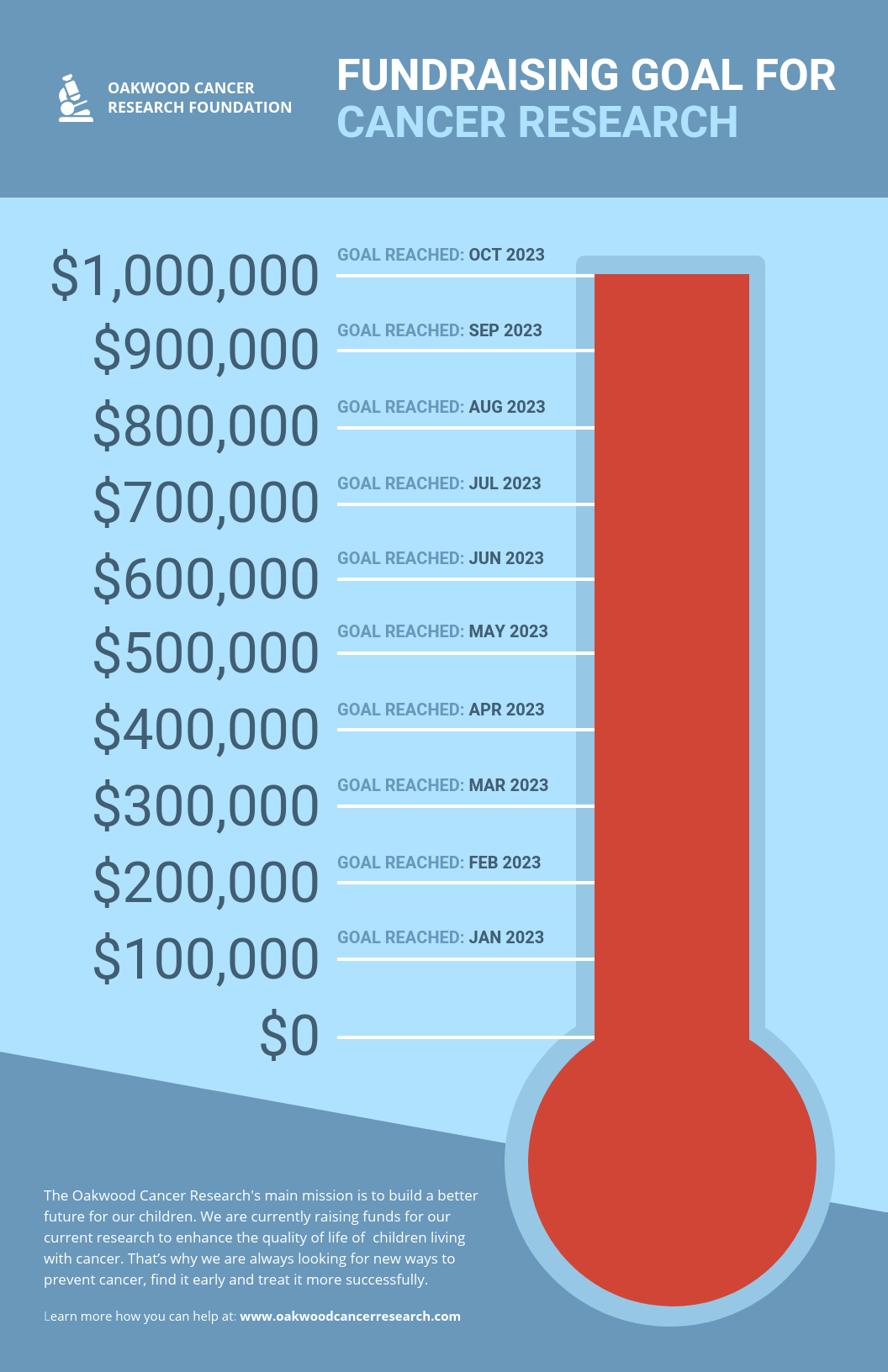
You want to show what your event or fundraiser has achieved. Instead of starting off with a blank timeline, use a creative timeline format to showcase goals reached.
This timeline example shows how the foundation has reached its goals every month. Notice how the timeline is cleverly designed based on a blood donation symbol (which makes it perfect if you’re looking for a visual timeline for your blood donation project!):
Event timeline examples
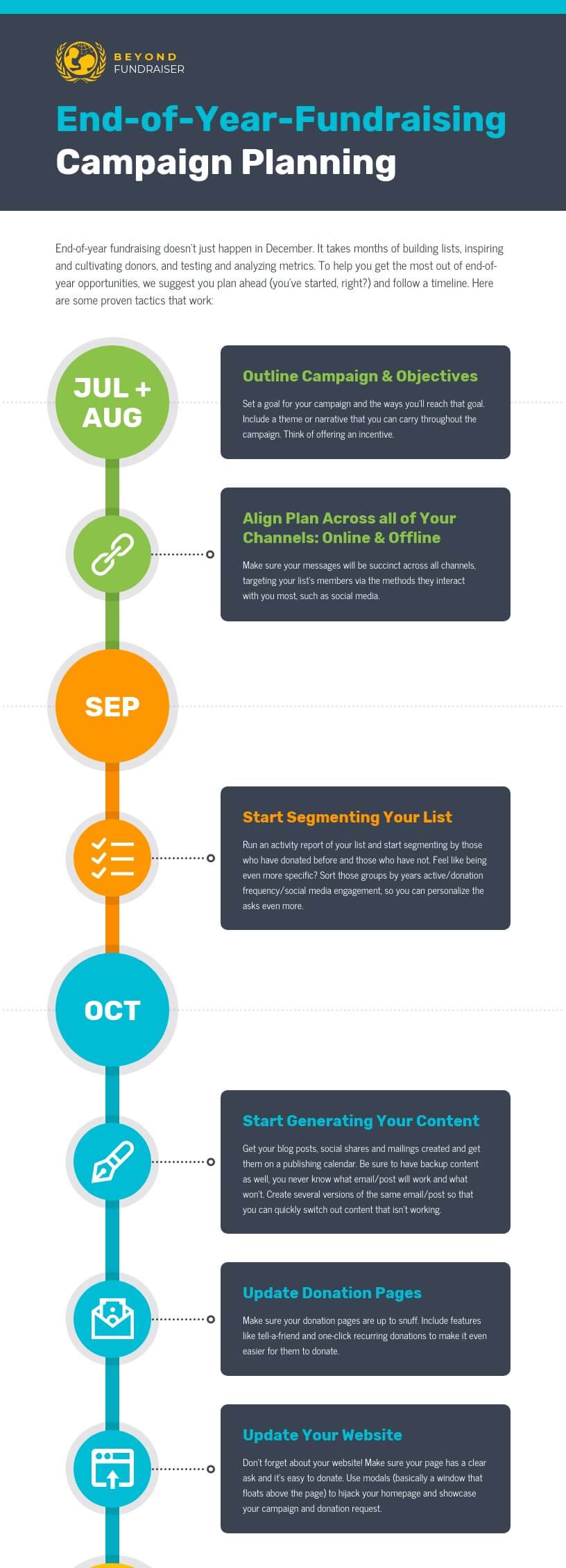
If you’re a busy small business that needs to budget its time, it’s important that you can indicate how much time should be spent on each activity in your timeline. One way to do this is to use bars of different lengths to visualize lengths of time.
This end-of-year fundraising campaign planning timeline template makes it easy to show how long each task should take. Just adjust the bar lengths to match your schedule, it’s a simple way to stay organized when time (and team energy) is limited.
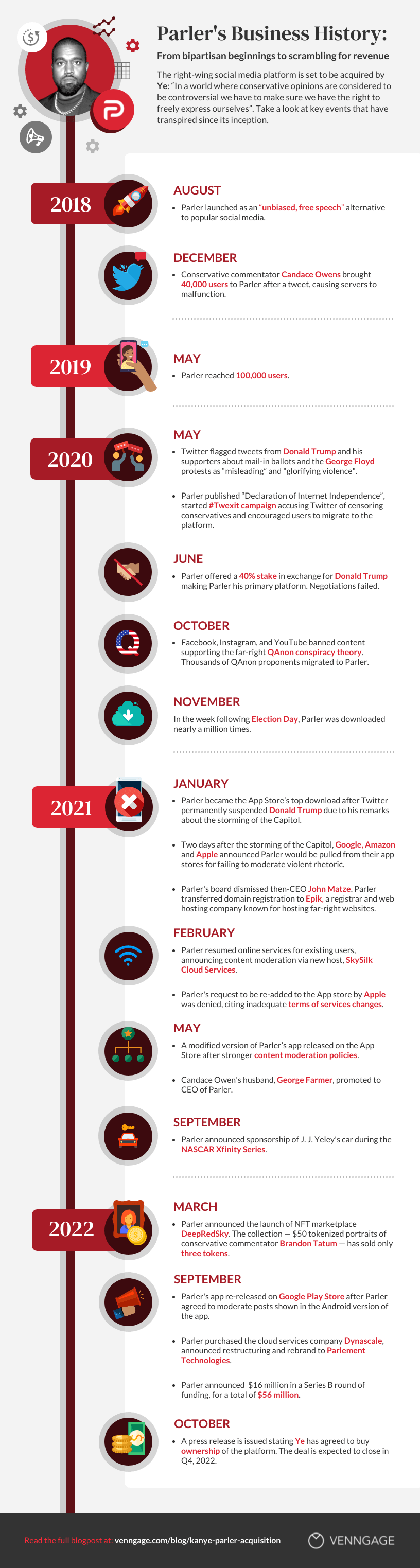
Or this timeline infographic which depicts Parler’s business story before being acquired by Kanye:
Wedding timeline template
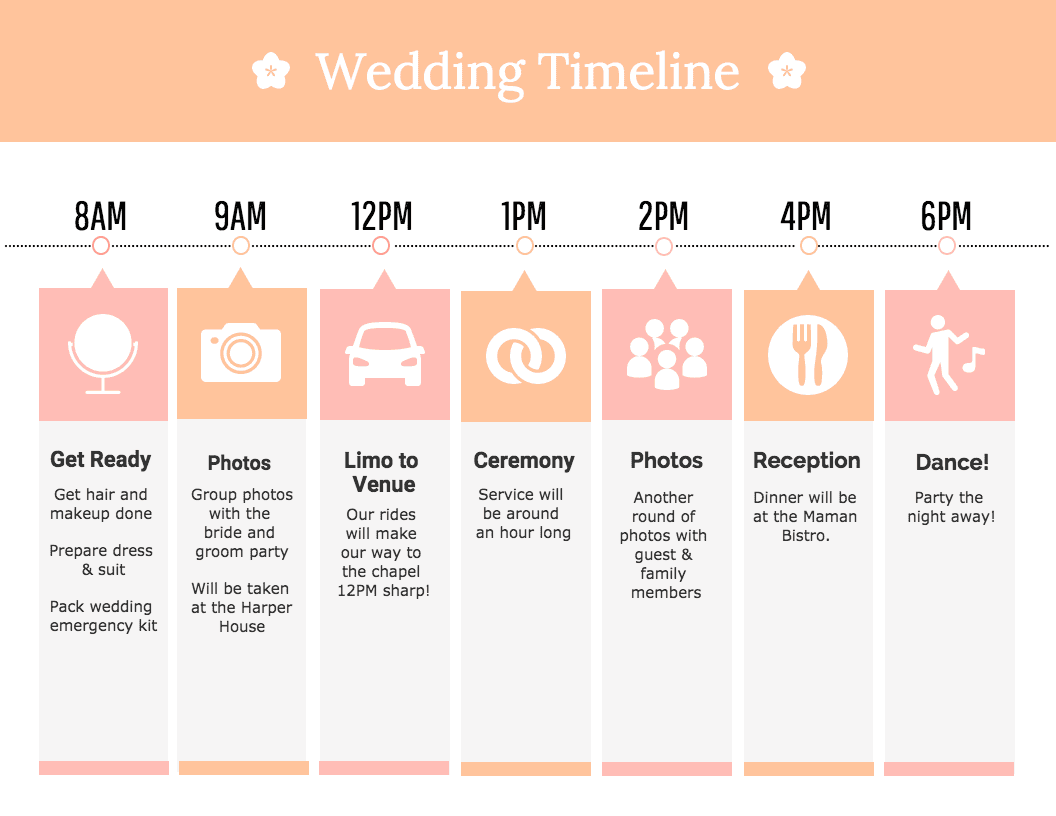
Another timeline example for an event that you may be planning as a small business is a wedding. You can include specific times and any important details people should know, just like in this wedding day timeline template:
Conference planning timeline template
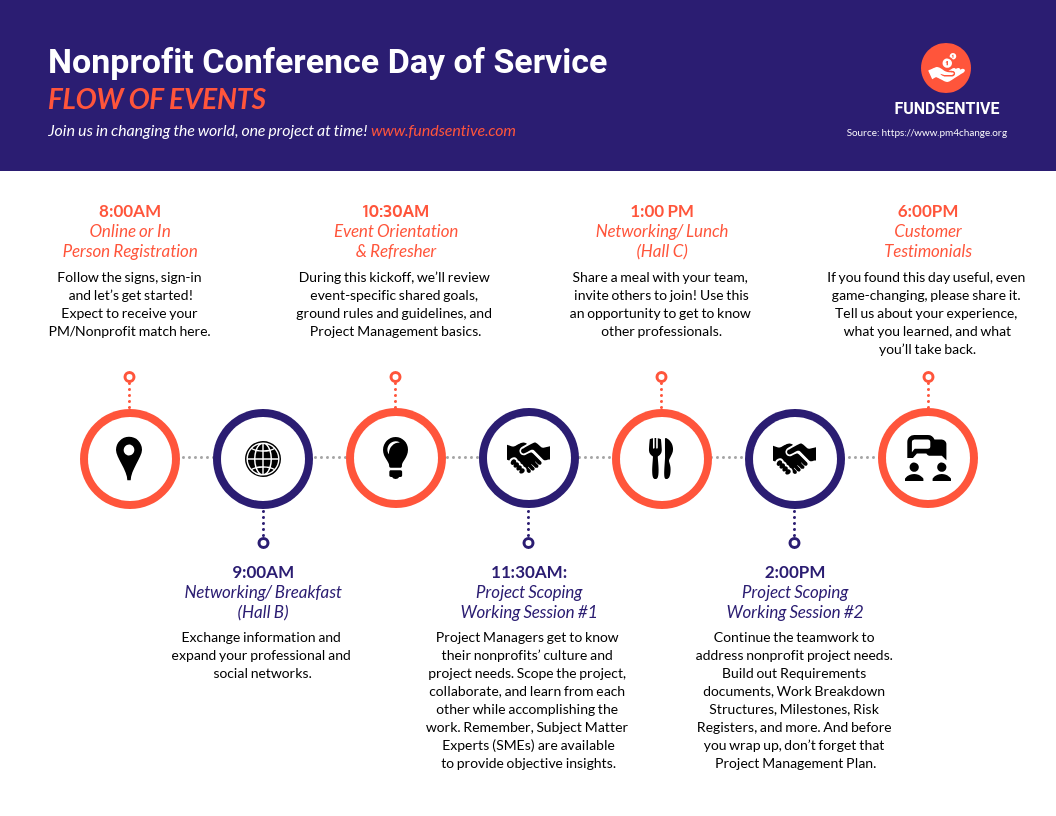
Want your event to go off without a hitch? Give your attendees a timeline of what the day will look like. That way, they’ll know what to expect ahead of time.
Don’t forget to include information about where each part of the day will take place. Including photos or illustrations of what to expect can also help get your attendees excited about the day’s events.
For example,
This nonprofit conference day of service flow of events timeline template helps you map out each part of the day—from registration to wrap-up—in a clean, easy-to-follow format that keeps your team and attendees on the same page.
Pro Tip: During timeline formatting, special event consultants and event planners of all stripes can add their branding to any templates of their liking. Then, save it as a template to use again and again. Meaning: less administrative work for you.
Calendar timeline example
Take a classic calendar and make it more effective by using icons. Pick icons to represent different types of events. Don’t be afraid to mix up the colors. Simple visuals make information easier to remember, so pick icons that will stick in your memory.
A calendar timeline template is great for organizing tasks or events by date—just plug in your activities by day, week or month to get a clear, at-a-glance view of your schedule. Perfect for planning campaigns, launches or content calendars.
Choose icons to fit your event timeline templates using Venngage’s library of over 40,000 icons.
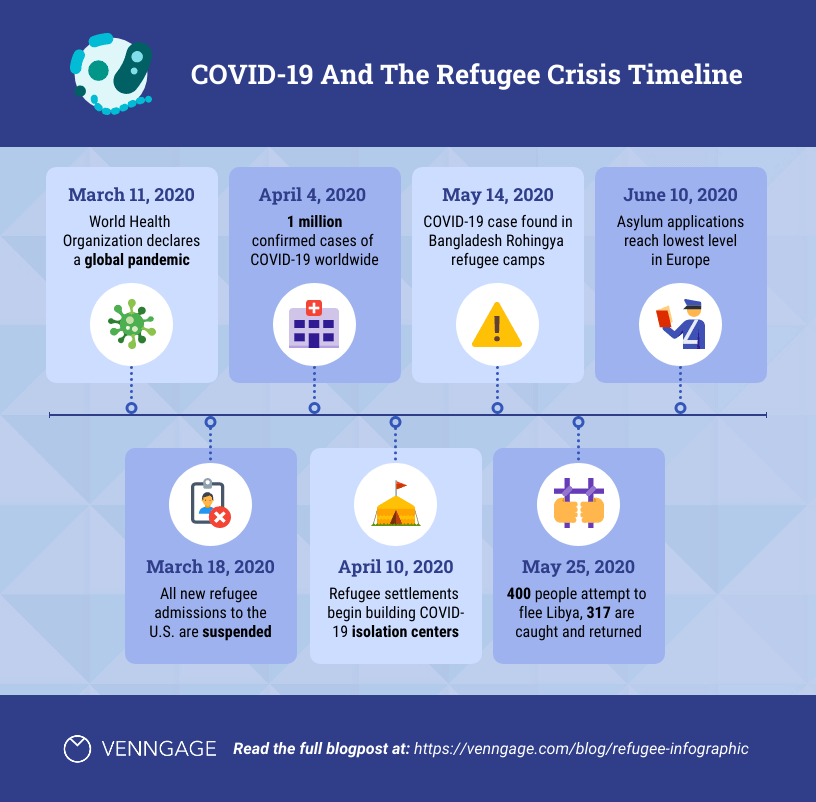
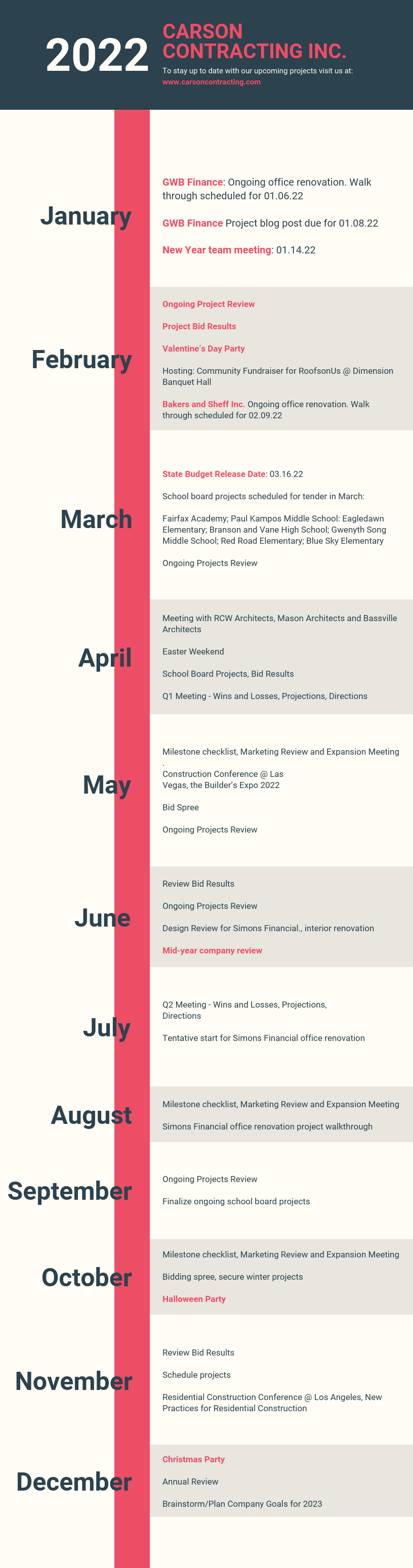
For another example of a calendar timeline outline, check out this template which is in a vertical format:
Marketing timeline examples
Social media timeline example
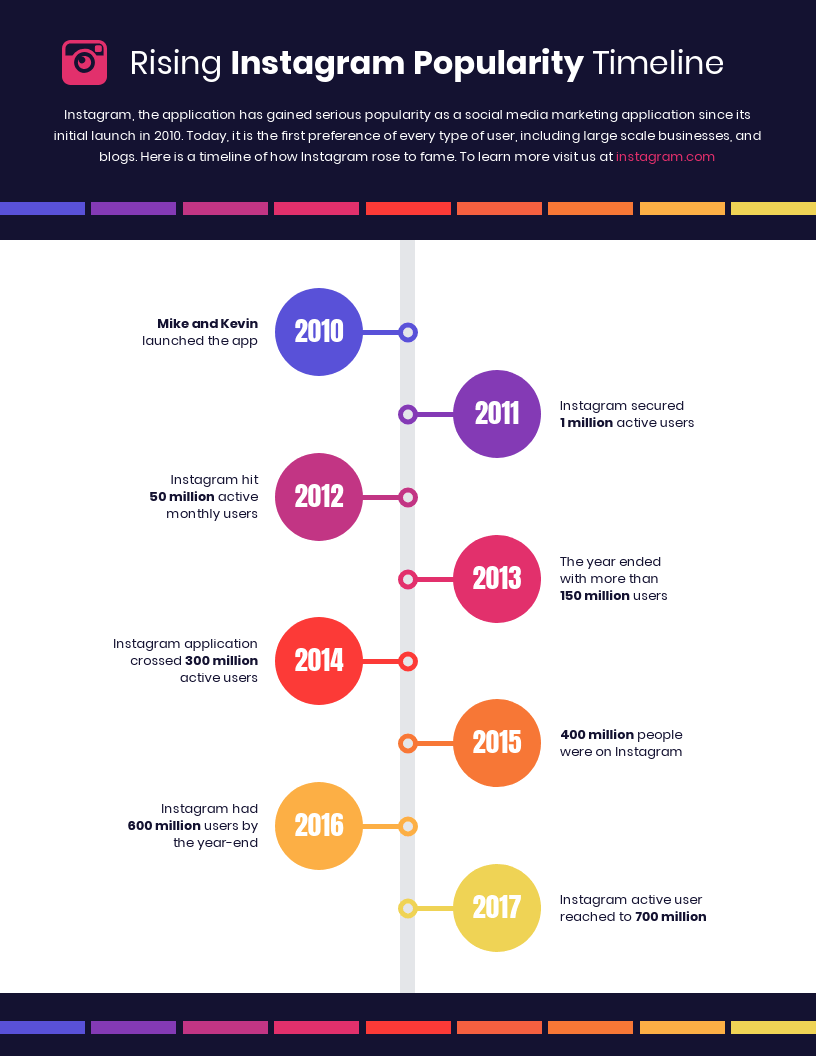
If you need to report on how your company’s social media channels grow followers over a period of time, it’s best to do that in a creative visual format. Posts with images produce 650% higher engagement than text-only posts.
Adopt this timeline template that presents Instagram’s user growth over time and edit it for your own user growth timeline:
Customer journey timeline example
Understanding your customers’ journey is a core component of a solid customer experience. Create an infographic that visualizes your various customer profiles.
Use icons to emphasize key steps in their journey. Take a look at how this timeline example uses icons to make each customer journey easy to understand:
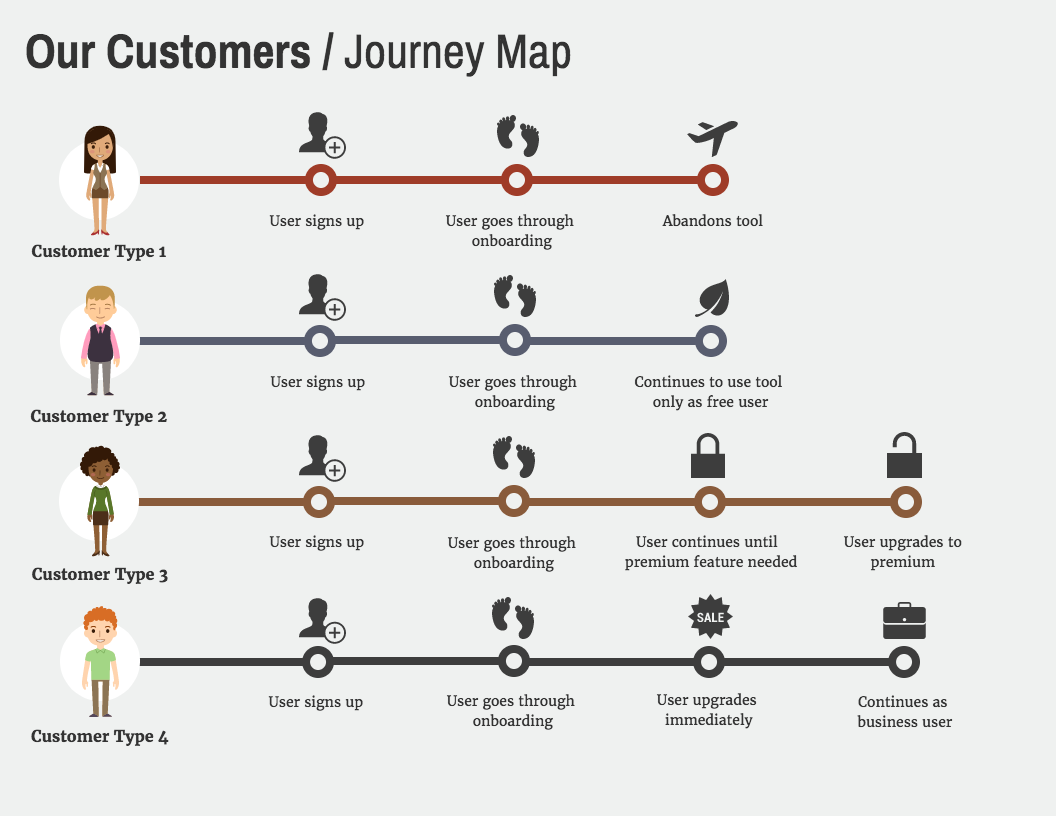
Click the template above to enter our online customer journey map maker. Customize the template to your liking—no design experience needed.
Iconic editable timeline
Icons visualize information in one small graphic. That’s why they’re perfect for including in a visual timeline for your events.
Pick an icon design with a widely recognizable meaning (such as social media platform logos) so people can scan your timeline for information about a specific topic.
You can also check Icons8’s icon library for social media icons, which offers everything from popular platforms logos like Facebook, Instagram, and X to less common ones.
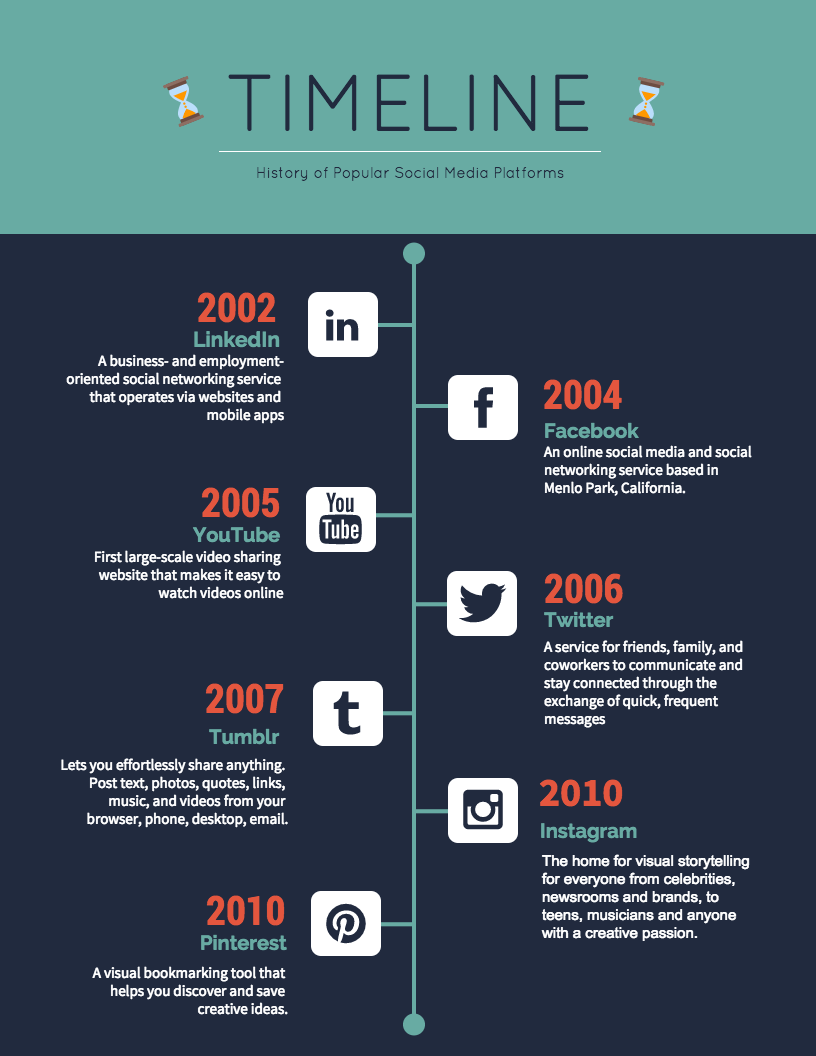
This historical timeline graphic example shows the history of social media platforms. It uses icons to identify which point is about each individual platform. You can always customize templates to fit your needs:
Simple timeline template
A simple timeline template allows you to make project planning easier for everyone involved. Your team will be grateful for the visualization of a difficult project or process.
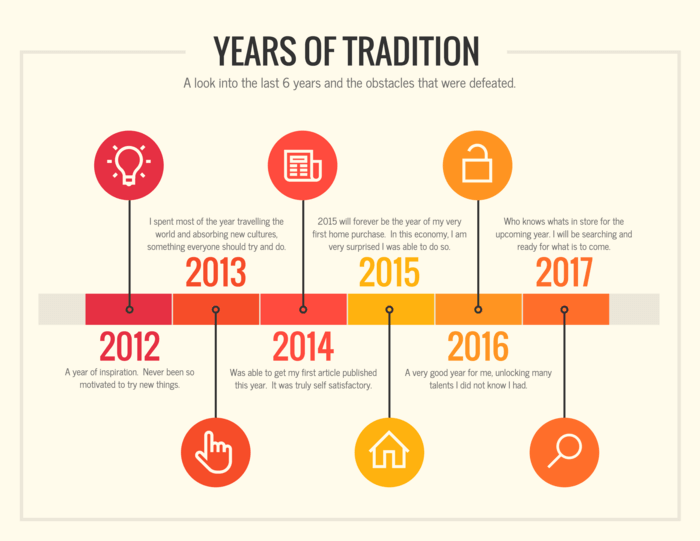
This years of tradition timeline template is perfect for showcasing milestones across decades, whether you’re highlighting a company’s history, celebrating an anniversary or telling the story of a long-standing event in a clear, visual way.
Historical timeline template
People often like to learn about the history of people, places, and things that they’re interested in.
This historical timeline template is a great way to share the backstory of something meaningful, whether it’s a company, cause or invention. Just plug in the key moments, and you’ve got a visual journey that’s easy for anyone to follow.
Retro historical timeline example
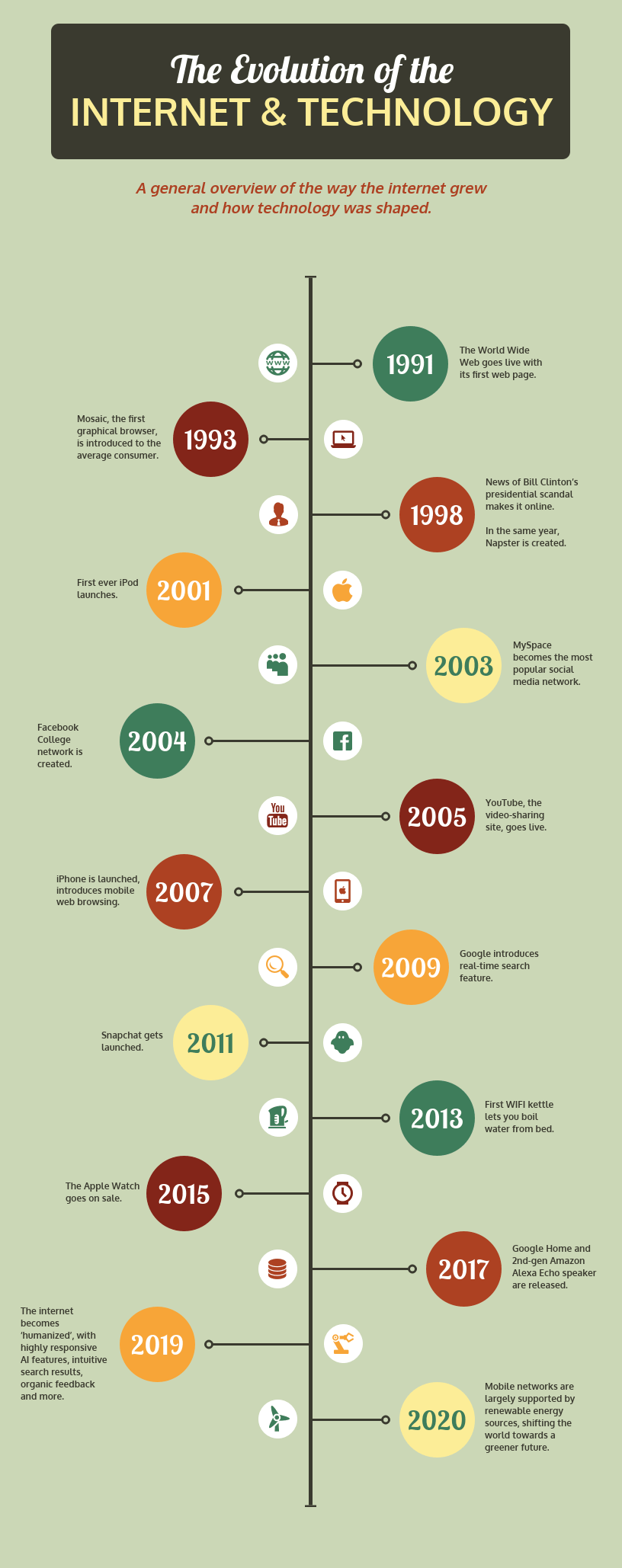
Real estate history timeline example
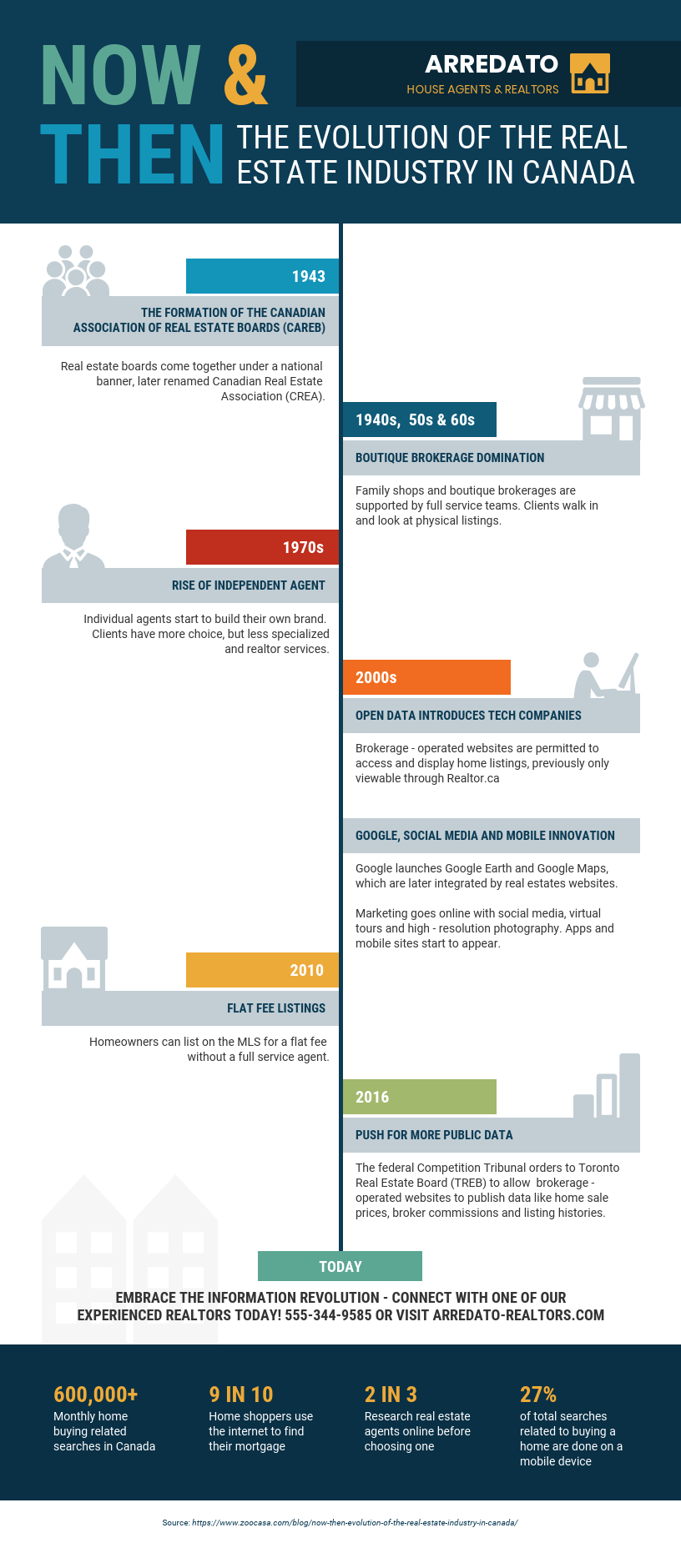
Showing the history of an industry that has existed for almost a century can be difficult. You don’t want to include too much information. That can be overwhelming for your audience.
This evolution of the real estate industry in Canada timeline template is perfect for highlighting key shifts in the market, policy changes, or major developments — great for educating clients, stakeholders or team members on how the industry has grown and changed over time.
Breaking up the decades like in this printable timeline template is the better option. It will make the timeline easier for customers to read and understand.
Brand history timeline example
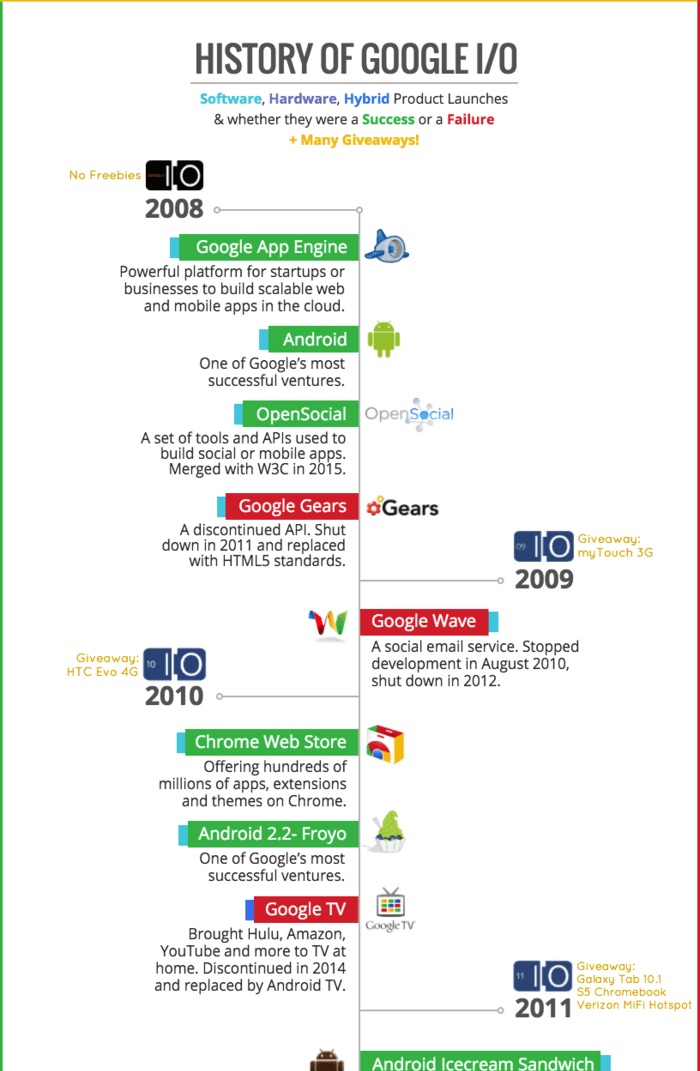
This historical timeline template uses Google’s iconic color palette to reflect the story. Icons and logos make it easy for readers to skim this timeline example and find their favorite products.
Use it to present about a company or an organization that has a rich history as it’s a really long and comprehensive timeline template (click to see the full infographic):
Periodical history timeline
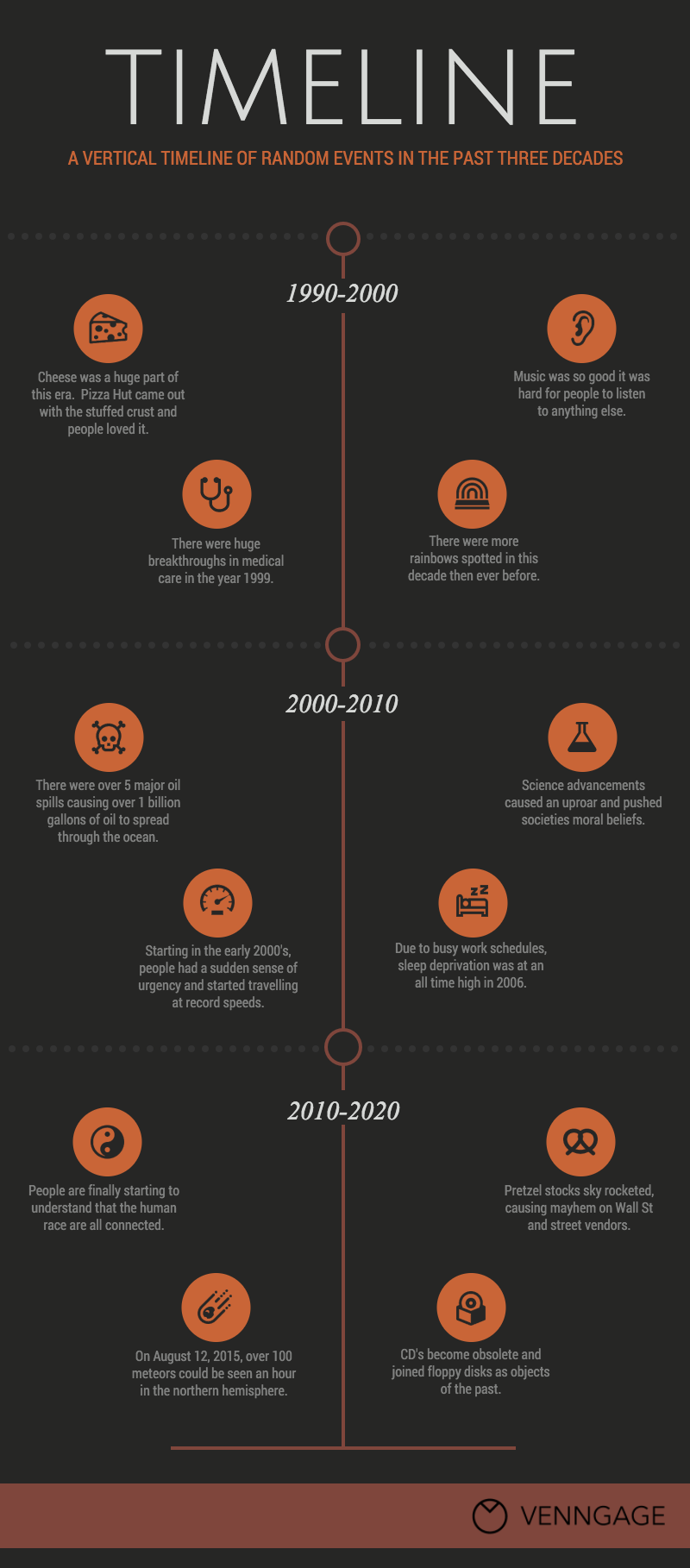
While most timelines typically use one connecting line down the middle to show progress over time, you can group years together using horizontal lines.
Group periods according to different technological breakthroughs, political movements, artistic and fashion trends, or any other broad theme.
Don’t be afraid to stray away from the classic branch timeline design. Get creative by moving events around the page and playing with different layouts.
Check out this history timeline example for some inspiration:
Historical infographic timeline
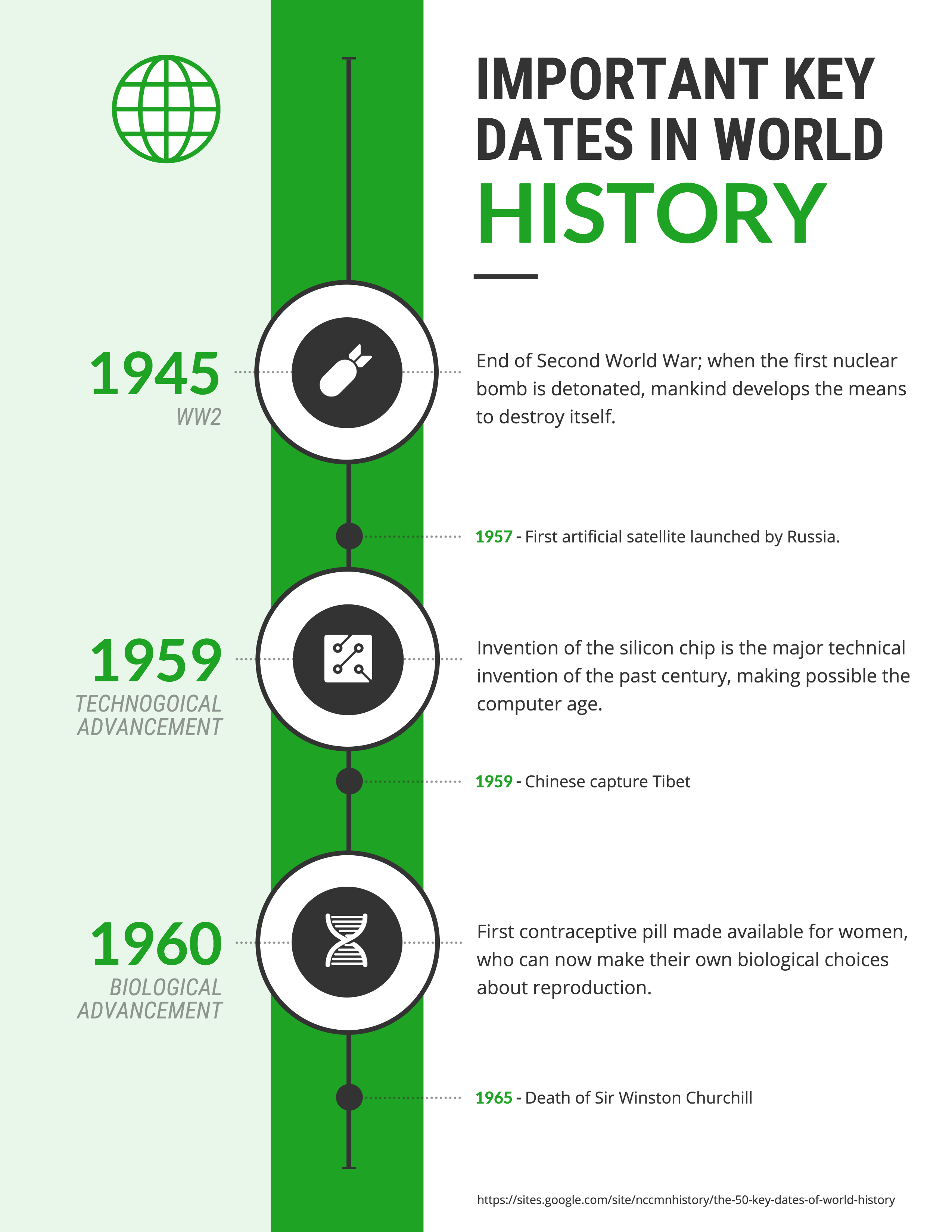
This history timeline template is great for sharing significant dates and events at a glance. Use bold colors and larger fonts to spotlight major moments, and add short, clear explanations to help your audience quickly understand why each one matters.
If you are pulling your information from other sources, be sure to cite your sources at the bottom of the infographic.
Arrow timeline example
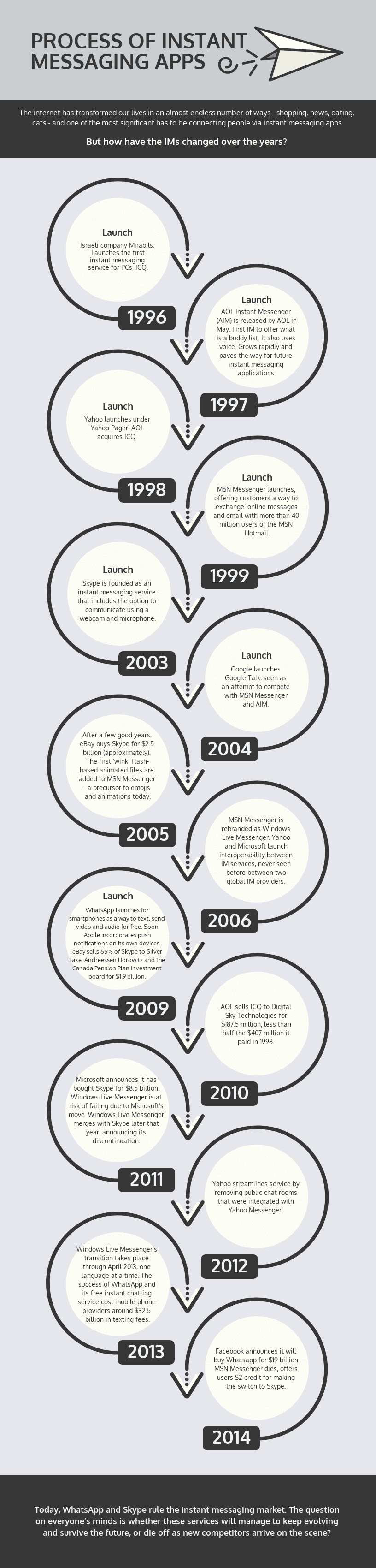
This timeline example uses text bubbles and cute arrow graphics to create a natural flow of information. Use this instant messaging app timeline template to outline the app’s growth step by step, whether you’re showing feature rollouts, version updates or major development milestones. It’s a simple way to visualize progress and tell the story behind the product.
Comparison timeline format
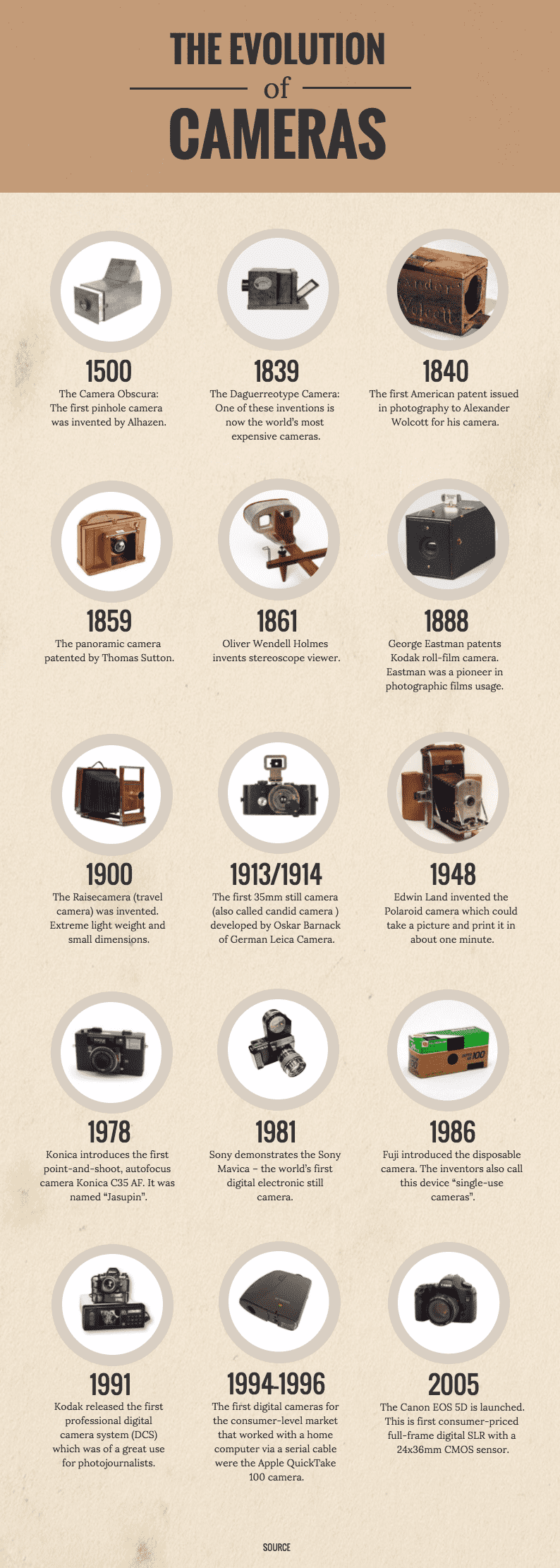
It’s fun to see how things have changed over the years—tech, fashion, event foods. Create a visual timeline that shows photos of a thing, to highlight how it has changed over the years. You can use a comparison infographic template to do this.
This timeline example shows how cameras have changed over the years, uses images and brief descriptions to inform readers:
Simple historical timeline template
While you can’t cover everything that has happened in history in one timeline, you can highlight the important, defining events. Summarize the history of a person, place or thing by showing key moments in history and offering concise explanations of why those moments are significant.
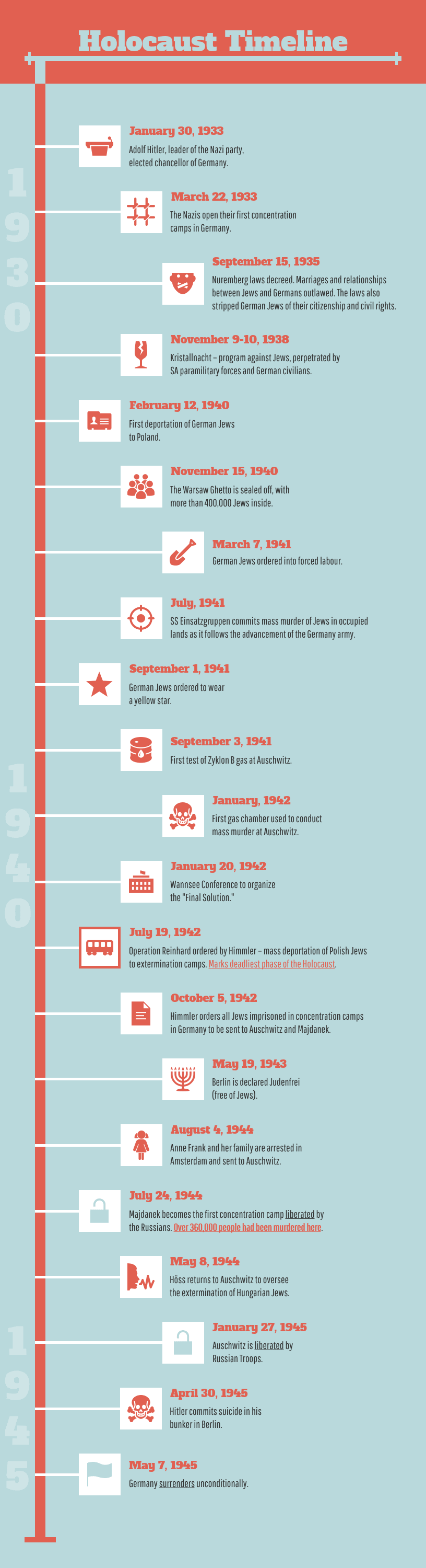
Use colorful icons to enforce and illustrate the information. If you have a resource where readers can go to get more information, cite it at the bottom of the infographic.
These political infographic templates are a good place to start.
Construction timeline examples
These are specific to the construction industry. You can use them to map out project phases, track permit approvals, schedule inspections and keep contractors and stakeholders aligned on deadlines.
Construction projects involve a lot of moving parts and a timeline helps make sure nothing falls through the cracks.
Construction progress timeline example
Sometimes, processes can be confusing, especially if there are a lot of steps to follow. It’s easy for people to forget steps in a process, especially in the construction industry.
A construction schedule timeline template visualizes the building process, organizes the steps and shows the connections between steps.
This construction project timeline template uses color text boxes to neatly organize its milestones by month:

Pro Tip: Consultants can use project timeline templates to keep a project on track, especially if there are multiple people involved (subcontractors, multiple stakeholders etc.). Assign a task to a different person and color-code these people/companies i.e. green for you, red for the client.
PS: Looking for a scheduling app to help you book meetings without the back-and-forth? Check out HubSpot’s Meetings tool.
Home renovation timeline template
Alternatively, you can organize your timeline by steps and the number of days you need to complete them.
Homeowners, contractors or interior designers can use this home renovation process timeline template to map out each step of a renovation. It’s a great way to set clear expectations, avoid delays and keep everyone on the same page.

Internal communications timeline examples
Visual timeline templates are an effective way to plan your business goals or detail a new process in your internal communications. You can lay it all out, summarize steps, and use visuals to emphasize points.
New hires at any company will understandably have a lot of information to process. This sprint timeline example details the first day on the job. It would be a welcome addition to the usual onboarding documents.
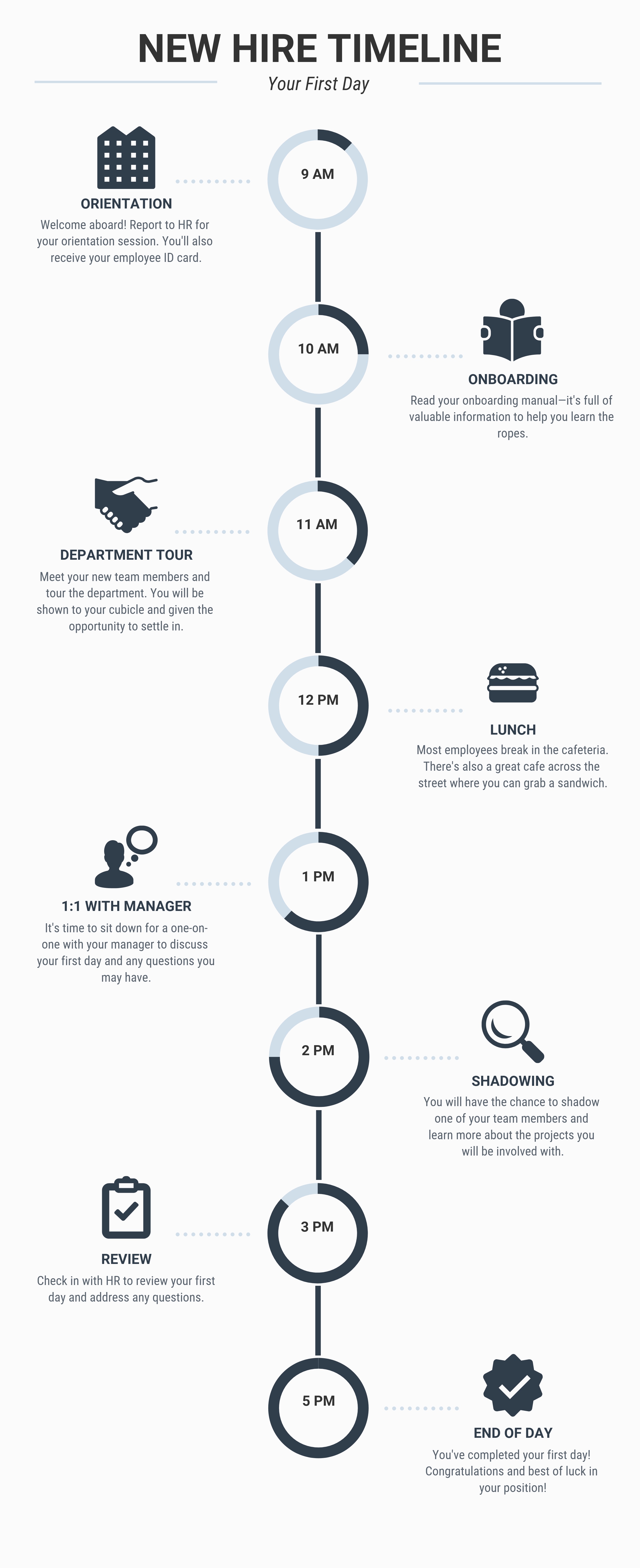
Pro Tip: Timeline templates can help simplify the onboarding process. You don’t need to limit your timeline to a new hire’s first day at the company either! Consider providing a timeline for their first week, month, or even the entire probationary period. Chart important information, like the dates of their reviews, or when their benefits kick in. This will be much appreciated by your new hire, who likely has a lot to keep track of!
Annual printable timeline template
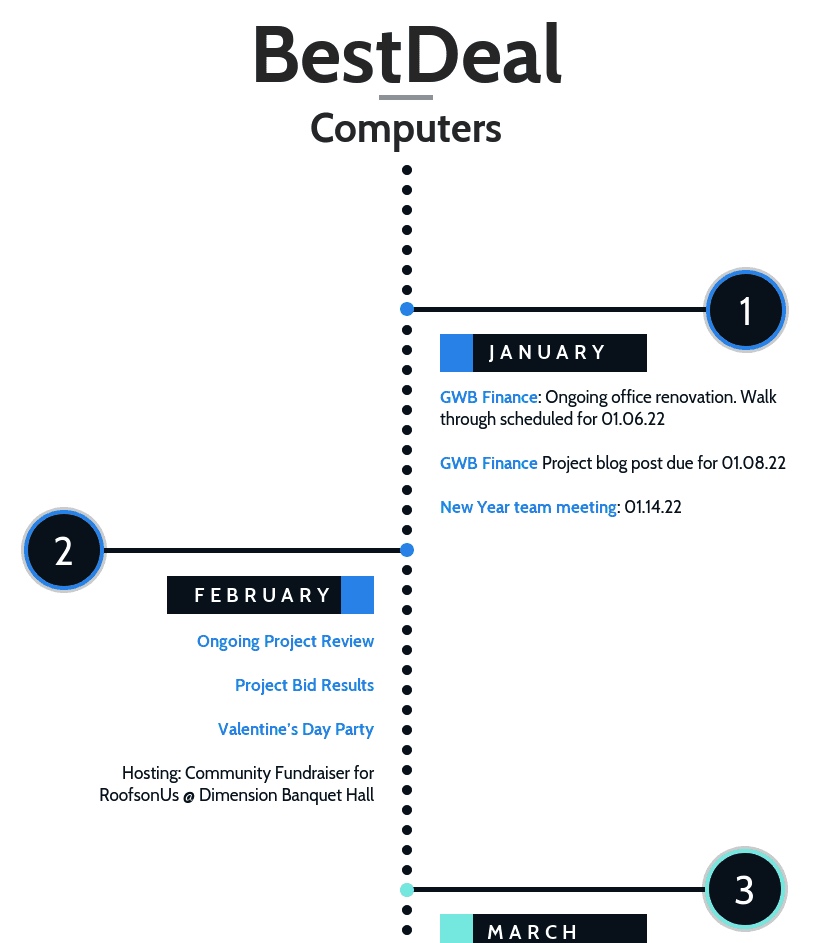
Zoom out even further and plan your entire year. Organize critical milestones by month using this vertical timeline template to share with your company:
Colorful printable timeline format
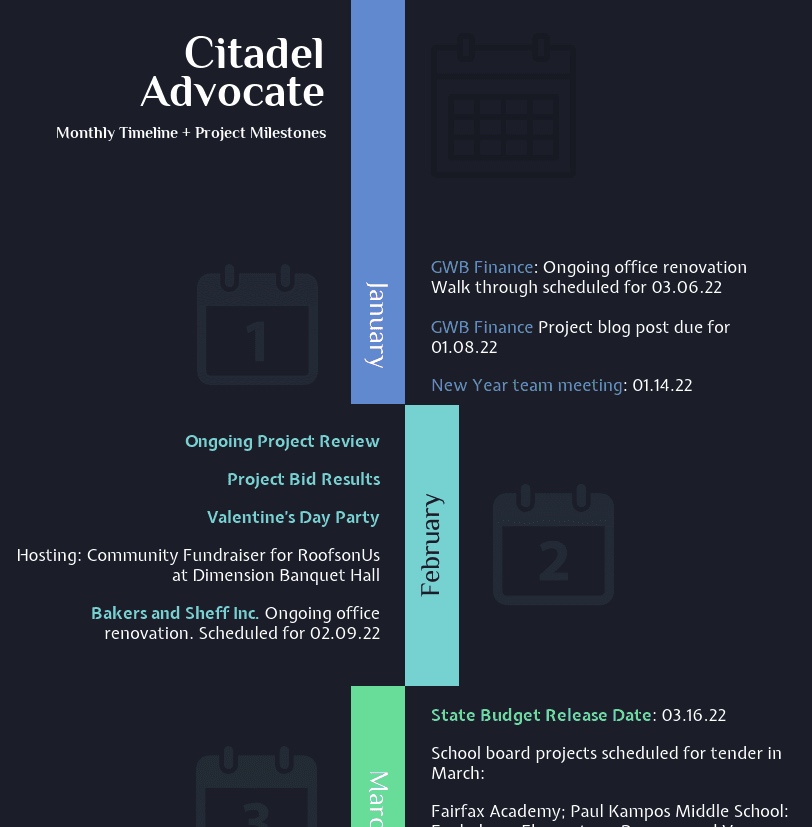
This timeline example takes a similar approach, but it color-codes the months and text for improved readability and impact.
Weekly timeline template
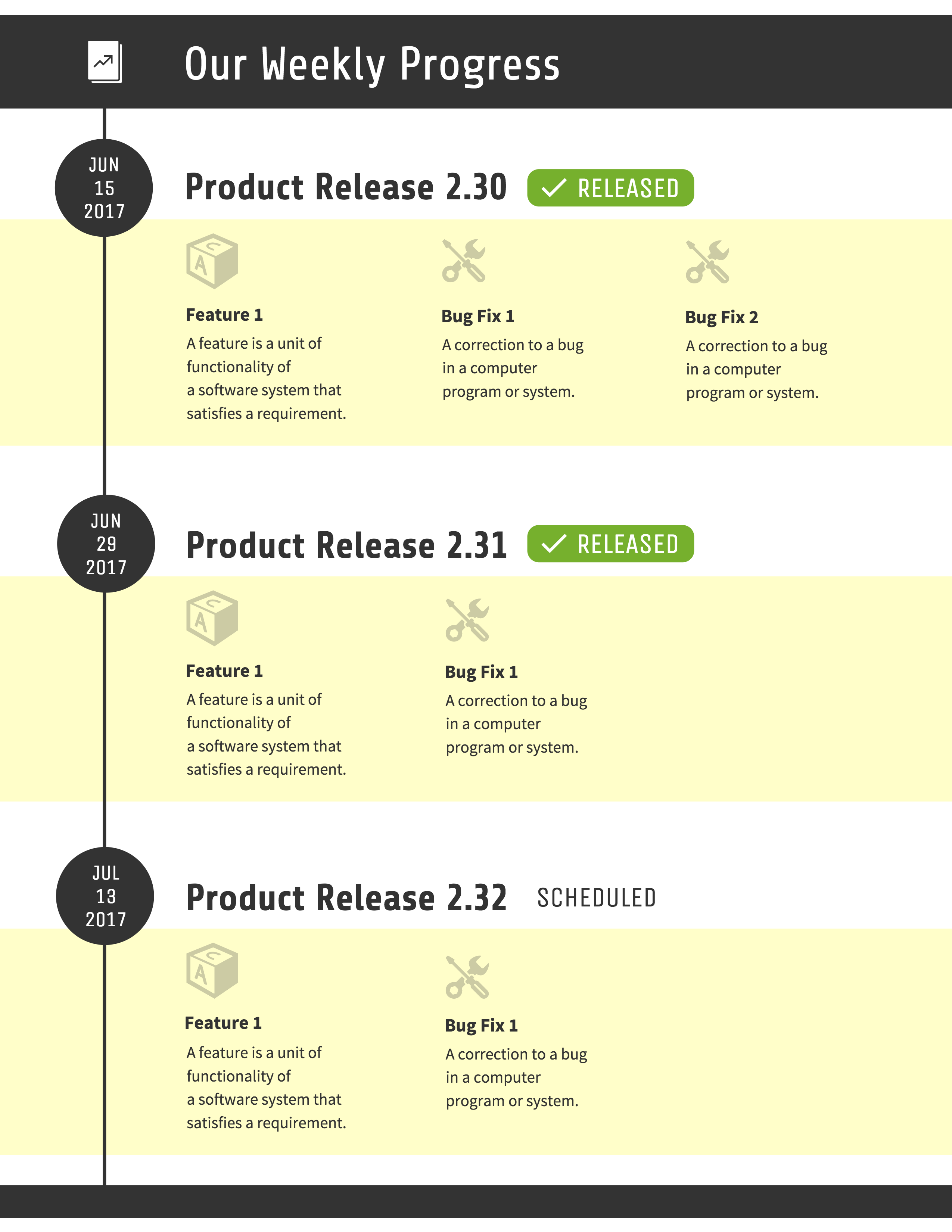
As mentioned earlier in this guide, you can keep track of your team’s progress week over week with a simple and organized timeline template.
Use symbols and icons to categorize different types of tasks so that readers will be able to skim the timeline and find the information quickly.
Alternate between two neutral background colors to increase the readability of your design. Here’s the two-week timeline from earlier that follows this scheme:
Pro Tip: A project timeline template can be a fresh way for consultants to make progress reports for stakeholders. The client can see at a glance what you’ve been up and how the project’s progressing. No wading through walls of text—a timeline is easy to scan, understand and digest.
Where to make a timeline: tools and templates
There are several tools you can use to build a timeline depending on how complex your needs are and how much design flexibility you want.
Microsoft Word and PowerPoint
Word and PowerPoint both have SmartArt tools that let you build a basic timeline quickly. They work well for simple, static timelines that don’t need to be updated often. The limitation is that adjusting the layout manually gets tedious fast, especially if your timeline has many events or needs regular updates.
Google Docs and Google Slides
Google Docs and Slides are a good option if you are working collaboratively. You can build a simple timeline using tables or shapes and share it with your team in real time. Like Word and PowerPoint, they are not built specifically for timelines so complex layouts require more manual effort.
Canva
Canva has a library of timeline templates you can customize with drag and drop. It is beginner friendly and works well for visual timelines that need to look polished without a lot of design work. It is best suited for simple to mid-complexity timelines.
Excel
Excel is a common choice for project timelines, particularly Gantt-style layouts. You can build one manually using a bar chart or use a pre-built template. It is a practical option for teams already working in Excel but the formatting can be limiting if you need something presentation-ready.
Venngage
Venngage has a library of timeline templates across different use cases including project timelines, historical timelines, event timelines and marketing timelines. You can customize colors, fonts and layouts directly in the editor without any design experience.
If you want to move even faster, Venngage’s AI Timeline Generator lets you create a timeline from a text prompt. Describe your project or use case and it generates a ready-to-edit timeline in seconds. It is a good option if you need a timeline that is both functional and visually clear. Browse Venngage’s timeline templates to find one that fits your use case.
Interactive timeline tools
If you are publishing a timeline on a website or in a digital report, tools like TimelineJS or Preceden let you build interactive timelines your audience can scroll through and explore. These are best for editorial or educational content where the reader needs to engage with the timeline rather than just view it.
FAQ about timeline templates
Where can I make a timeline?
Use Venngage’s AI Timeline Generator to design timeline templates for free using simple text prompts. You can alsochoose a template that suits your needs and edit it according to your content.
With Venngage’s diverse icons and stock photo library, you can design timelines that appeal to wider audiences.
What’s the difference between a timeline and a Gantt chart?
A timeline shows events or milestones in chronological order. A Gantt chart shows tasks, durations, dependencies and progress. If you need to communicate a sequence of events, use a timeline. If you need to manage a project with overlapping tasks and deadlines, a Gantt chart is the better choice.
Is there a timeline template in Google Docs?
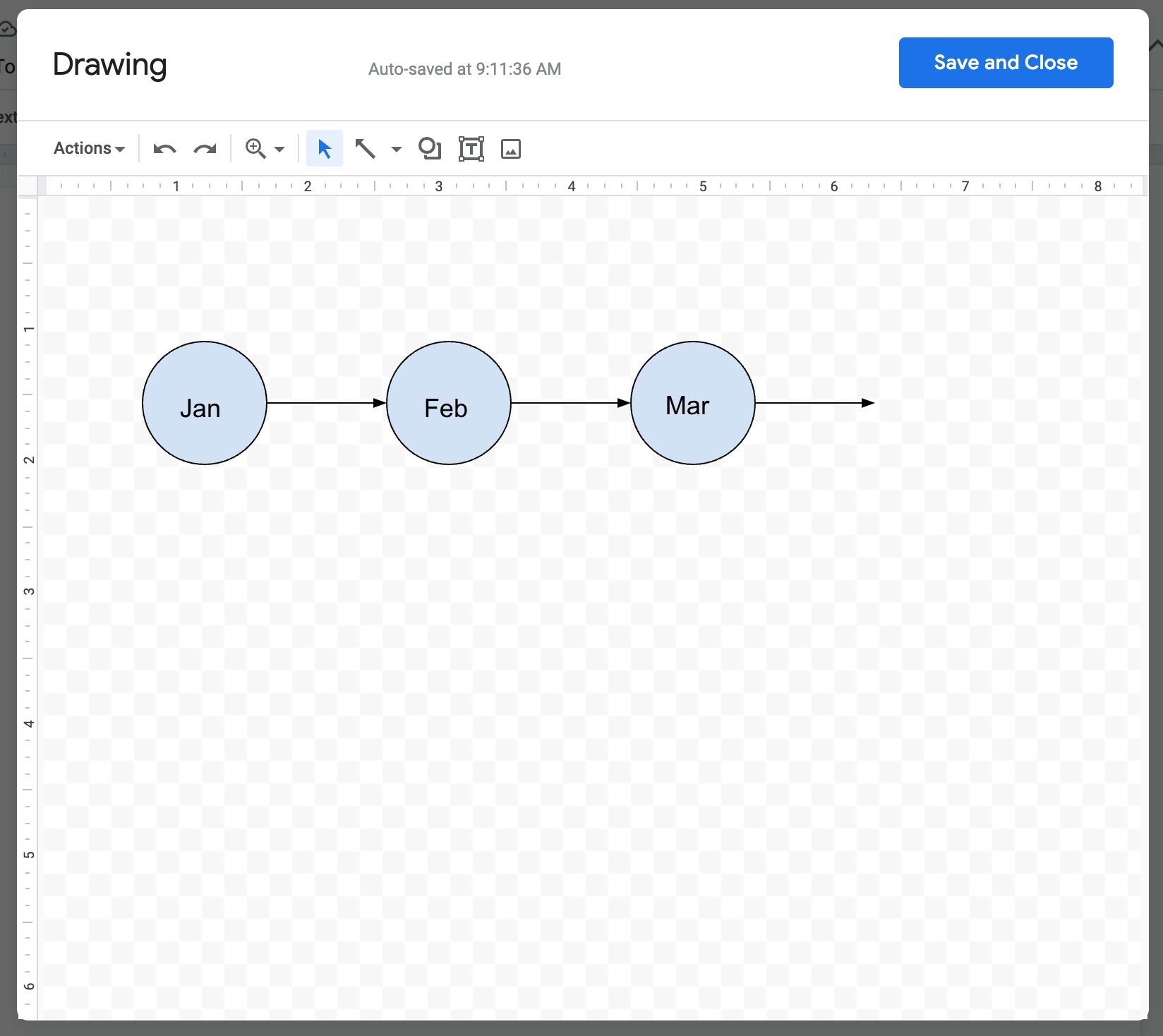
While Google Docs lacks built-in timeline tools, you can manually create one using Google Drawings. However, this method is limited in design flexibility. For a more professional and time-saving solution, use Venngage to create your timeline, then export it as an image and insert it into your Google Doc.
Is there a timeline template in Word?
Similar to Google Docs, Word doesn’t have a default timeline template. Of course you can still manually create one using the lines and shapes, or by using the SmartArt function. Check out this guide on how to create a timeline in Word if you want to go that route.
But, also similar to Google Docs, timelines created in Word take too much time and don’t look as good as the ones created using a design solution like Venngage.
A simple fix would be to choose a timeline template from Venngage’s library, edit it and export it as a PNG so you can upload it to your Word document.
Or, watch this video to learn how to create a timeline template.
Not a designer? No problem. Create an engaging timeline template with Venngage, the simple design solution for businesses.
PS: Looking for a different kind of infographic? Venngage can help you:
- Create a business strategy or brainstorm new ideas with a mind map
- Explain a complex process with process infographics or product roadmaps
- Compare and contrast multiple options with comparison infographics
- Raise awareness about an issue or cause with nonprofit infographics
Need some timeline formatting tips? Read our guide on how to create a timeline in 6 easy steps.