

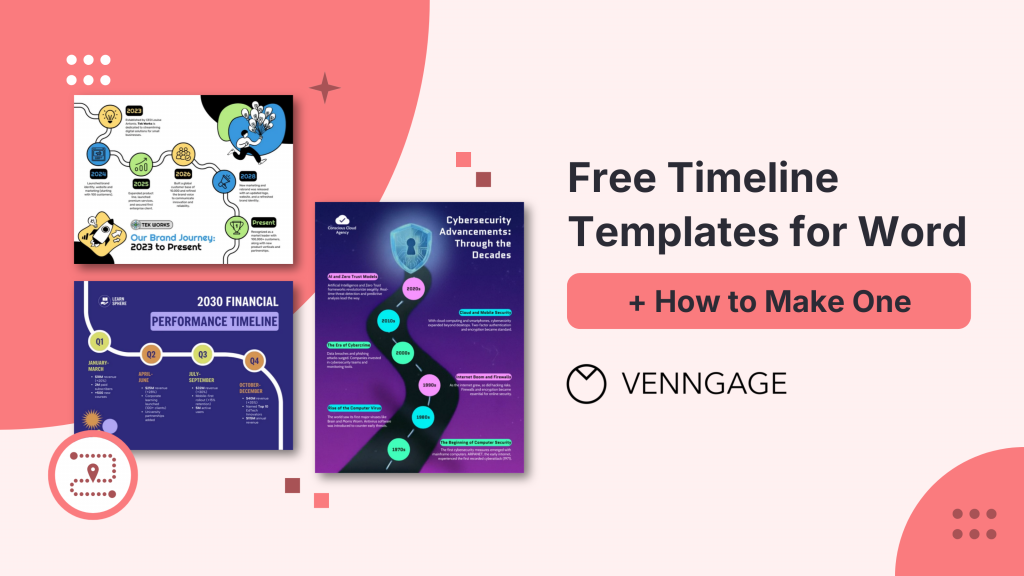
If you need a timeline in Microsoft Word, you’re probably not looking to build one from scratch or figure out whether to use a template, SmartArt or something else entirely.
This guide walks you through the fastest ways to create a timeline in Word, including the best template types, a simple SmartArt method, and when Word gets the job done vs when another tool is easier.
You’ll also find free, editable timeline templates by use case, a step-by-step SmartArt walkthrough and practical formatting tips to keep your timeline clear and readable in Word.
Can you create a timeline in Word?
Yes, you can create a timeline directly in Microsoft Word using SmartArt. The built-in process and timeline graphics let you quickly visualize events without needing design experience.
Word also works well with downloadable, fully editable timeline templates. These give you more flexibility with layout, colors, and formatting while still keeping everything easy to customize.
That said, Word is best suited for simple visual timelines. If you’re managing detailed schedules, dependencies or complex project tracking, you’ll likely need more advanced tools.
Best timeline template types for Word
Before you start creating a timeline for Microsoft Word, you first need to determine where in your document it will be placed.
If you have the freedom to let the timeline take up an entire page, use more real estate by creating a vertical timeline.
Here are some timeline templates for Microsoft Word to get you inspired as you bring your vision to life.
Note: If you’re using a design from Venngage Timeline Maker, it’s usually best to export it as an image (PNG) and insert it into Word for the cleanest, most consistent formatting.
Simple timeline template for Word
If you just need to show a few key events without overthinking the design, this is the one to go with. A simple timeline template keeps everything clean and easy to follow with no extra layers and no complicated formatting.
It’s especially useful when your timeline is supporting content (like in a report or proposal) rather than being the main focus.
- Best for: Quick overviews with a few key milestones
- Layout: Horizontal, evenly spaced events
- Works well in Word when: You want something fast, readable, and easy to drop into documents like reports, resumes, lesson plans, or presentations
Simple timelines can run horizontally, but they’re also a good match for vertical or portrait orientation. While this particular version is probably too tall for your Word doc, just update it with your content and it will flow seamlessly.
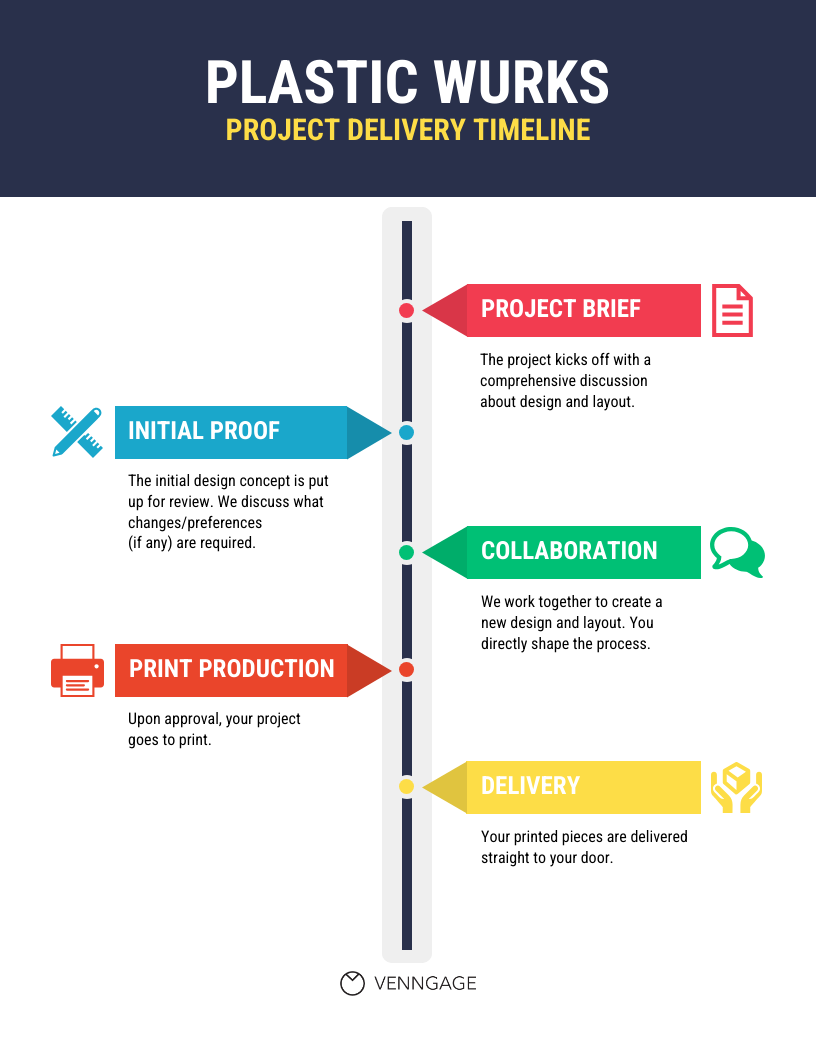
Project timeline template for Word
Keeping projects on track is crucial to the success of any organization. In some cases, a delay of even a day could cost big bucks. In 2022, 91% of construction managers reported project delays, with 31% attributing them to unrealistic plans and 19% to a lack of resources.
As Abraham Lincoln once said, “Give me six hours to chop down a tree and I will spend the first four sharpening the axe.” Careful preparation, like creating clear project timelines, can make all the difference in keeping work on schedule.
- Best for: High-level project phases and deadlines
- Layout: Horizontal with grouped stages or phases
- Works well in Word when: You’re presenting a simplified version of a project without detailed task tracking
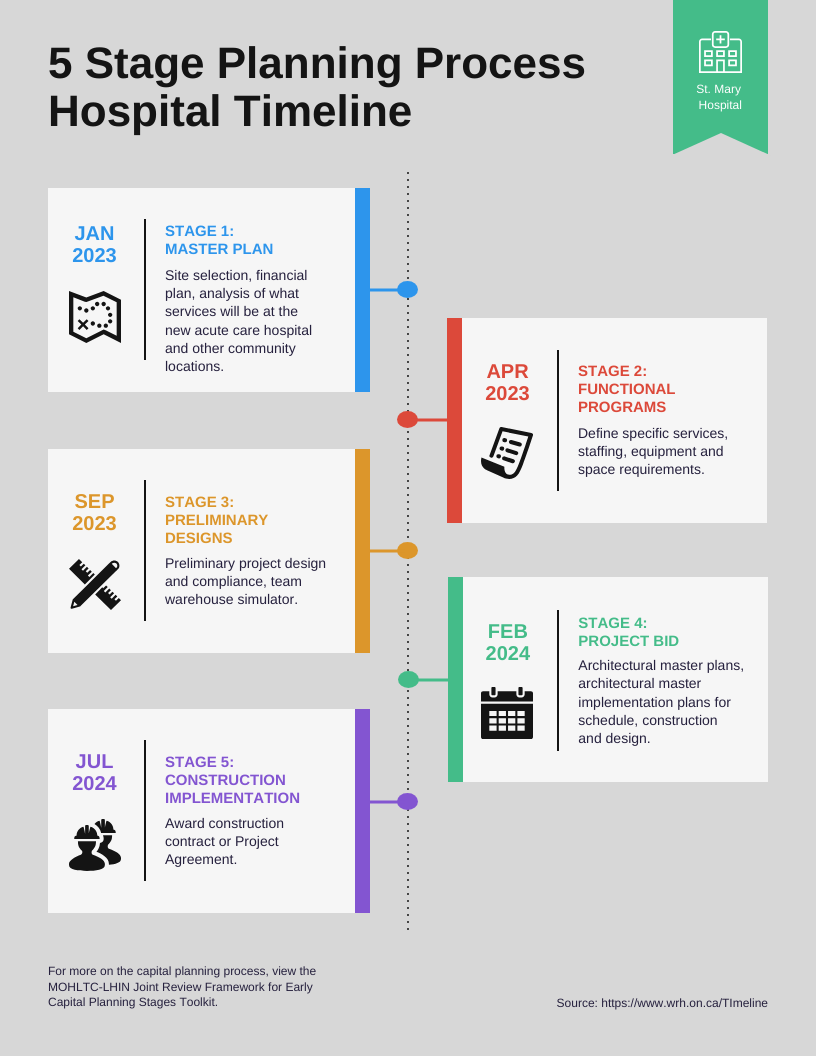
Project timelines can include specific dates, months or weeks on which specific tasks are expected to be completed. That requires the planning of the project to be advanced enough that it’s possible to note these dates, of course.
61% of companies using project management tools completed projects on time, compared to 41% of those not using them. As Gregory D. Githens puts it, “Project management is like juggling three balls—time, cost and quality.”
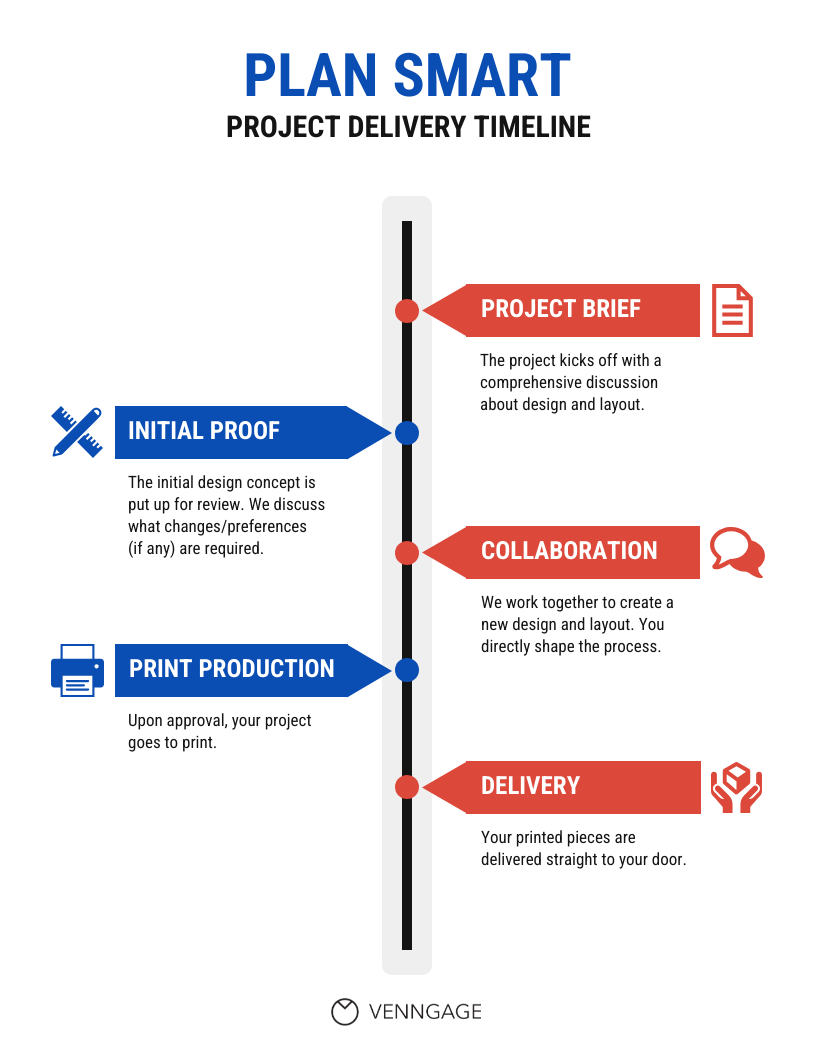
If you don’t yet have specific dates or timeframes outlined, that’s OK. For informational or planning purposes, consider this free project timeline template that will help all interested parties understand the workflow.
Related: 15+ Simple and Editable Project Timeline Templates You Can Use in Word & PowerPoint
Vertical timeline template for Word
Word documents default to a letter-sized page, or 8.5 inches wide by 11 inches tall. With a standard 1-inch margin around the page, that leaves a vertically oriented rectangle on each page. When creating timelines for Word, consider ones that get the most of portrait orientation.
- Best for: Step-by-step processes or limited page width
- Layout: Top-to-bottom vertical flow
- Works well in Word when: You’re working in portrait orientation or need to fit a timeline into a narrow section
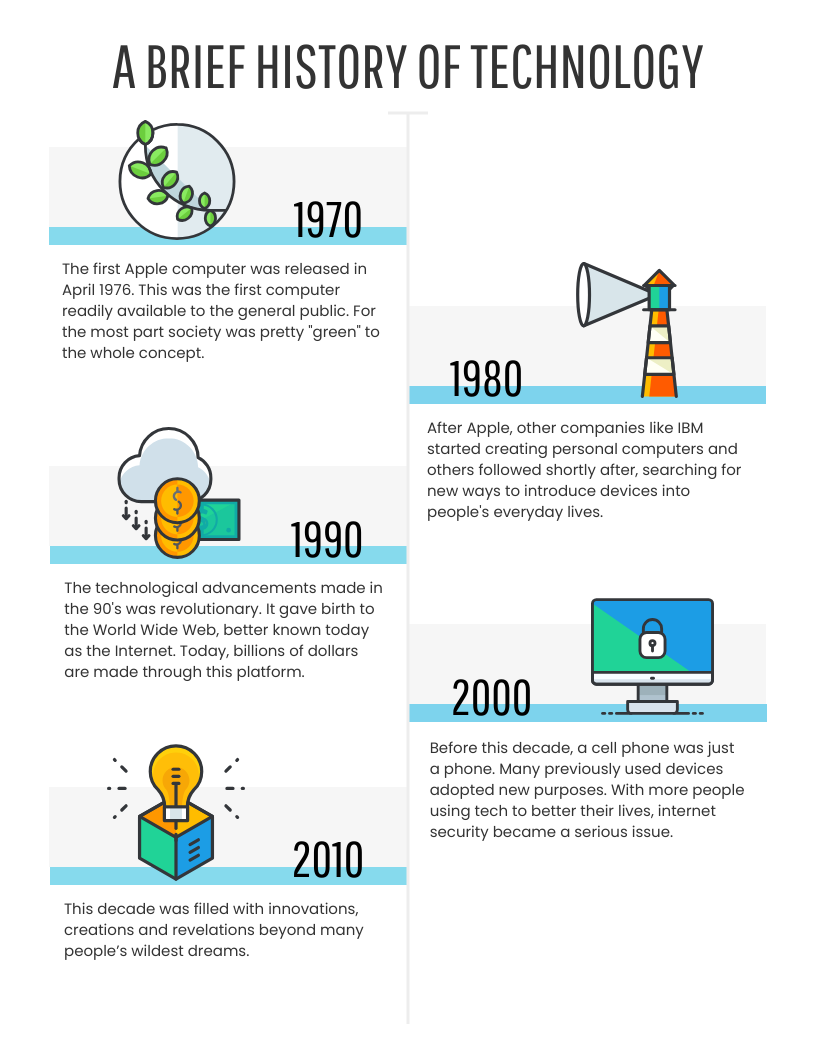
This technology history timeline would easily slot into any Word document thanks to its simple design and modern style.
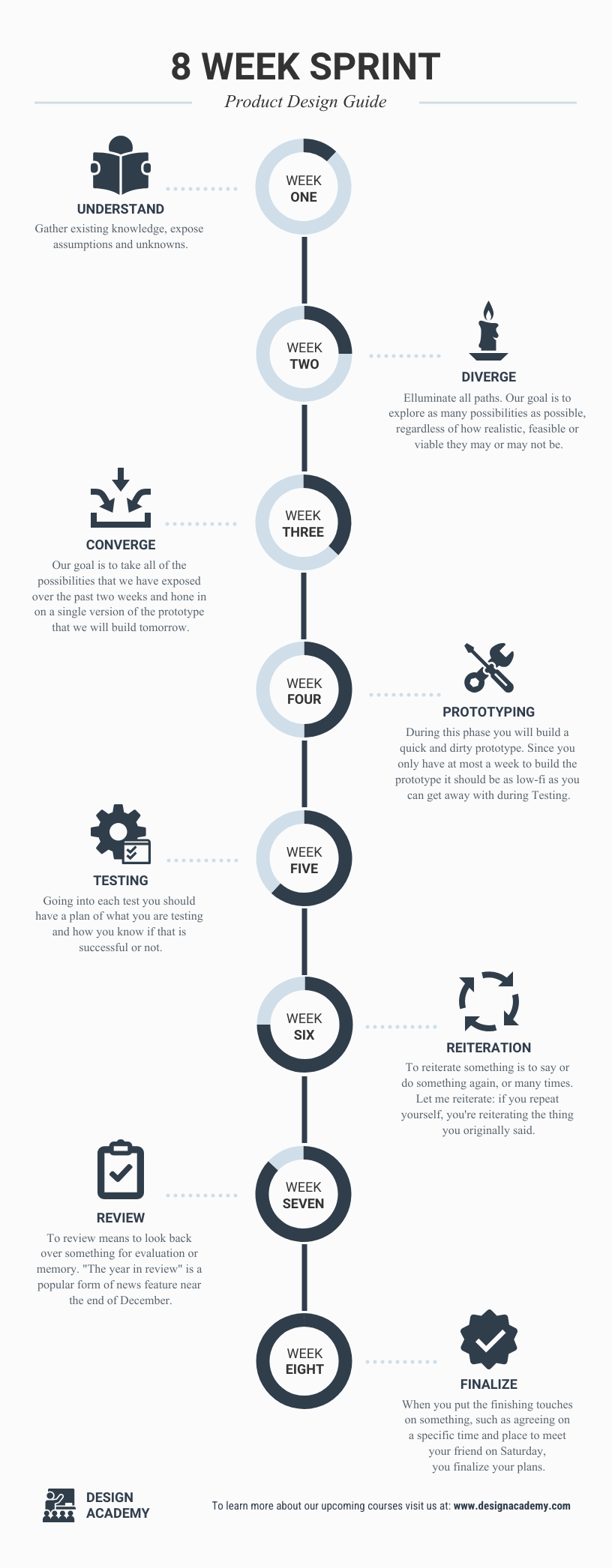
This colorful vertical timeline shows you how much personality and visual appeal you can add to the timelines you create for Word using Venngage’s Timeline Maker.
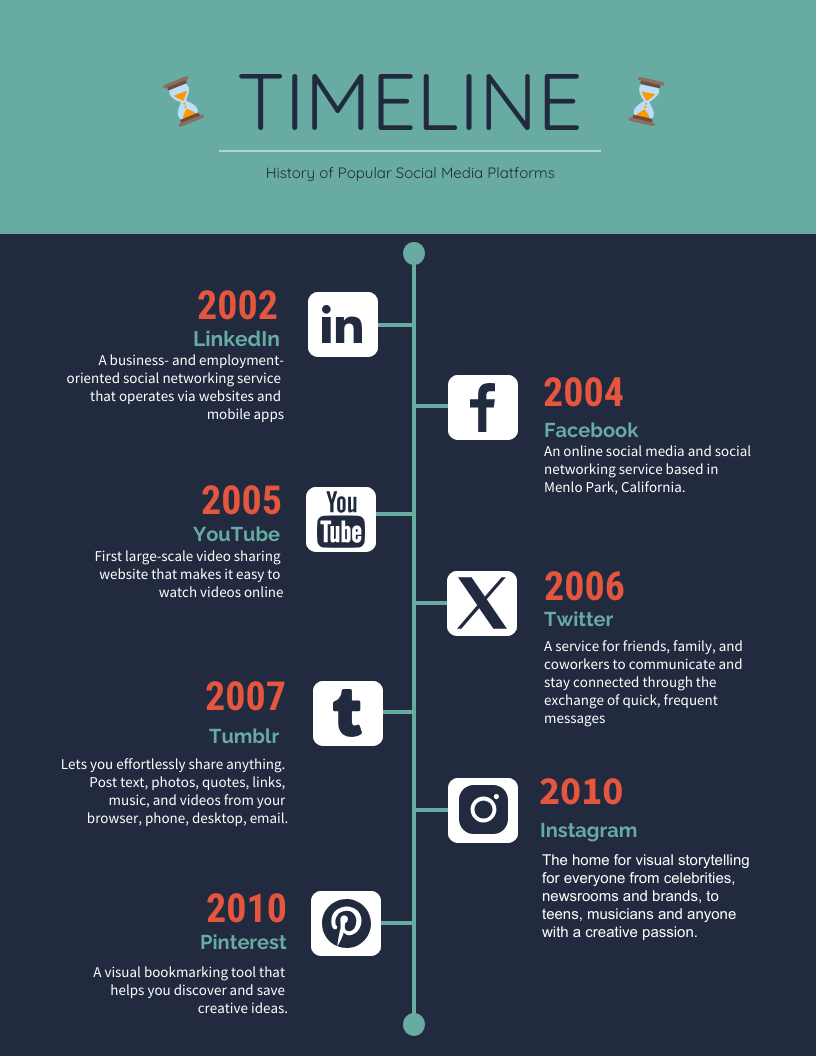
Integrate well-known logos to enable your audience to make immediate mental connections at just a glance.
Event or history timeline template for Word
Timelines can also be used to catalog events from the world at large, including ancient and recent history. These types of timelines are most often used for content marketing purposes, but they can also be used to educate and inform within Word documents.
- Best for: Chronological storytelling or historical events
- Layout: Linear (horizontal or vertical) with date-based progression
- Works well in Word when: You’re explaining sequences clearly in essays, reports or presentations
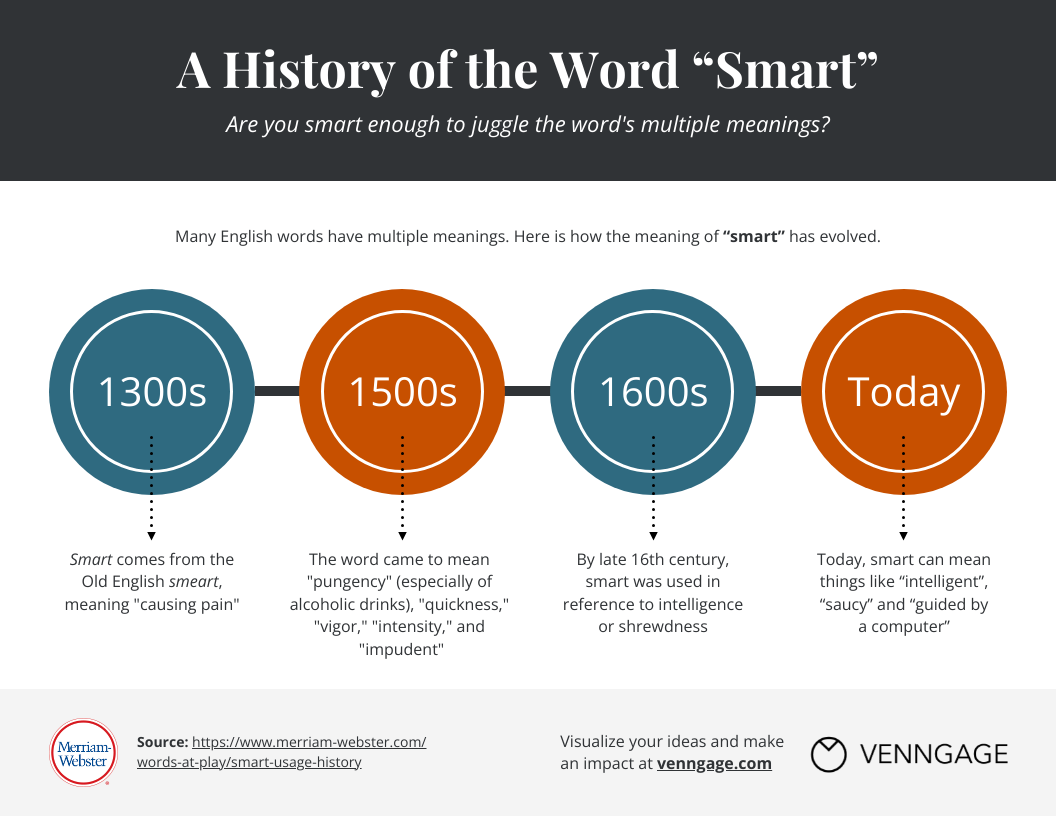
Event and history timeline templates can be useful additions to Word documents, especially when you want to make sure whoever is reading it has a basic level of knowledge.
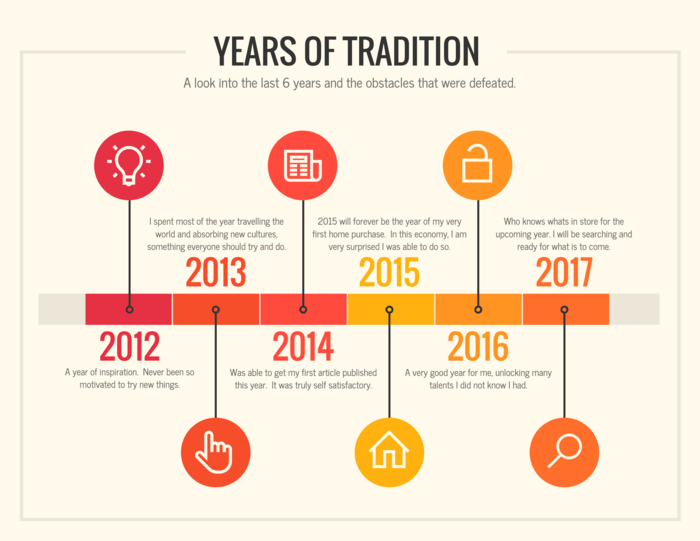
History timelines aren’t limited to world events or developments. This example shows how a personal history can be conveyed in a history timeline that would easily slot into a Word document like a job application or resume.
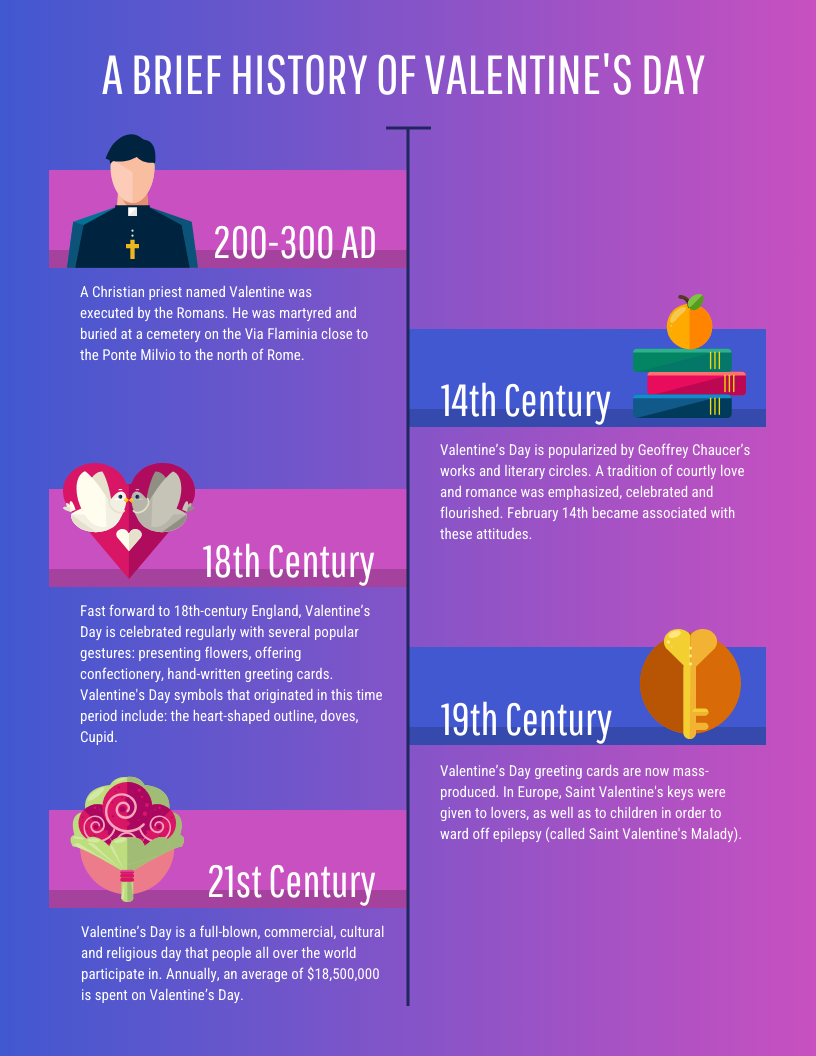
These timelines are also a good fit for a vertical presentation (more of those momentarily). This is often the best of both worlds, as it takes up basically an entire Word page.
Events like conventions, gatherings, reunions and others require meticulous planning, often down to the hour. Event timelines are wise additions to participant or speaker packets created in Word.
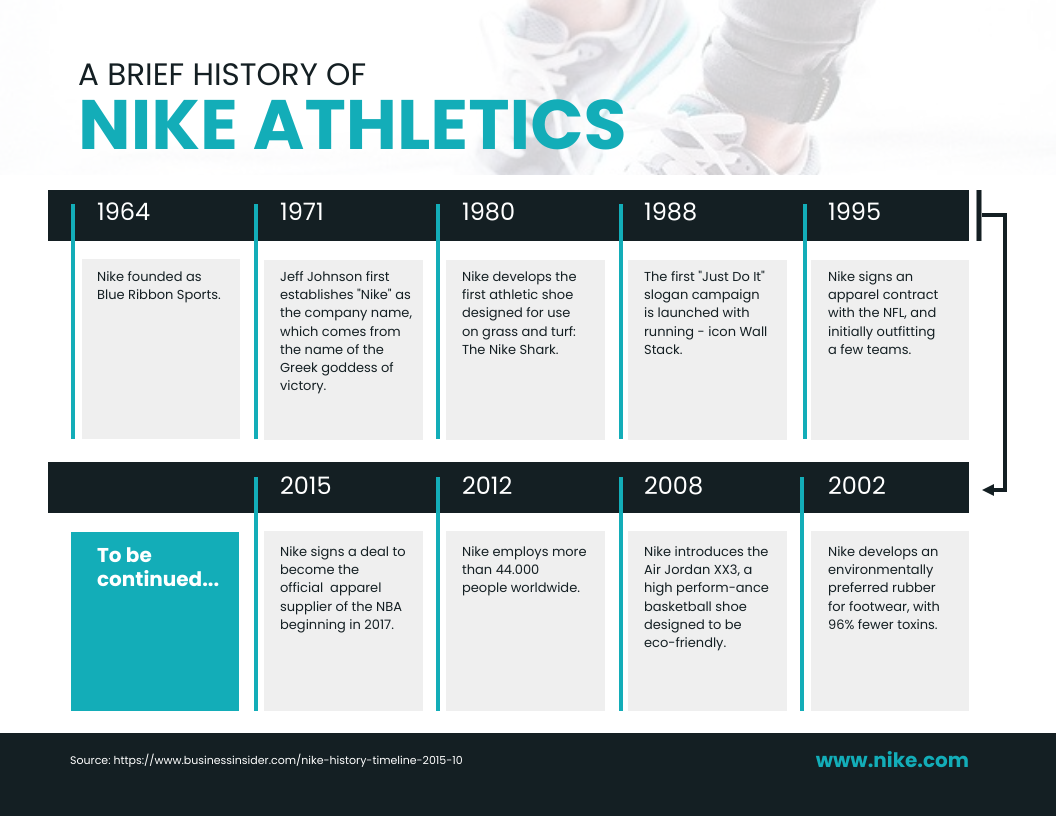
This horizontal timeline created to illustrate the events in the corporate history of Nike could easily be updated for event planning. Think of it as a calendar. When and where will activities happen and who will be involved?
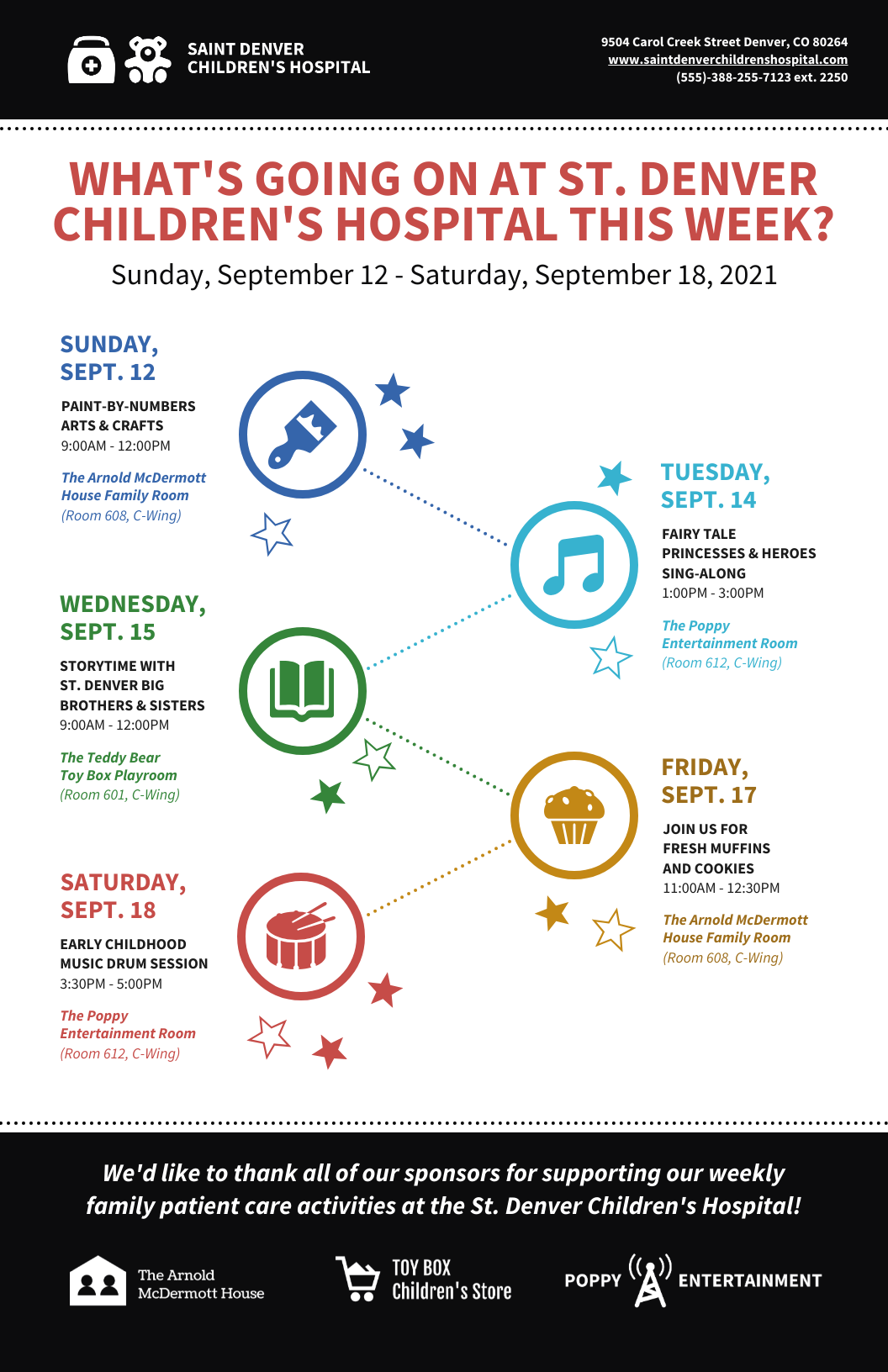
Your Word documents may not need to feel like event posters. But consider templates like this event timeline if what you’re planning leans celebratory rather than corporate.
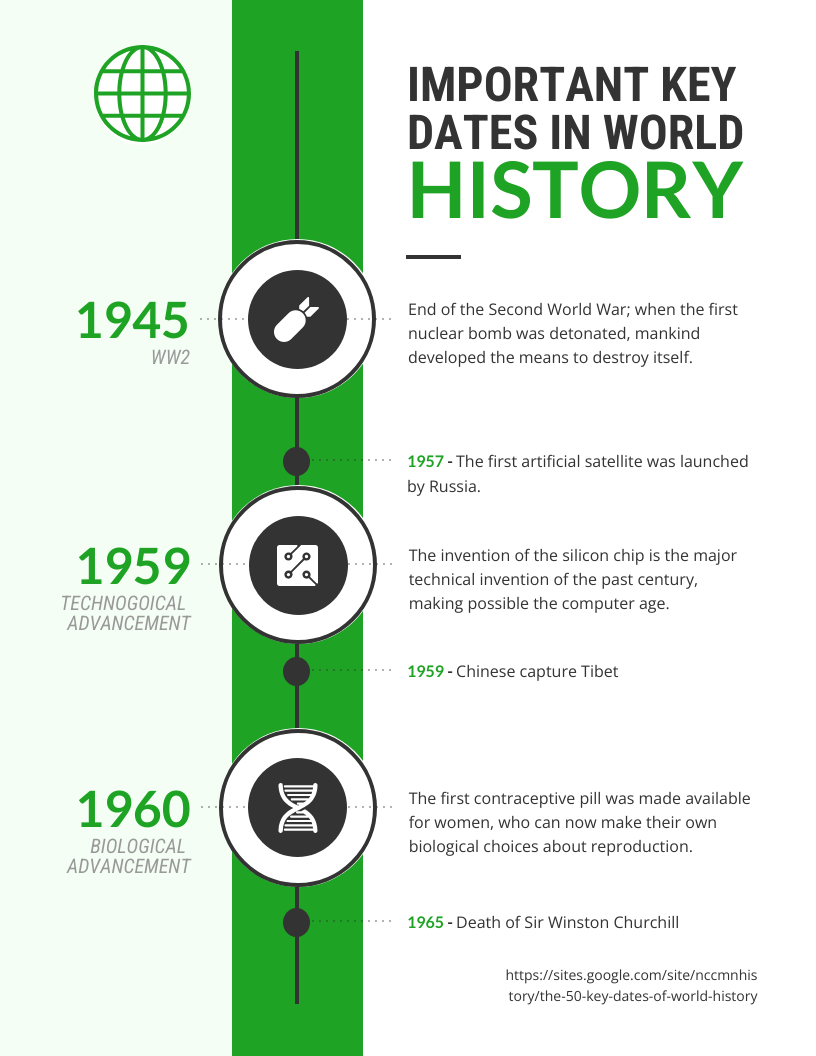
This history timeline would be easy to modify for an event timeline. Use the circles and icons to plug the keynotes and other major events and use the smaller text to provide important supporting information.
Project management timeline template for Word
I’ve touched on this a bit already, but project managers are some of the most regular users of timelines. Project management timelines are excellent additions to Word documents, particularly proposals or contracts.
- Best for: Broad project tracking with key milestones
- Layout: Horizontal with milestone markers and brief labels
- Works well in Word when: You need a visual summary and not detailed task dependencies or schedules
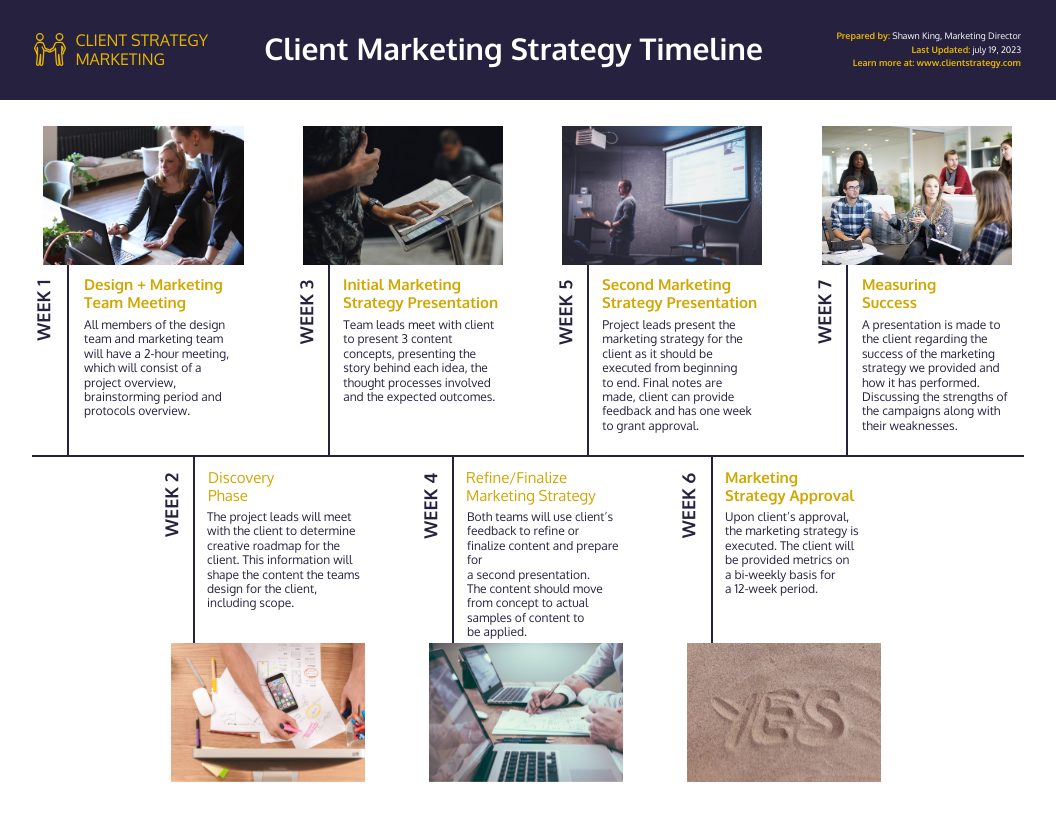
Project management timelines are easy to slot into contracts for client review or other planning documents formatted in Word. Add some images of your actual projects to further engage your team and clients.
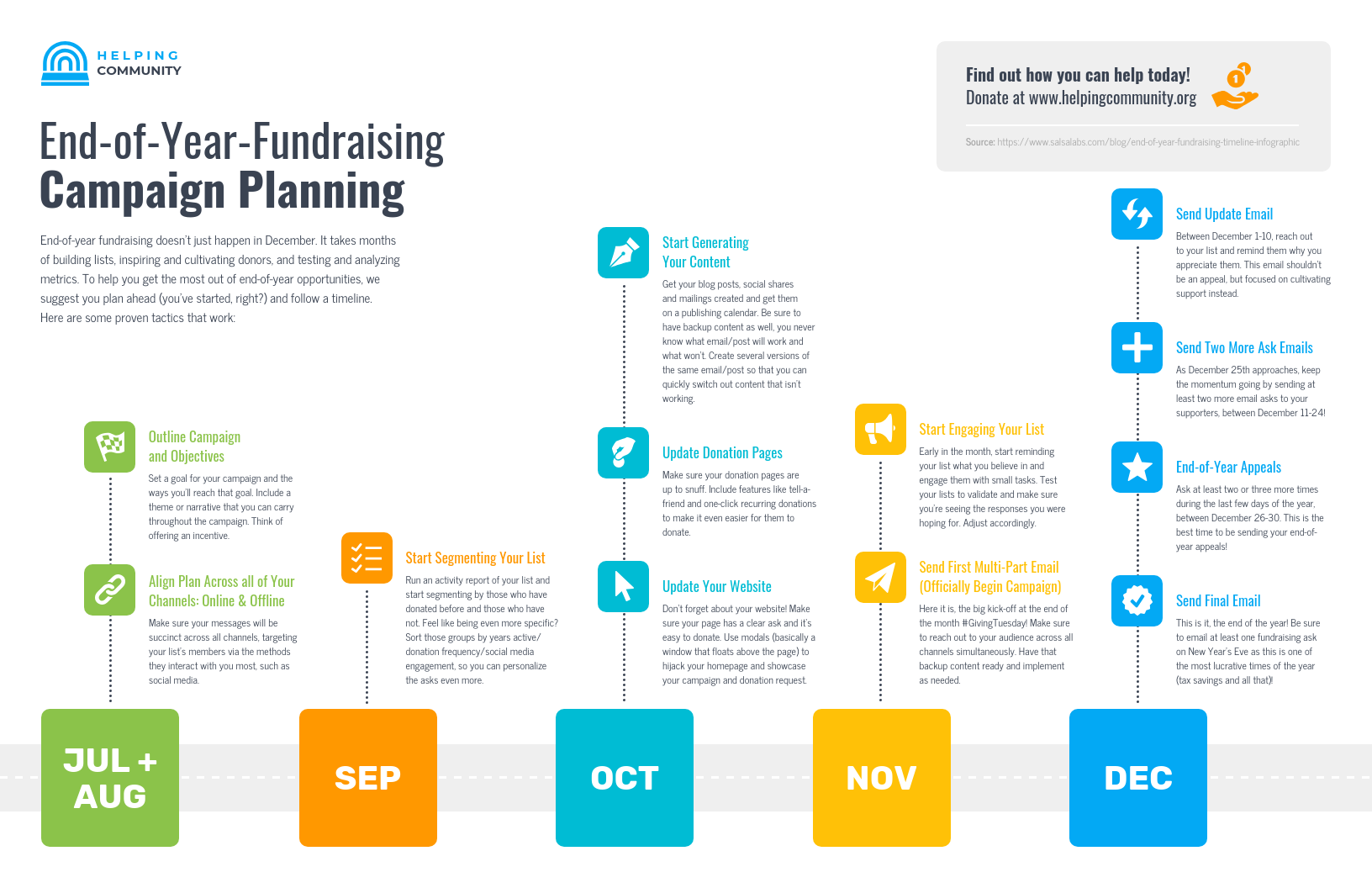
Keep all necessary tasks clear in the team’s mind with a project management timeline that lists out each task’s target completion date.
Project plan timeline template for Word
Project plan timelines can be used in the early phases of a project before too much work has been done. In fact, creating a project plan timeline for a Word document like a proposal or the first draft of a contract can help all parties see issues and make changes.
- Best for: Outlining phases, deliverables and timelines
- Layout: Structured horizontal timeline with grouped sections
- Works well in Word when: You’re sharing a plan overview without needing constant updates or collaboration
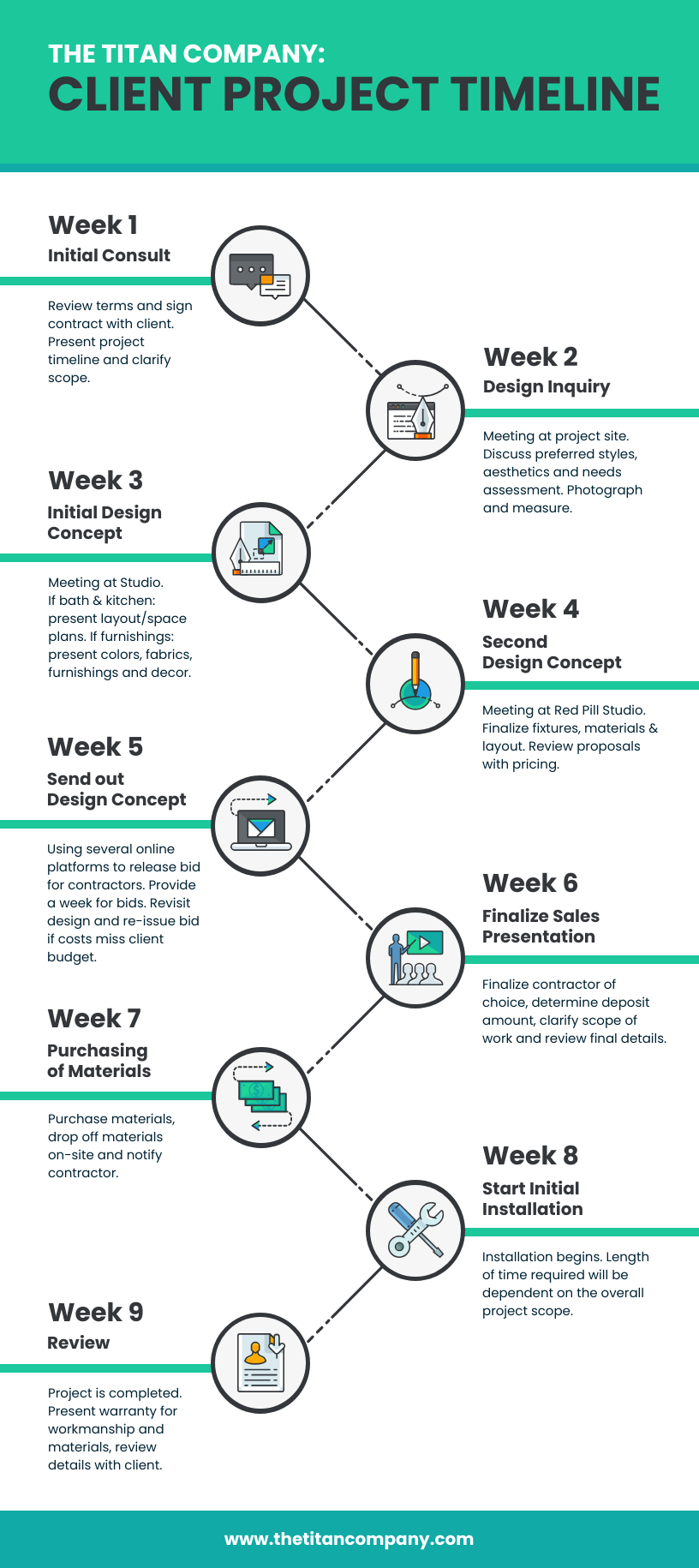
Project plan timelines are useful before, during and even after projects. Even before you’ve landed that big contract, it’s helpful to create a project plan timeline that outlines ideal timeframes for the completion of various steps.
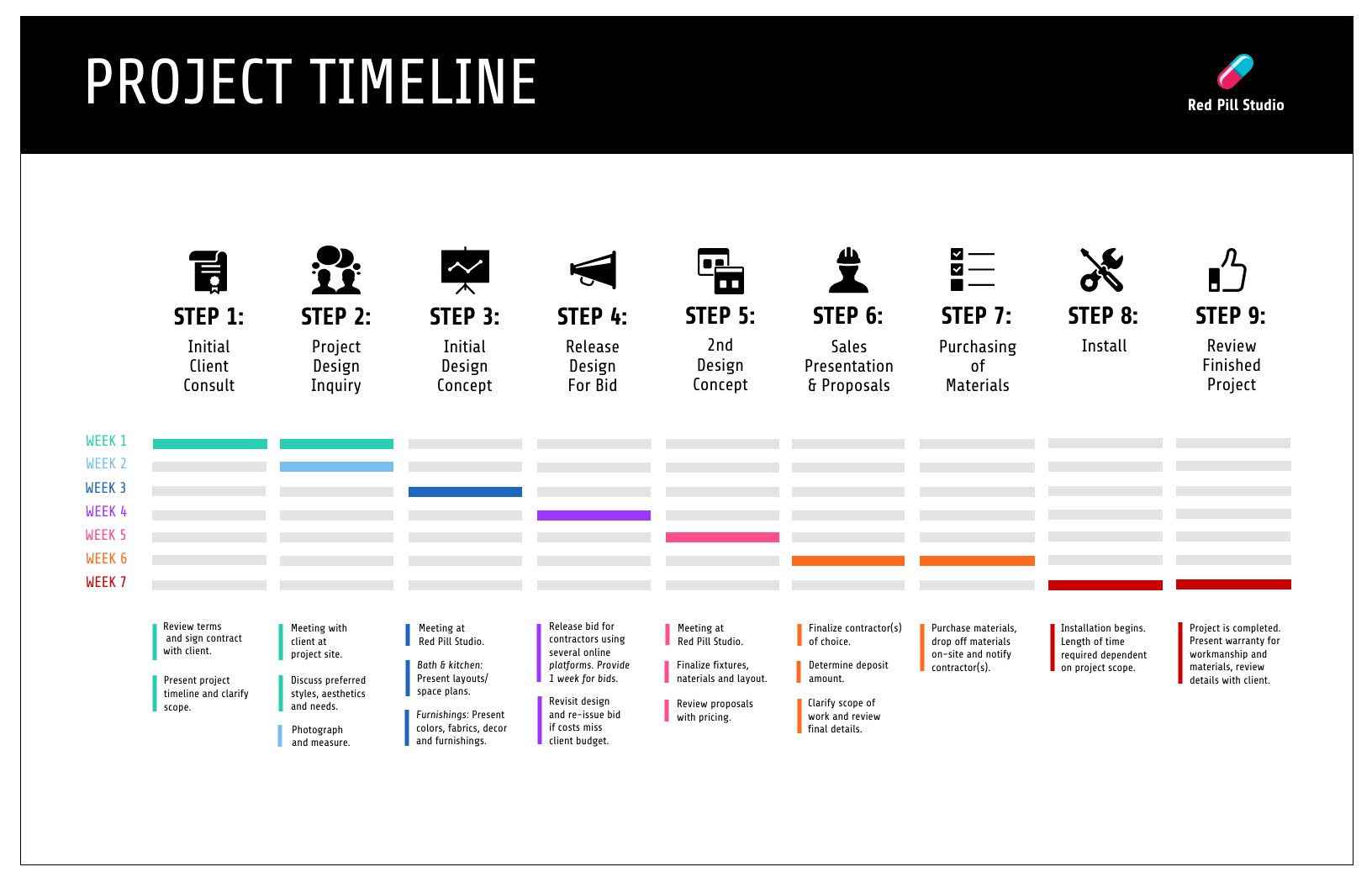
Add some light data visualization like this project plan timeline. Note how each week is color-coded and a new team or task is highlighted. This is helpful to help team members understand how their tasks may intersect or overlap with teammates.
Project schedule timeline template for Word
Get into the nitty-gritty details of the flow of your team’s work with a project schedule timeline. These can be easily updated to cover a single big event or several weeks or months of tasks that need to be completed.
- Best for: Showing timing of tasks at a basic level
- Layout: Linear with time-based segments
- Works well in Word when: The schedule is simple and doesn’t require precise scaling or frequent changes
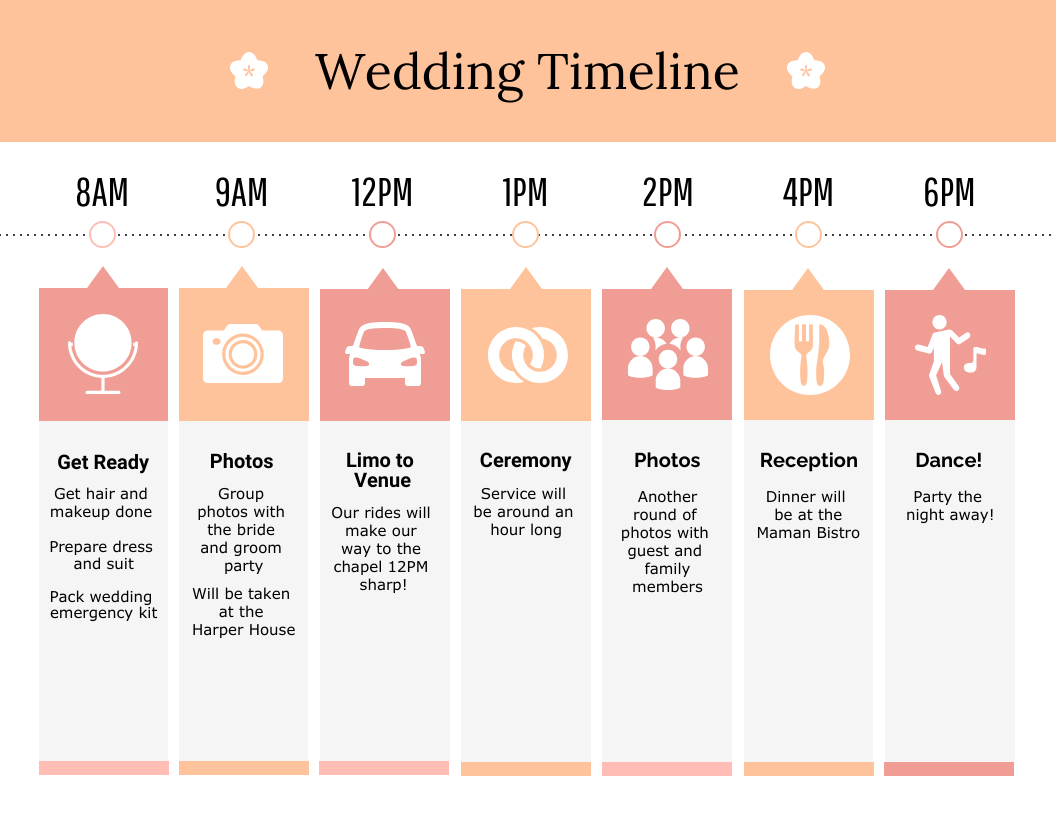
What is a wedding if not one big, joyful, emotionally draining project? Take inspiration from this schedule template for your events, whether they’re big meetings, conventions or other complex projects.
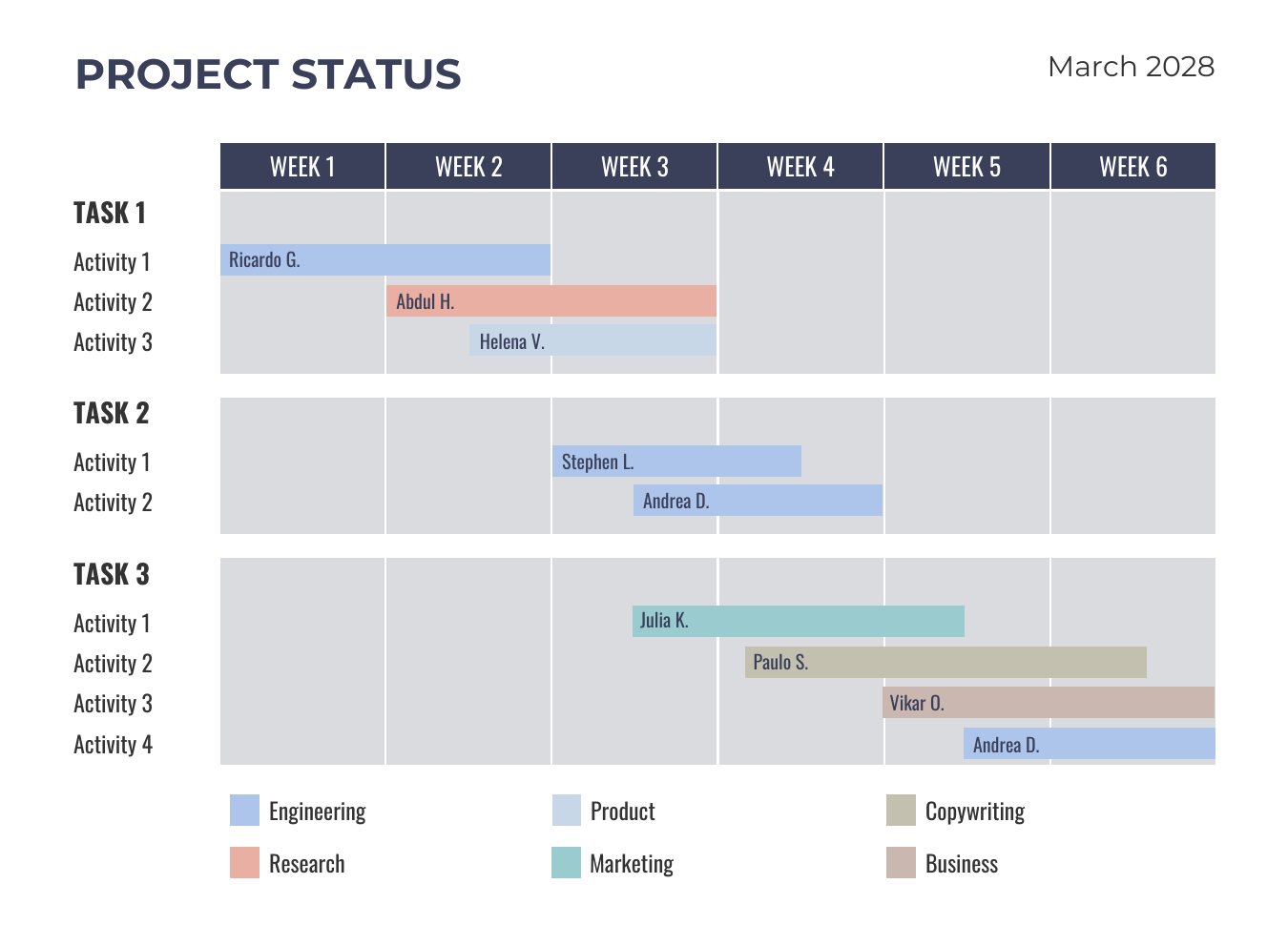
This project schedule template can be quickly edited and customized for your team. Note how both names and job functions are listed. Being so detailed with a project schedule is an excellent way to build accountability in your work.
Project milestone timeline template for Word
Keep the entire team well-informed by adding a project milestone timeline to your Word documents. Depending on how often you’re creating new docs for the project, it may be wise to consider project milestone templates that can be updated when tasks are completed.
- Best for: Highlighting major checkpoints or achievements
- Layout: Clean horizontal layout with emphasized milestone markers
- Works well in Word when: You want to keep things concise and focus only on key outcomes
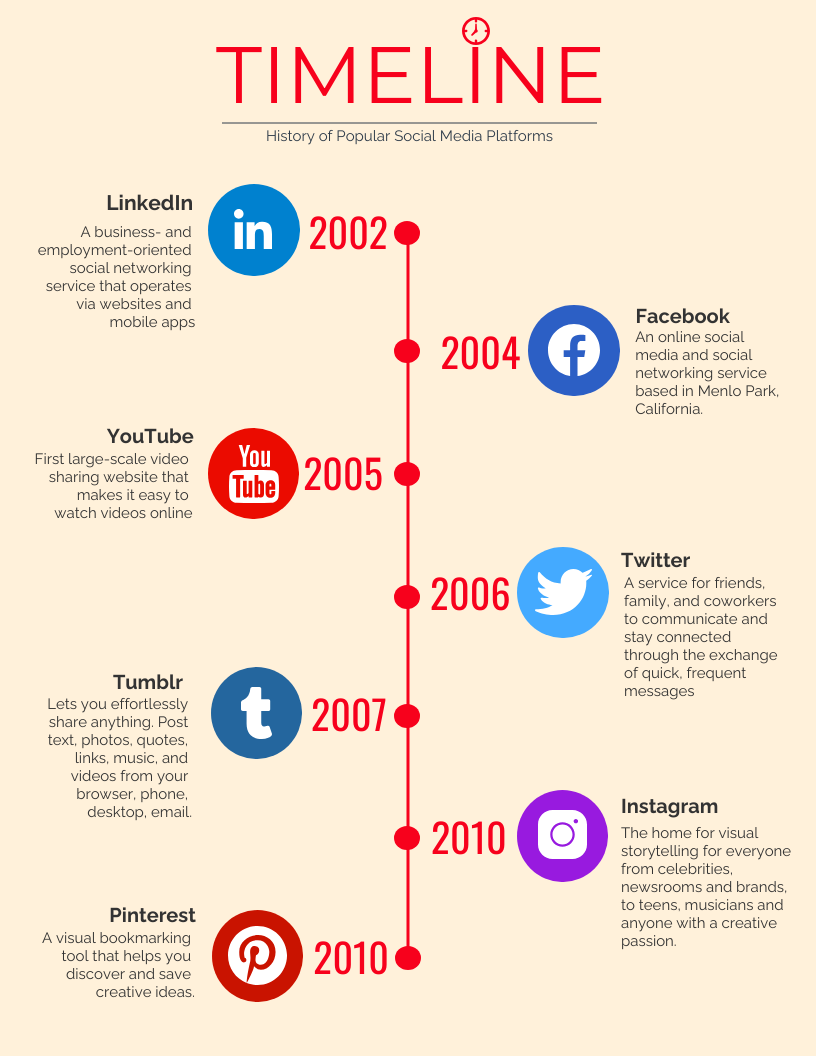
While this example applies to social media platforms, it would also make a great addition to your project milestone template library. Rather than social media logos, consider icons that apply to each phase of the project.
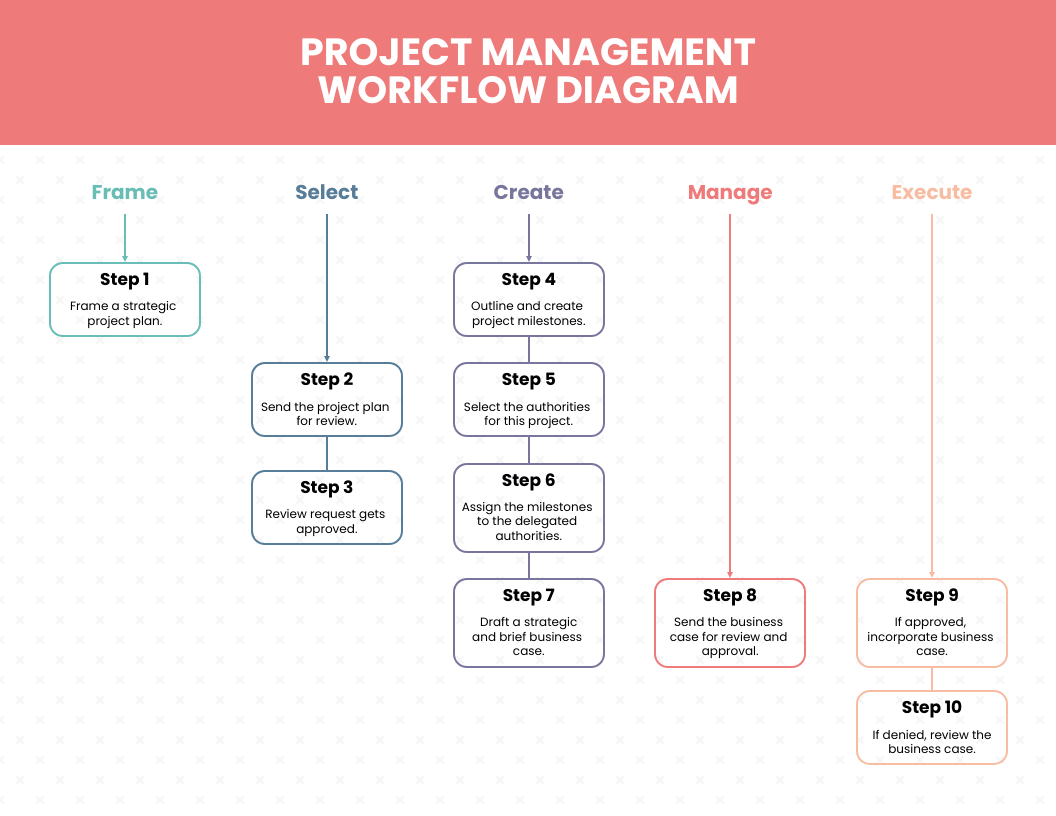
This unique approach to a project milestone timeline reduces visual clutter while it illustrates when and how various roles and responsibilities overlap throughout the course of a project.
Chronology timeline template for Word
Explain the beat-by-beat events with chronological templates. These are useful both for real-world historical events as well as the detailed steps that will take place in your projects.
- Best for: Ordered sequences of events over time
- Layout: Linear, date-driven flow
- Works well in Word when: You need a straightforward, easy-to-follow progression without complex formatting
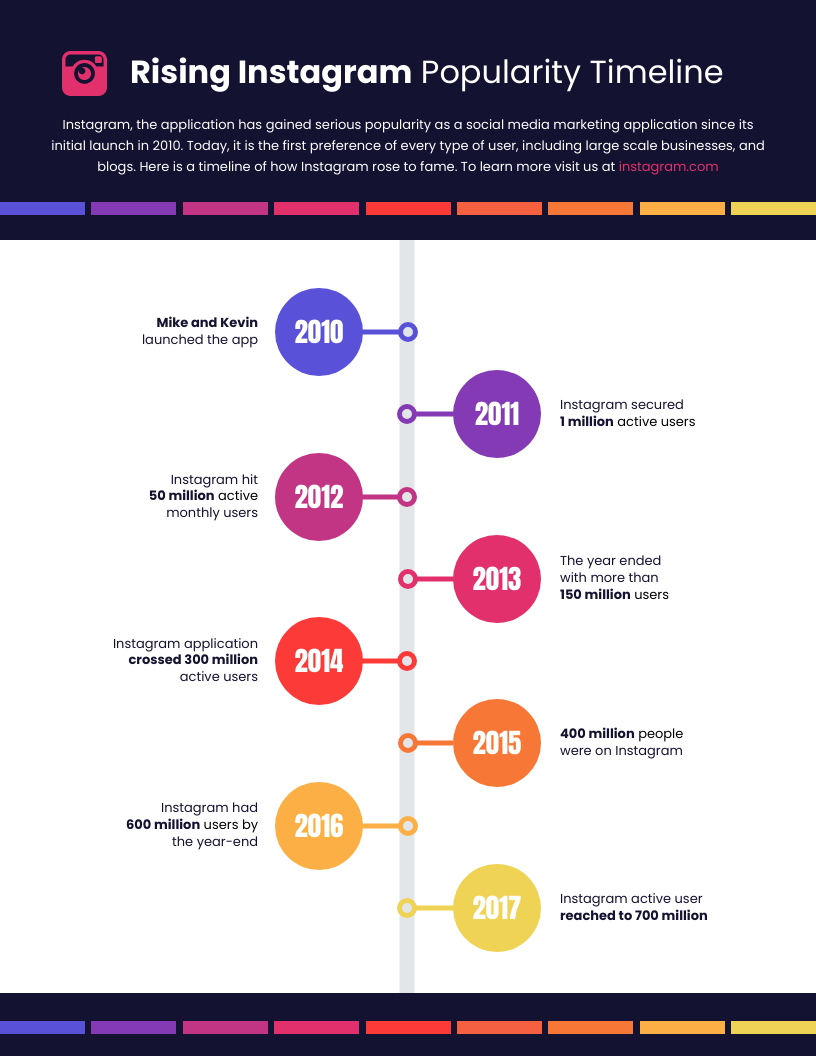
Chronology templates are easy to add to Word documents in which the reader will need to know certain basic facts in order to understand what’s to come.
This is especially true with white papers and other research in which a lack of knowledge about how events have transpired could affect understanding and appreciation.
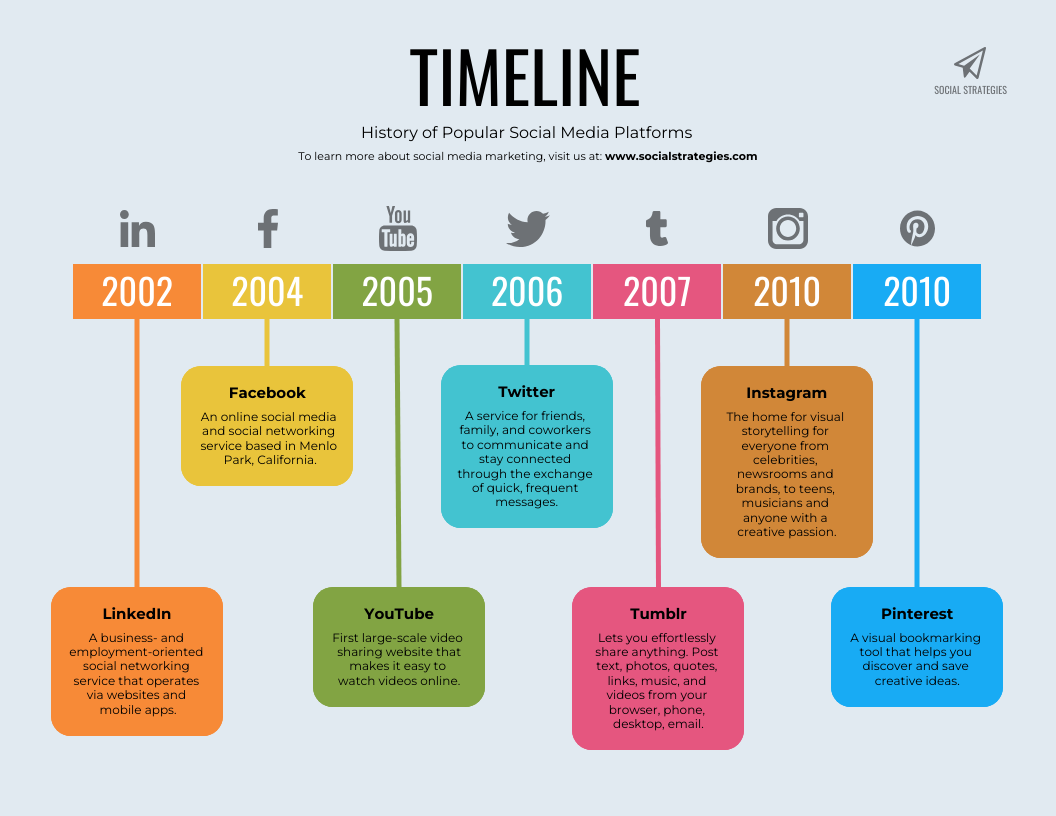
Chronology timelines can also be created in horizontal formats, as this example illustrates. Consider updating the color palette if your Word doc is for a corporate audience.
Related: 40+ Timeline Templates, Examples and Design Tips
How to make a timeline in Word
Quick-start verdict
- Fastest built-in method: SmartArt
- Best for: Simple milestone timelines
- Not ideal for: Precise scheduling, dense project plans, or anything you’ll need to update often
If you just need something quick and clean, SmartArt is your best bet. It’s not perfect but it gets the job done fast. Creating a timeline manually in Microsoft Word can take approximately 30 minutes, whereas using SmartArt graphics reduces this time to about 2 minutes.
Before you jump in, a couple of quick notes:
- The exact path is: Insert → SmartArt → Process → Basic Timeline
- Word spaces everything evenly, so it won’t reflect real time gaps unless you manually tweak it
- Try to keep it to 5–7 milestones max or it’ll start looking cramped
- These steps are pretty much the same across Microsoft 365, Word 2021, and Word 2024 (the buttons might look slightly different on Mac or web)
Word offers a pair of timelines in its stock SmartArt gallery, and the creation process for SmartArt timelines is considerably shorter than for custom-made ones. Microsoft Word offers two timeline-specific SmartArt graphics: Basic Timeline and Circle Accent Timeline. But the result leaves quite a bit to be desired.
Step 1: Open a blank document and switch to landscape
Start with a blank doc and switch it to landscape. Timelines naturally run horizontally, so this just gives you more breathing room right away.
Step 2: Go to Insert > SmartArt > Process
Head to Insert → SmartArt → Process. This is where Word hides the timeline-style layouts.
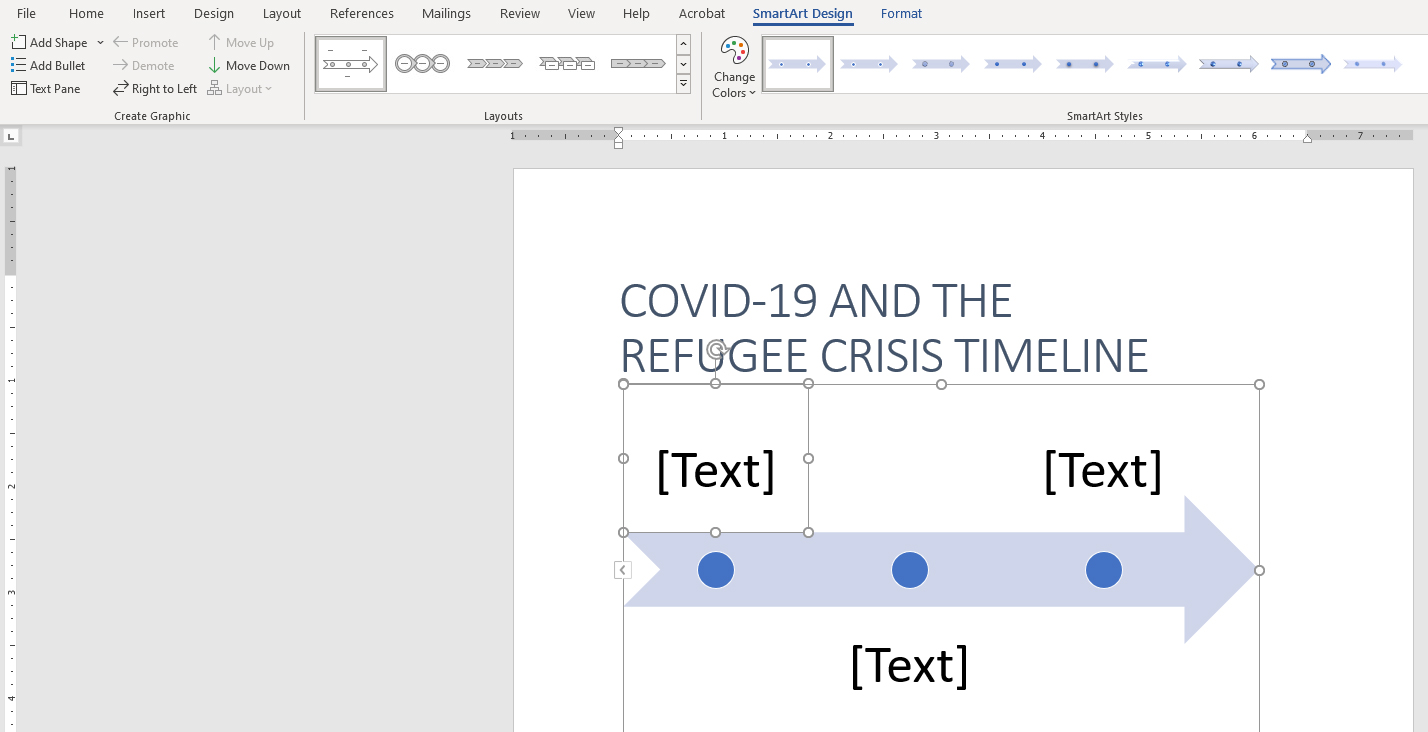
Step 3: Choose a basic timeline layout
Pick Basic Timeline. There’s also a Circle Accent option, but honestly, your choices are pretty limited here. There are only two graphics made for timelines, though there are some other SmartArt graphics that would probably work, too.
Step 4: Enter your dates and milestone text
Open the text pane and start typing your milestones. Keep things short since Word will start shrinking or wrapping your text if it gets too long, and that’s when things get messy.
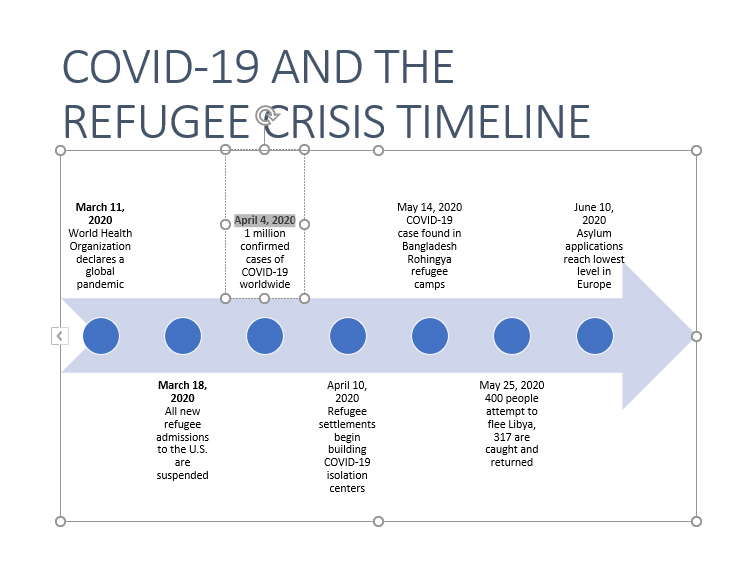
Step 5: Add or remove events
You can add or remove milestones as needed, but try not to go overboard. Around 5–7 events is the sweet spot before everything starts feeling squeezed.
Step 6: Rearrange milestones and adjust the layout
This is where you’ll likely do a bit of nudging. SmartArt doesn’t actually understand time spacing so it just distributes things evenly. So if you care about accuracy, you’ll need to manually adjust positions.
Overall, SmartArt is great when you want something fast and “good enough.” Just know that once you start tweaking, things like text resizing and alignment can get a little fiddly.
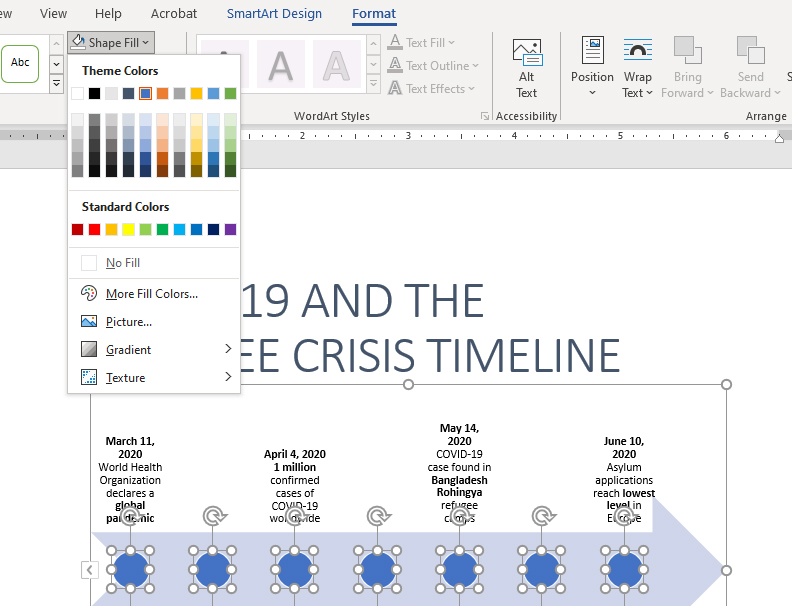
Additional tip: inserting icons
Under the insert menu, pick the icon drop-down and search for appropriate entries. You’ll need to change how they are aligned by bringing them in front of the text under the graphics format menu. Change the color there, too.
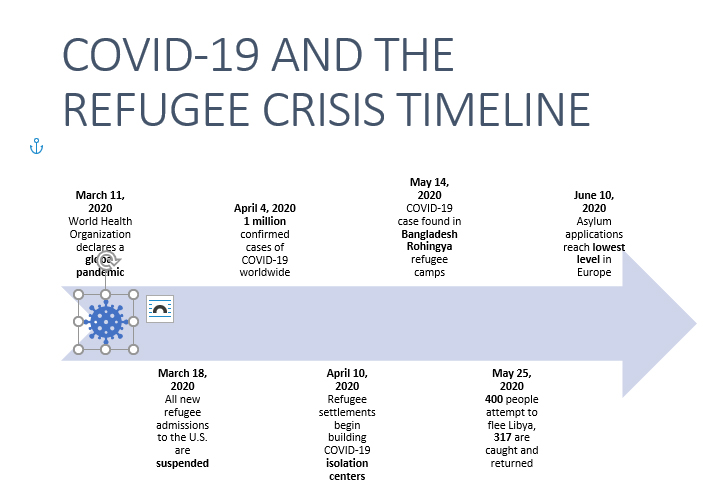
In addition to not having a huge supply of icon options, having to do so many manual adjustments made this SmartArt graphic not quite smart enough for us.
Finished product: Hard to read
The final result is hard to read because the text automatically adjusted to make room for each entry. Writing the text and having it appear was a nice time-saver, but those time savings were completely erased by the other adjustments I had to make.
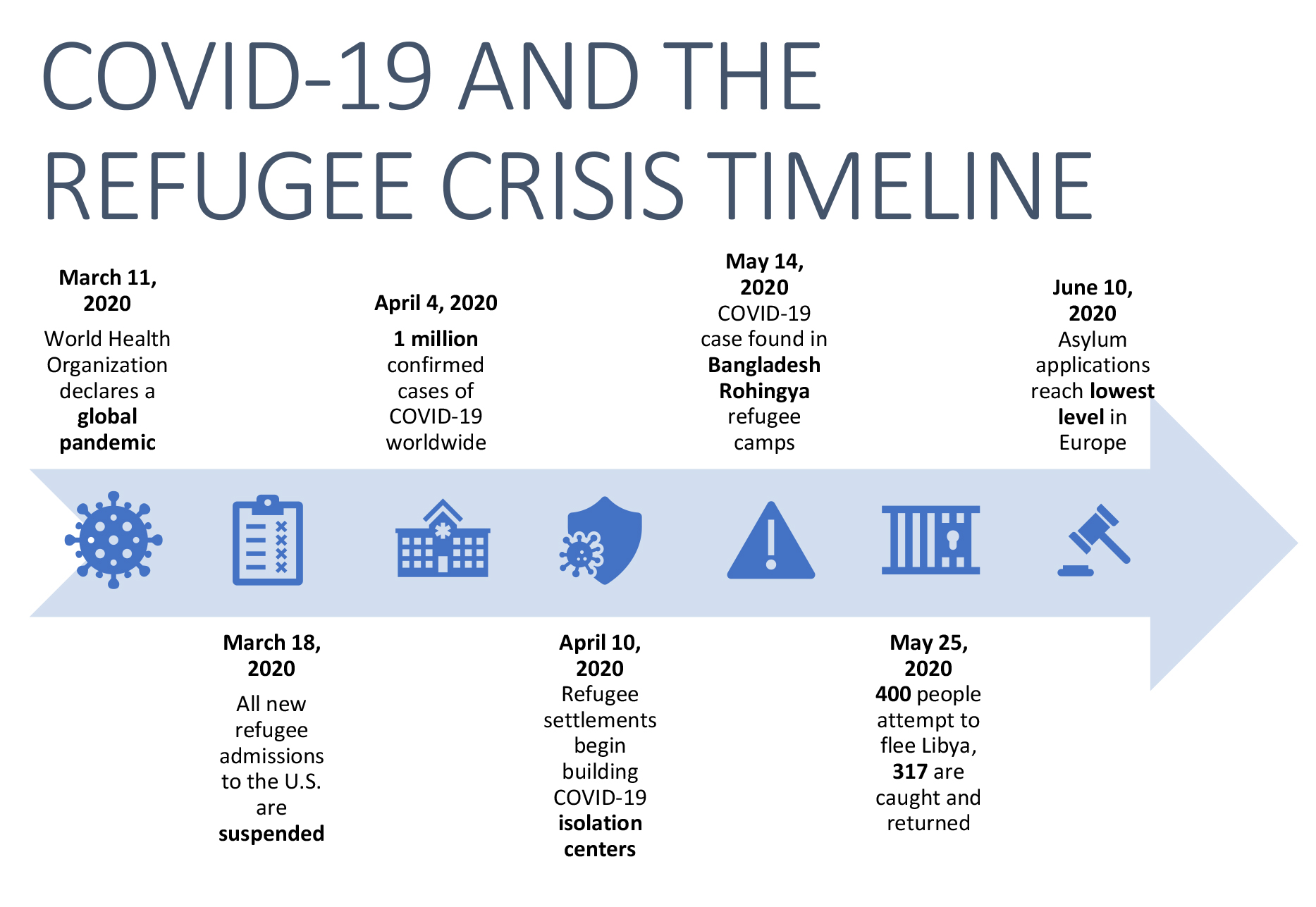
Here’s the simple, news-y timeline design I was trying to replicate. The manual route got us much closer to this finished product, but in both cases, the experience was clunky and time-consuming and ultimately not as effective as this version.

Related: 40+ Timeline Template Examples and Design Tips
How to customize a timeline in Word so it looks better
Once your timeline is set up, a few small tweaks can make it look a lot more polished and way easier to read.
Change colors and SmartArt styles
Start by simplifying your color choices. Using one consistent palette (ideally 2–3 colors) keeps everything cohesive instead of chaotic. SmartArt styles can give you a quick visual upgrade and using one accent color for key milestones helps guide attention without overdoing it.
Adjust fonts and text size
Fonts matter more than you’d think. Stick to one font for headings and one for supporting text and bump up the size of dates or key events slightly so they stand out.
A few quick rules that help immediately:
- Keep labels short (long text breaks the layout fast)
- Avoid cramming too much into each milestone
Common friction you’ll notice:
- Text starts shrinking as you add more milestones
- Labels wrap awkwardly and become harder to scan
Add a clear title
Give your timeline a clear, descriptive title at the top. It doesn’t need to be fancy, just specific enough that someone understands it at a glance.
Improve spacing and milestone placement
This is where your timeline really starts to look “designed” instead of thrown together.
- Switch to landscape orientation for horizontal timelines so you have more space
- Use portrait (vertical) when you’re limited by page width
- Keep spacing between milestones even
- Align milestone positions consistently so the flow feels intentional
Common friction here:
- Alignment can drift when you drag elements around
- Getting icons to sit nicely often takes more manual tweaking than expected
Keep the timeline readable
This is the part most people overlook. The goal isn’t to fit everything, it’s to make it easy to follow.
- Use one consistent color palette
- Keep labels short and scannable
- Avoid overcrowding (less really does look better)
- Leave enough white space between elements
When too many milestones are added, everything starts to fall apart: text shrinks, spacing tightens, and the timeline becomes harder to read. Keeping things simple makes the biggest difference.
Timeline vs. Gantt chart: What’s the difference?
These two often get mixed up, but they serve different purposes:
- Timeline
- Focuses on high-level milestones or key events
- Shows what happens and when, in a simple visual format
- Great for presentations, reports, or overviews
- Gantt chart
- Breaks projects into detailed tasks over time
- Shows overlaps, durations, and dependencies between tasks
- Helps track progress and manage more complex workflows
- Using Word
- Works well for creating simple timelines with SmartArt or templates
- Not designed for detailed project tracking or dependency management
- For Gantt charts, more specialized tools are usually a better fit
When Word is the right tool for a timeline and when it isn’t
Word works well for timelines but only within a certain scope:
- Use Word when you need:
- A simple visual timeline inside a document or report
- A clean way to show milestones or key events
- Something quick to create, edit and share without extra tools
- Use another tool when you need:
- Complex project planning with multiple tasks and moving parts
- Dependencies or overlapping timelines
- Frequent revisions or real-time collaboration
- A true Gantt chart with detailed tracking features
In short, Word handles straightforward visuals nicely but once your timeline starts functioning like a full project plan, it’s worth switching to a more specialized tool.
| Method | Time required | Ease of editing | Visual quality | Best for |
|---|---|---|---|---|
| Word SmartArt | Fastest | Easy for basic edits, limited for layout control | Basic but clean enough | Simple visuals in reports, proposals, resumes, and lesson plans |
| Manual shapes in Word | Moderate to slow | Flexible, but adjustments can get fiddly | Can look polished with enough tweaking | Custom timelines with a small number of milestones |
| Downloadable template inserted into Word | Fast | Easy if the template is editable | Usually more polished than SmartArt | Quick timelines that need to look more professional |
| Venngage / dedicated design tool | Fast to moderate | Easier for visual editing and layout changes | Most polished | Presentation-ready timelines, branded visuals, and designs to insert into Word |
How to create a timeline for Word in Venngage
Creating a Microsoft Word timeline in Venngage is easy and intuitive. Thanks to the new smart list features and smart templates Venngage is rolling out, it’s even quicker and more streamlined to bring your vision to life.
Step 1: Sign up for a free Venngage account
You can sign up with your email, Gmail or Facebook account.

Step 2: Select a timeline template from our templates library
Aside from the ones I’ve shared above, there are also hundreds of timeline templates you can easily edit even if you have no design skills.
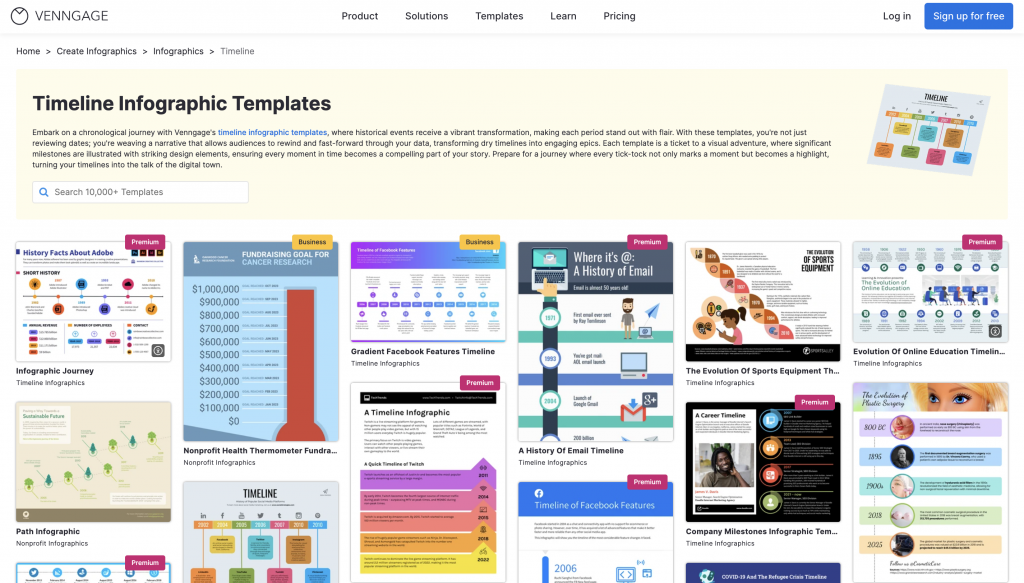
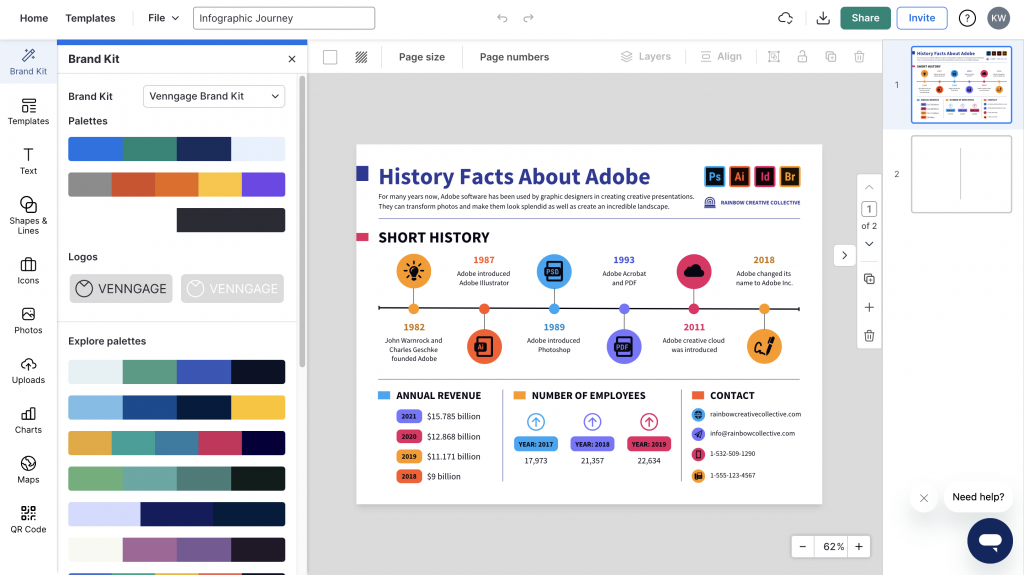
Step 3: Start editing your timeline with our smart timeline editor
Most of our templates are created with the simple drag-and-drop editor that lets you design in minutes, even if you have no design skills.
Venngage is also rolling out new smart templates with the smart editor which makes it easy for you to add new nodes/branches to your timeline.
You can add, edit, delete or drag nodes, texts, icons around in one click, and the node will automatically adjust to whatever content you add to it as well.

Step 4: Liven up your timeline with icons, illustrations and branding elements
There are over 40,000 icons and illustrations for you to visualize any information you want on your flowchart.
If you upgrade to a Business account, you can enjoy My Brand Kit—the one-click branding kit that lets you upload your logo and apply brand colors and fonts to any design.
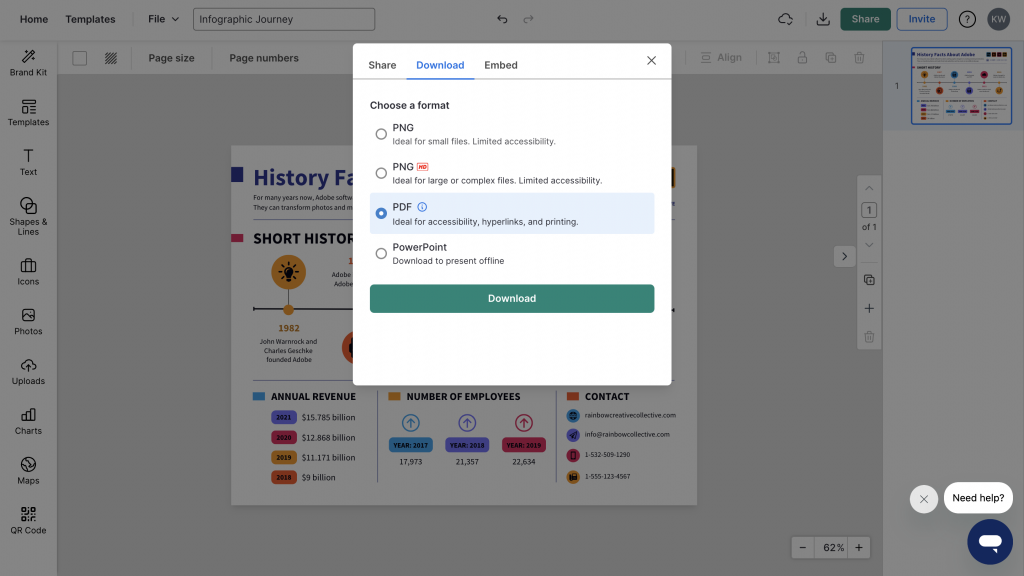
Once you upgrade, you can download your timeline as a PNG file that you can insert to your Word document. After you’ve downloaded, feel free to go back and make edits any time.
You can also export your timeline in PDF, Interactive PDF or PowerPoint format—if you want to use it for your presentation.
FAQ About timeline templates in Word
Does Word have a timeline template?
Word doesn’t offer a dedicated “timeline template” library by default, but you can create timelines using SmartArt graphics or download editable timeline templates online. SmartArt is the quickest built-in option, while templates give you more flexibility with layout and design.
Where do I find Microsoft Office timeline templates?
You can find timeline templates directly within Word by searching in the template gallery when creating a new document, or browse additional options on Microsoft Office’s online template library. Many third-party sites also offer downloadable Word-compatible timeline templates.
What is the best Microsoft app to make a timeline?
It depends on what you need. Word works well for simple, visual timelines inside documents. For more detailed or data-driven timelines, Excel or PowerPoint often provide better layout control. For complex project timelines, specialized tools are usually a better fit.
Can I make a Gantt chart in Word?
You can create a basic Gantt-style chart in Word using shapes or tables, but it requires manual setup and isn’t ideal for ongoing updates. Word isn’t built for tracking dependencies or managing schedules, so dedicated project management tools are more effective for true Gantt workflows.
Choose the fastest way to make a timeline for Word
If your goal is to add a clean, readable timeline to a Word document without wasting time on manual formatting, the best approach is to start with the simplest format that fits your content.
For quick, straightforward timelines, Word gets the job done. SmartArt is the fastest built-in option, and ready-made templates can save you even more time by handling the layout for you. What matters most isn’t adding more design, it’s choosing a layout that keeps your timeline clear and easy to follow.
If you need something more polished or easier to adjust over time, templates give you a better starting point without the risk of overcrowding your design. And if your timeline involves frequent updates, detailed scheduling, or dependencies, that’s usually a sign you’ll be better off using a more specialized tool.
At this point, you can choose the right format, avoid clutter, and build a timeline that actually fits your document instead of working against it. If you want a more polished visual to drop into Word, you can start with a template or create one using Venngage Timeline Maker.