

![How to Write a Case Study [+ Design Tips] Blog Header](https://venngage-wordpress.s3.amazonaws.com/uploads/2021/08/How-to-Write-a-Case-Study-Design-Tips-Blog-Header.png)
You need an impactful medium to share your business successes with potential customers and partners. The best way to showcase your brand is by designing a case study.
Case studies are a method of research and storytelling. They help readers gain a better understanding of a subject or process.
In this guide, we’ll explain how to write a case report that markets your business, as well as some design tips.
Don’t know how to start designing case studies? Create a case study with Venngage’s templates. No design experience required.
What is a case study?
Case studies are defined as documents that examine a person, groups of people, events, operations and processes to analyze real-world problems, issues, or theories. A case study is used in business, psychology, epidemiology, as well as the medical and scientific fields. These reports are also used for social and political work.
For marketing purposes, a case analysis can be a document that outlines problems faced by a customer. It also shares the solutions a brand provided to solve them, such as in the case report below.
Let’s see an example. McKinsey’s case study on Starbucks details how the coffee giant partnered with them to develop an Inclusive Spaces Framework. The case study explains how McKinsey helped Starbucks surpass ADA standards by using heatmaps to identify exclusion points (like entryways and restrooms), involving people with disabilities in design, and implementing features such as wider aisles, varied lighting zones, and accessible tools.
Another example is Venngage’s case study on Colorado State University’s College of Health and Human Sciences (CHHS). Venngage’s accessibility-first templates, real-time checker, and intuitive editor slashed organizational chart creation by 95% (saving 2-3 hours per project), empowered non-designers, and sparked a campus-wide inclusivity culture.
Here’s how a case study structure looks like:

Case studies usually share success stories for a business partnership or client. But case reports can also be used to analyze a process that went wrong.
This type of study will outline the need for improvements and suggest next steps. As a result, these case studies are not shared externally.
You can look at some case study examples for inspiration to design your report. Read on to learn about the importance of case studies and how to write them.
Related: What is a Case Study? [+6 Types of Case Studies]
What is the purpose of a case study?
Case studies are effective marketing tools that build trust and act as social proof for your brand.
Customers are more likely to choose your company if they know that other businesses like theirs have also benefited.
More importantly, when a customer participates in creating a case report with a brand, they endorse the company and their experience with it.
In other words, a business report, like the example below, acts as a recommendation to anyone on the fence about working with your brand or using your products.

Here are key purposes of a case study:
- Documenting a process: Its primary job is to record exactly how a specific situation was handled from start to finish.
- Providing a detailed reference: Case studies can also serve as a deep-dive resource for anyone who needs to understand the “how-to” of a complex project.
- Validating the solution: It proves that your product or service works in a real-world environment, not just in a sales deck.
- Overcoming objections: By showing a similar client who had the same doubts or hurdles, you proactively answer a prospect’s “but will it work for me?”
- Shortening the sales cycle: Providing a detailed roadmap of a previous win helps a lead make a decision faster because the risk feels lower.
Related: Report Design Ideas to ENGAGE Readers [10+ Tips & Templates]
What is the format of a case study?
A case study can be of varying lengths. It can also take a variety of forms, such as a simple two-page document or a Venngage business infographic like the one below.

A standard business case study follows a narrative arc. It focuses on the problem first, how you solved that problem and then the results. It’s essentially a “before and after” story that proves you solved a specific problem.
Here are the key components of a case study:
1. Executive summary
Think of this as your “elevator pitch.” It’s a high-level overview—usually 2 to 3 sentences—that captures the client’s name, the core problem, and the most impressive result. Busy readers should be able to stop here and still understand the value you provided.
2. Client profile
Before diving into the “story,” give some context. Briefly describe who the client is, their industry, and their size. This helps a prospective lead think, “They’ve worked with companies just like mine,” which immediately builds rapport.
3. The challenge or problem statement
This is the “villain” of your story. Don’t just list a surface-level issue; dig into the consequences. If they had low website traffic, explain how that was hurting their bottom line or causing them to lose out to competitors. This sets the stage for a high-stakes solution.
4. The discovery or strategy phase
This is a “behind the scenes” look at your brain. Explain the specific research, audits, or frameworks you used to identify the root cause. Showing your thought process proves you aren’t just guessing—you’re a strategist with a repeatable method.
5. The implementation or solution
Detail the specific actions you took. Instead of a vague “we did SEO,” break it down into “we optimized 50 high-intent pages and overhauled the site architecture.” Use this section to showcase your unique tools, workflows, or creative “pivots.”
6. The results and key metrics
This is the most critical section. Move beyond vanity metrics and focus on business impact. Use a mix of hard data (e.g., $10k saved per month) and soft data (e.g., improved team morale).
Alternatively, go down a more visual route by using data visualizations to showcase your results. You can use different types of charts and graphs or use a single number or donut chart.
This case study template is a great example of how to highlight results.

Related: How to Choose the Best Types of Charts
7. The client testimonial
A well-placed quote acts as an unbiased third-party endorsement. The best testimonials aren’t just “they were great,” but rather “before working with them we struggled with X, and now we have Y.” It adds an emotional layer to the technical data.
8. Conclusion and future outlook
Briefly wrap up by mentioning the long-term impact of your work. If the project opened doors for future growth or if the client is still seeing gains months later, mention that. It shows you care about sustainable success, not just a one-off project.
How do you write a business case study?
Writing a case study requires research and revision. First, decide the objective before you start writing.
Case studies in marketing, like the below example, are meant to highlight your company’s successes. Choosing a client to showcase is also an important step in the writing process.

Below, we share the top steps to complete when writing a case study to promote your business.
Step 1: Determine your objective
Before you start writing case studies, decide what the main objective for this exercise is. Case reports don’t have the potential to go viral, nor are they shareable on social media.
But a case study is an effective tool for converting prospects into customers. They can also encourage business partners to take that final step and sign on the dotted line.
You need to approach your case analysis differently than all other content. This is why you need to have an objective for undergoing the process of writing a case study. Your objective could be:
- Showcasing your results: Highlight the specific, measurable wins you achieved for a client to prove your value.
- Building authority in a niche: Demonstrate deep expertise in a particular industry so you become the go-to expert for those types of projects.
- Explaining a complex process: Walk the reader through how you solve difficult problems, making your workflow easier to understand.
- Supporting the sales team: Create a library of proof that helps close deals by showing potential customers exactly how you’ve helped others.
- Testing a new strategy: Document the effectiveness of a new service or framework to see if it’s worth scaling.
- Addressing customer pain points: Focus on a very specific hurdle your audience faces and show the exact steps you took to clear it.
For example, this report shows how the fictional company Toy Crates used the services of Ad Factory to significantly increase its sales.

The main objective of your case study is to highlight your business processes. You should also show the benefits of using your product. But there needs to be a relatable angle for whoever is reading your study.
Possible angles for a case study can be:
- Audience growth
- Launch of a new type of product
- Entry into a new market
- Improvements in conversion rates
- Increased revenue
- Increased traffic or social media impressions
- Technology or software adoption
This case study focuses on lead generation. The report showcases the efforts behind boosting the client’s lead generation program and the successes achieved.

Once you determine the best objective for your analysis, you can move onto the next step. Look for a client that best showcases positive aspects of your company.
Step 2: Choose the right client
You need a particular type of client as the subject of your case study. This client will be a loyal customer. They should be willing to participate in the study. The client should also align with the objective of your study.
Pick a customer who knows your product inside and out. They should not be someone who used your product once and had success with it.
You want to showcase consistent and high-quality results over a period of time. In this example, the fictional Ad Factory also showcased Loot Box as a client that had success with their brand.

You also want to choose customers who have had success directly from using your product. If a brand has seen overall growth and your product was just part of that success, it won’t make for a compelling case study.
Step 3: Contacting your client for the case study
The customer you choose for your case study should know what the process entails.
Be open in your communication about what you need to put together the case report. This could be communicated through calls, email conversations, or a project management tool.
Set a deadline and share a project timeline so the client knows what the process will look like. Let them know what documentation or statistics you will need for them before you start writing.
Offer something in exchange for participating in the case study. These could be product discounts, a temporary upgrade, a mention in your newsletter, social media, or increased brand awareness.

It is imperative that you let the customer know how their information and data will be used. Tell them if you’re posting the case analysis to your blog, sharing it on YouTube, or with your email subscribers.
Some clients may not want their professional information shared with large audiences, so clarify this step of the process first.
Related: 40+ Timeline Template Examples and Design Tips
Step 4: Research your case study
Once your client agrees to participate in the case analysis, you can begin researching. Remember the objective of your case study and research the subject accordingly.
For example, we wanted to show how infographics help businesses grow their audience. We contacted our user, ChadSan, who had seen massive growth after adding infographics to their marketing campaigns.
We put our findings into a research infographic along with quotes from the client, charts and graphs.

To do this, we researched the content ChadSan created before and compared their traffic to when they started using infographics.
It’s also important to look at the industry your client is in so you have an idea of what success looks like in that sector.
Step 5: Conduct client interviews
Conducting interviews with clients is a good way to get information for your case report.
You can hold interviews via video call, which you should record to double-check later or conduct the interview via email.
Email interviews might require follow-ups if you need further clarification on particular questions.
Asking the right questions is crucial during the research phase. You don’t want ‘yes’ or ‘no’ as an answer. You need qualified information and data to build out a case study, like the one below.

For example, we asked our contact at ChadSan for her experience using infographics in her marketing. We also asked about her main challenges, why she had chosen Venngage and the benefits of using Venngage.
This is also the stage when you can ask for concrete examples of how your product benefited your client.
We asked ChadSan to share some examples of the infographics they had created using our templates. This helped show our product in use, further social proof of the advantages of using Venngage infographics.
Step 6: Create the case study outline
With the client interview completed, gather the data you have and start writing the outline for the case report. Remember the case study format we shared earlier when you’re preparing the outline.
This will help you design a case study that is memorable, like this example.

For a case study blog post, you should prepare the following:
- Title
- Subtitle
- About the company
- Overview of the study
- The results, with charts
- Call to action
Write a few notes for each point that you can elaborate on in the next writing stage. By following this process, you can build out a case study like this example.

Step 7: Draft your case report
The outline is your starting point for drafting the case report. Like any other piece of content you create, a case study needs to be engaging. It also needs a beginning, a middle and an end.
Use classic marketing storytelling approaches when writing case studies. Introduce your characters (the client), the conflict (the business problem), the resolution (the benefits of your product).
By using this technique, you can write a case study like this example.

Conclude with an analysis of your success and a testimonial recommending your product and brand.
Designing a case study manually can take a lot of time, especially when you need to add data and visuals. To ease the load, you can try Venngage’s AI Case Study Generator. All you need to do is enter a text prompt and it will create a case study for you in seconds. Once it’s generated, you can customize it to fit your requirements.
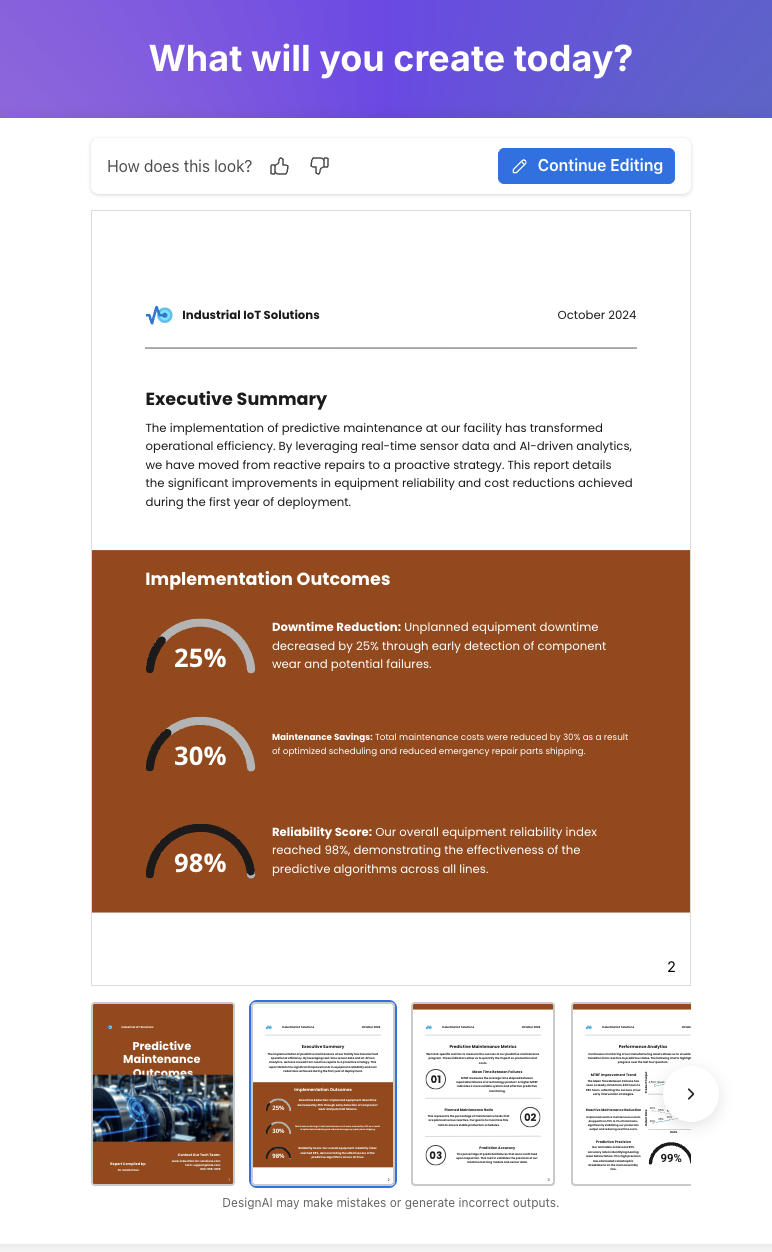
Another option is to use one of Venngage’s pre-designed case study templates and edit it easily using the AI Design Assistant.

Venngage’s AI Case Study Generator helps you with:
- Smart data visualization: You can import data directly from Google Sheets or Excel, and the tool will automatically generate charts that match your case study’s design.
- Brand kit integration: To keep things consistent, you can use the Brand Kit feature to automatically apply your brand colors, fonts, and logos to any template or AI-generated draft.
- Interactive elements: If you’re sharing your case study digitally, you can add interactive links, videos, and hover-over effects to make the data more engaging.
- Collaboration features: You can invite team members or clients to comment on the draft or edit in real-time, which helps speed up the approval process.
- Export for any format: Once you’re done, you can export your work as a high-quality PDF for printing, a PNG for social media, or a shared link for your website.
Step 8: Finalize your case study
Revise your study and ask one or two colleagues to glance over it to catch any mistakes you may have missed.
You should send the report to the client you’re showcasing for their approval. When you and the client are satisfied with the case study, an infographic study like the one below is ready to be published.

Share a link to the case study with the client to promote on their platforms. You can share the case report on your social channels, with partners and to your email subscribers.
Related: What is an Infographic? Examples, Templates & Design Tips
Case study design tips
Now that you know how to write your case report, here are some tips on case study design. Improving the aesthetics and usability of your study will make it memorable to read. In the long run, the study will help boost brand awareness.
Use a case study template
Make the case study design process easier by using a template. Venngage offers a variety of customizable case study templates, like this one, to make any study attractive and engaging.
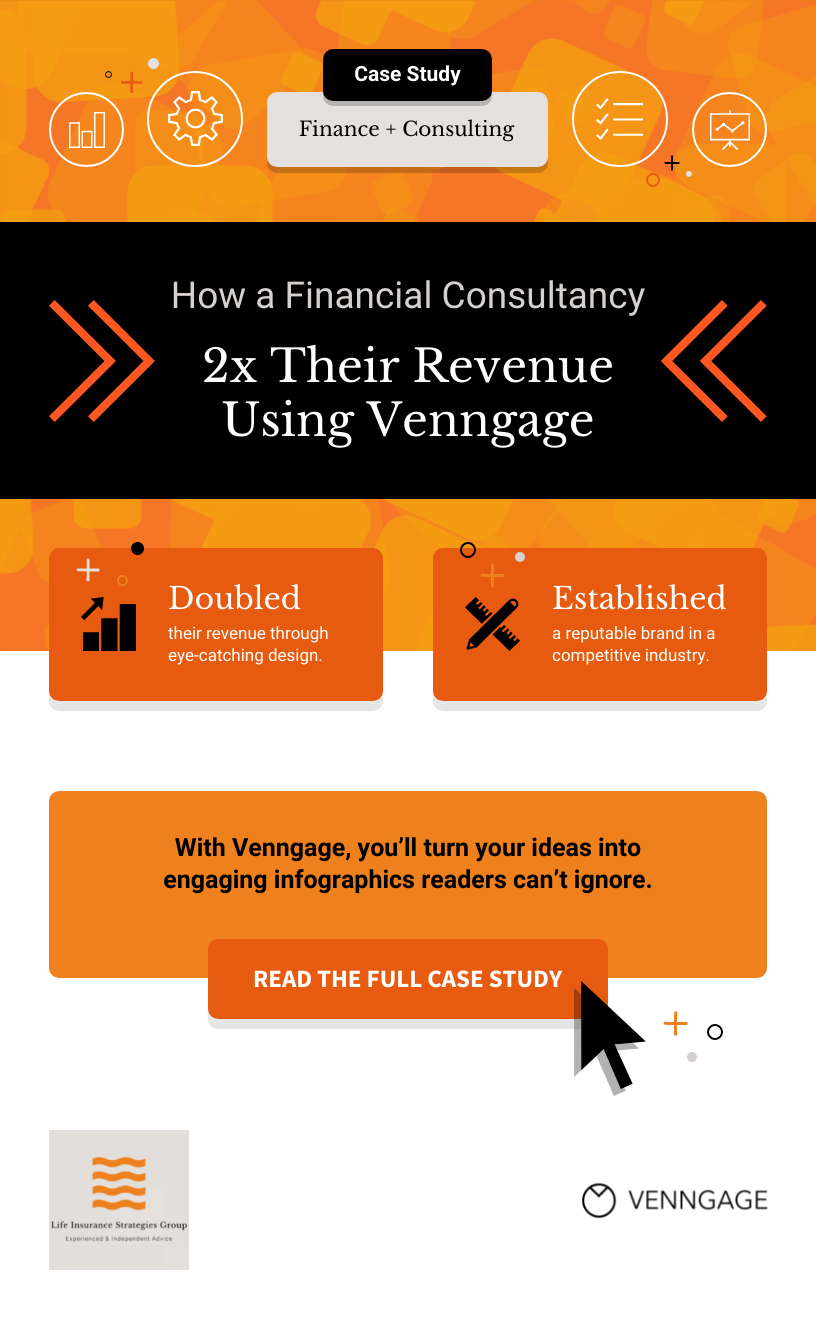
Incorporate white space
A great way to make your case study engaging is to incorporate one important rule of design: use plenty of white space.
White space is all the blank areas around your text and visuals. This space gives your information room to breathe and makes it easier for readers to absorb your story.
Take a look at this template for inspiration. There is plenty of room around each element. This makes the study easier to navigate.

Write short paragraphs of two or three lines and use bullet points to create more space around your text. Leave room around your visuals, as well, so users can move through the sections easily.
Related: The Ultimate Guide to Design Thinking
Visualize data for your case study
Case studies include a great deal of information but that doesn’t mean they need to be packed full of text. Visuals are a great way to catch the eye and keep users interested in your report.
Statistics are a key element of case reports but numbers on their own can get lost. Instead, visualize your data using Venngage’s Chart Maker and Graph Maker.
Design pie charts, bar graphs, donut charts, line and area graphs, or maps to visualize numerous types of data for your case studies, like in this example.

Related: How to Tell a Story With Data: A Guide for Beginners
Add branding to case reports
Branding is an important facet of case reports. Anybody reading the study should know which companies were involved, both the client and your brand.
Add recognizable brand elements such as your logo and the client’s logo. Use your brand colors and brand fonts throughout your case study design.
Ensure that your design adheres to your brand guidelines, including your brand voice.
Take a look at this case study infographic Venngage created with Baptist Care. We incorporated both our logos in the infographic. We also used the brand colors and fonts of both companies.

Common mistakes to avoid while writing case studies
To keep your case study professional and effective, here are some common mistakes you should avoid:
- Making it too long: If you provide a wall of text, people will skip it. Keep your points concise and use bullet points to make the content scannable.
- Focusing only on yourself: The client should be the hero of the story. Focus on their journey and how your partnership helped them win, rather than just listing your own features.
- Using too much jargon: Write for the decision-maker, not just the technical experts. Keep the language clear and direct so anyone can understand the value.
- Forgetting the visuals: A case study without charts or screenshots can feel dry. Use visuals to prove your data and break up the text.
- Vague results: Avoid phrases like “improved significantly.” Use hard numbers and specific metrics to show exactly what changed.
- Ignoring the “before” state: If you don’t clearly explain how bad the problem was at the start, the solution won’t seem as impressive.
- Leaving out a call to action: Don’t forget to tell the reader what to do next. Whether it’s booking a call or downloading a guide, give them a clear next step.
Case study FAQs
What subjects are covered in a case study?
Depending on the field of study, case reports can examine a variety of subjects, including:
- a person
- a group of people
- an event
- a location
- an organization or business
For example, case studies in psychology may be focused on a person or groups of people. Medical case reports might study events or groups of patients.
Businesses can examine other organizations, as in this example, or events.

What are the characteristics of a case study?
Case studies are characterized by the units or subjects they examine. These units need to be studied in totality. Every aspect of the person, organization or event needs to be included.
Reports should also be qualitative as well as quantitative. This means that case study research describes problems and solutions.
It also backs those assumptions up with data. Both aspects must be included in the analysis, as in this example.

How can you design a case study with Venngage?
Venngage makes it easy to design case studies by offering numerous editable templates. Create an account with Venngage and browse the library for a template.
Customize the template, like the one below, in the easy-to-use drag-and-drop editor. Add text, pick colors, icons, add photos and charts and graphs.

What is the ideal length of a business or marketing case study?
Most effective case studies land between 500 and 1,500 words. You want enough detail to prove your point without losing the reader in fluff; if it’s for a slide deck, keep it to one or two punchy pages.
What key elements should every case study include?
Every strong story needs a clear challenge, a specific solution, and measurable results. Don’t forget to include a direct quote from the client to add a human touch and extra credibility.
How do you choose the right topic or client for a case study?
Pick a client who had a recognizable problem and saw a clear, data-backed “win” because of your work. Ideally, choose a brand or situation that your future “dream clients” can relate to.
How should a case study be structured for maximum clarity and impact?
Stick to the classic “Challenge-Solution-Results” framework. Use clear headings, bullet points for readability, and a strong summary at the very beginning for people who just want to skim.
How do you present case study results to make them more convincing?
Use hard numbers and percentages rather than vague phrases like “we improved things.” Visualizing that data with charts or “before and after” snapshots makes the impact feel much more real.
What tools can help you create and design a professional case study?
Design platforms like Venngage are perfect for creating professional layouts without needing a degree in graphic design. For gathering the data and quotes, simple tools like Google Forms or Zoom interviews work best.
How can case studies help with seo and lead generation?
They act as “long-tail” keyword magnets because they often mention specific industry problems and niches. When prospects search for a solution to a problem you’ve already solved, your case study shows up as the perfect answer.
Use a case study to highlight your brand’s successes
A case study can be a powerful marketing tool that showcases the advantages of using your product.
By highlighting real clients and their successes, you can provide social proof to potential customers and partners.
Designing case studies has never been easier. Use Venngage’s templates to create engaging reports to impress your audiences and help you grow your client base.