

ChatGPT business proposals definitely stand out, but not in a good way. It mostly happens because people open a blank chat, type “write me a business proposal for [client],” add a little context, and send it ahead. When it lands in the client’s inbox, they already know it’s AI from the writing, formatting and structure.
So, how do you write a business proposal with ChatGPT without giving it away? First, you need a solid brief and prompts. Second, it requires ruthless editing.
This guide covers the step-by-step process, tips and checklists to keep in mind while creating a business proposal using ChatGPT. I’ll also share prompt templates and examples to help you create a solid business proposal.
Can ChatGPT write a business proposal? (Yes — with guardrails)
Yes, ChatGPT can write a business proposal. If you’re writing one for the first time and don’t know where to start, or you’re short on time, ChatGPT can help you create a first draft, However, you’ll need to edit it thoroughly.
What ChatGPT is great at while generating business proposals:
- Producing an overall proposal structure
- Writing the first draft
- Generating tone variations of the same section
- Summarizing discovery call notes into a clean executive summary
- Generating options when you’re stuck (three different ways to phrase scope, two pricing structures to choose from)
That said, don’t rely on ChatGPT to create a final business proposal you can send to the client directly. ChatGPT, or any other generative AI tool for that matter, can’t draft a complete, comprehensive proposal on its own. You need to guide ChatGPT and edit the business proposal before finalizing it.
What ChatGPT can’t do reliably:
Here’s what to look at carefully when you generate a business proposal using ChatGPT:
- Overall structure: It’ll give you a sensible default structure, but it may not match what the client expects, especially for things like RFP responses, technical proposals, grant applications, or industries with strict formatting conventions such as legal, healthcare, government, or finance.
- Any statistics: ChatGPT can fabricate plausible-sounding numbers. OpenAI’s September 2025 research paper confirmed that ChatGPT can hallucinate and give you fake numbers and data. So make sure to verify every number mentioned in the business proposal.
- Case studies: If you ask for a relevant case study, ChatGPT might invent one. Replace the template with a real example from your work.
- Legal terms and conditions: Anything binding, including the scope of work, payment schedules, liability clauses and acceptance criteria, needs your review and ideally a thorough check by a legal professional.
- Client discovery notes: If you don’t feed it discovery notes, it fills the gaps with generic assumptions.
- Em dashes. Nothing against em dashes, but ChatGPT overuses them. A proposal full of em dashes is one of the clear indicators that you used ChatGPT for drafting it. Search for em dashes in the document and replace them as you edit.
Business proposal vs business plan (plus pitch deck + RFP response)
Before you create a proposal, a quick refresher on what you’re actually generating. ChatGPT often confuses business proposal with business plan, pitch decks or RFP. You might not notice until it’s halfway through writing the wrong thing.
A business proposal is a document you send to a specific client to sell a service or solution. A business plan is an internal or investor-facing document that maps your strategy, market and financials.
Here’s the quick distinction across all four:
These four documents have some overlapping sections (executive summary, problem statement, solution), but the purpose is different. A proposal closes a sale. A plan justifies a strategy. A pitch deck sells a meeting. An RFP response wins points against a scorecard.
Before you start prompting ChatGPT, tell it explicitly which one you’re writing.
Related: 7 Best AI Business Plan Generators in 2026 (Tested for Investors & Lenders)
What a winning business proposal should include (7 core sections)
Before you add a prompt to ChatGPT, create a rough list of everything you want to include in the proposal. This helps you generate section by section instead of asking ChatGPT to write the whole thing in one go (which is why it gives a generic output).
The business proposal structure and layout will vary depending on your industry, client and what you’re offering. But here’s the most common structure used across different industries.
The 7 core sections of a business proposal
- Cover and title page with client and project details. Client name, your company name, project title, date and your contact. Keep it clean. This is the first thing the client sees.
- Executive summary (outcome-led). A one-page summary of the proposal that opens with the outcome the client gets. Don’t add your company history here. Write this section last, after the rest of the proposal is locked.
- Problem or needs assessment. A clear statement of the problem you’re solving, the context around it and the cost of doing nothing. This is where you prove you’ve actually listened to the client.
- Proposed solution and scope. Your approach to solving the problem, the methodology you’ll use and a clear statement of what’s in scope. Also state what’s out of scope to avoid any disputes later.
- Deliverables and acceptance criteria. A list (or table) of exactly what the client receives along with the criteria for each deliverable to be considered complete.
- Timeline with milestones and dependencies. Project phases, key milestones, who owns what and what you need from the client (sign-offs, access, content) to hit each date.
- Pricing, assumptions and next steps. Your investment breakdown, what is covered in the pricing and one clear call to action.
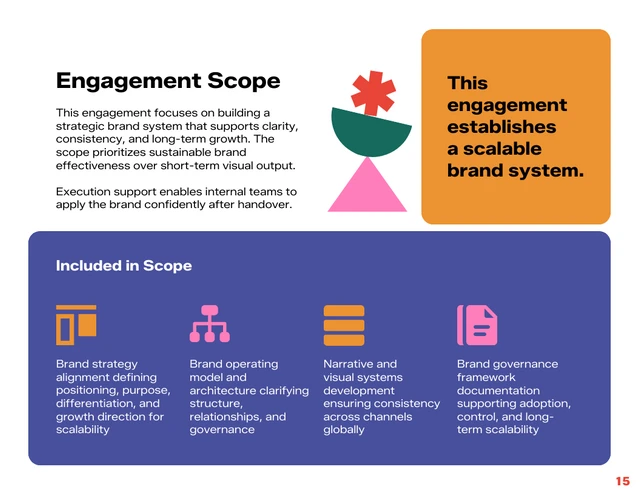
For example, this branding strategy proposal clearly outlines the project scope, explains how the strategy would support the client’s business goals, and includes a detailed timeline so the client understands what will be delivered at each stage of the project.
This proposal format works well for agencies, consultants, or freelance strategists pitching branding services to clients who want clarity on deliverables, timelines, and expected outcomes.
This is a generic proposal that small business owners or freelancers can use for clients across all industries.
If you want to make your business proposal more detailed, you can add a few more sections.
Optional sections (use when relevant)
- Proof: Case studies and testimonials similar to the industry or work client is looking for.
- Team bios: Helpful for service work where the people matter (consulting, design, dev). Skip for product-led proposals.
- Risk and mitigation: A trust-builder for higher-stakes deals. List the things that could go wrong and how you’ll handle them.
- FAQs: Useful if you’ve answered the same client questions across past deals
- Appendix: Supporting documents, detailed specifications and longer case studies
- Terms and conditions: Payment terms, IP ownership, cancellation and any other legal language. Get this reviewed before you reuse it
However, if you want to share a short business proposal, include only 5 sections: the problem, the solution and scope, the timeline, the pricing and a clear next step. Everything else is optional. These five are not.
Related: How to Write a Research Proposal Using ChatGPT (Step-by-Step + Prompts)
Step 0 — add the client brief to ChatGPT
The reason why ChatGPT might be giving you a generic business proposal is because it doesn’t have enough information. You need to give it a detailed brief about the client, industry, scope of work and other relevant details.
This is the precursor to generating a solid business proposal in ChatGPT. The more context you give it upfront, the better the draft.
Here’s a sample brief you can copy and edit. Give details the same way you’d brief a human proposal writer.
Client and industry
[Company name, size, sector, and the specific market they operate in.]
Decision maker and evaluation criteria
[Name, role, and the 2 to 3 things they’re scoring you on.]
Current problem and cost of inaction
[The problem in one line, plus what it costs them in money, time, or risk.]
Desired outcome and success metrics
[The specific result the client wants, and how it will be measured.]
Constraints
[Timeline, budget range, compliance, procurement rules, anything that limits the proposal.]
In-scope and out-of-scope
[Bullet what you’re doing, then bullet what you’re not. Both go in the proposal.]
Proof assets available
[Real case studies, testimonials, or named clients you can reference.]
Pricing model
[Fixed fee, retainer, milestone-based, time and materials, or tiered.]
Competitors or alternatives the client is considering
[Other vendors, in-house build, or “do nothing.”]
Tone and length
[Formal, conversational, or punchy. Plus page count target.]
Next step you want the client to take
[One specific action with a deadline.]
You can paste this brief in the master prompt I’ll share below.
I also ran a test to see whether adding a brief makes any difference or not. Let’s see what ChatGPT generated with and without a brief.
Without brief:

With brief:
As you can see, the output with the brief is more tailored.


The ChatGPT workflow to write a business proposal (5 steps)
Now I’ll take you through the complete workflow on how to write a business proposal using ChatGPT.
Step 1 — Set role, audience and constraints (master prompt)
The master prompt is the first message you send to ChatGPT. It tells ChatGPT who it is, what it’s writing and what rules to follow.
Here’s the master prompt you can copy.
You are a senior proposal writer helping me draft a business proposal for a client.
Use only the information I give you. Do not invent statistics, case studies, testimonials, client logos, or pricing. If anything is missing or unclear, ask me before assuming. Flag any assumption you make in [square brackets] so I can verify it.
Writing rules:- Match the tone and length from my brief-
Write in clear, plain English.
No buzzwords like “leverage,” “robust,” “synergy,” “cutting-edge,” or “game-changer”
No em dashes
No filler phrases like “in today’s competitive landscape” or “we are excited to”
Use short paragraphs and active voice
Lead with the client’s outcome, not our company history
I’ll share the intake brief next.
After you read it, confirm you’ve understood, then wait for me to ask for specific sections. Don’t write the full proposal until I ask.
Paste this first. Then paste the intake brief as your next message. ChatGPT should respond by confirming what it understood and waiting for instructions.
This sets up two things that matter for the rest of the workflow: ChatGPT has clear rules, and you control which section gets written when (instead of letting it dump 8 sections in one wall of text).
Step 2 — Generate a proposal outline (prompt)
Once ChatGPT has the brief, ask for the outline before any drafting. This catches structural issues early.
Prompt to copy:
Based on the brief, give me an outline for the proposal.
For each section, include: –
– The section title
– 2 to 4 bullet points covering what should go inside
– A recommended length (in sentences or paragraphs)
Don’t write the section content yet. Just the outline.
Review the outline against your brief. If a section is missing (commonly: out-of-scope items, assumptions, the specific next step), tell ChatGPT to add it. If a section is bloated, tell it to cut. Do this back-and-forth until the outline matches what you actually want to send.
This step takes 5 minutes and saves an hour of editing later.
Step 3 — Draft each section one at a time
Now you go section by section. Don’t ask ChatGPT to write the full proposal in one prompt. The output will be shallow on every section and you’ll edit forever.
Here’s the order that works best:
- Problem statement. Sets the stakes. Easy to write because the brief already has it.
- Proposed solution and approach. Your method for solving the problem.
- Scope, including what’s out of scope. The single most important section to get right.
- Deliverables. Ask for a table format with deliverables, description, and acceptance criteria as columns.
- Timeline with milestones. Ask for a table with phase, milestone, owner, and dependency as columns.
- Pricing. Include assumptions and (if it fits) two or three options.
- Proof and credentials. Pull from the proof assets in your brief. Don’t let ChatGPT invent any.
- Terms and next steps. Keep terms short and review them yourself. Make the next step one specific action.
- Executive summary. Write this last. You can’t summarize a proposal that isn’t written yet.
For each section, prompt like this:
Draft the [section name] for the proposal. Keep it [X paragraphs / a table / under 150 words]. Use only the details from the brief. Flag any assumptions.
Review each section as it comes out. Tighten before moving to the next one. If a section needs a tone shift, ask ChatGPT to rewrite it in that tone (instead of moving on with the wrong voice baked in).
Related: How to Create Infographics Using ChatGPT
Step 4 — Make the proposal persuasive
Follow these five tips to make your business proposal more compelling:
1. Rewrite the opening so it leads with the client’s outcome
The first paragraph is where 80% of clients decide whether to keep reading. Most ChatGPT proposals open with your company’s history, your years of experience, or a generic “we are excited to present this proposal.” None of that is about the client.
Lead with what the client gets. Use their words from the brief.
Avoid:
We are a full-service marketing agency with over 10 years of experience helping businesses grow. We are excited to present this proposal for your social media management needs.
Do:
You want to grow Instagram followers from 1,200 to 3,000 in 90 days and bring weekday foot traffic up by 20%. Here’s how we’ll get you there in the next three months.
2. Turn features into specific deliverables
Make every deliverable specific enough that the client knows exactly what they’re getting.
3. Place proof where doubt shows up
Most proposals dump testimonials at the end in a “what our clients say” section that nobody reads. Move them.
The right place for proof is wherever the client is most likely to hesitate. Two spots usually matter most:
- Right after pricing, especially if you’re at the top of their budget range. A testimonial from a similar client about ROI quiets the price objection.
- Right after the scope, if you’re proposing something the client hasn’t done before. A case study of a similar project quiets the “will this actually work” objection.
Don’t quote a generic five-star review. Quote the specific result.
Avoid:
They were great to work with. Very professional!
Do:
We went from 800 followers and zero foot traffic from Instagram to 2,400 followers and an average of 30 new customers a week, mentioning the page. Took 75 days.
4. Write a compelling call to action (CTA)
ChatGPT closes proposals with “We look forward to hearing your thoughts.” That’s not a CTA.
A clear CTA has three parts:
- One specific action (sign, reply, book)
- A date
- What happens after
Examples:
- Reply ‘yes’ by Friday. I’ll send the agreement and a kickoff call link for Monday
- Sign and return the agreement by Nov 1 to lock the December start.
- Book a 20-minute call [link] by Friday to walk through this before you take it to your team.
- Reply with ‘go ahead,’ and I’ll start Monday. First invoice goes out the same day.
- Pick a tier and reply by Wednesday. I’ll send the matching agreement within 24 hours.
Step 5 — Edit, validate and finalize the business proposal
Before sending, confirm:
- Scope of work is exact (in-scope and out-of-scope both listed)
- Deliverables and acceptance criteria match what was discussed
- Timeline, milestones and dependencies are accurate
- Pricing matches what you actually charge
- Payment terms are correct (amounts, dates, milestones)
- Client name, company name and decision-maker name are correct everywhere
- Contact details (email, phone, address) are correct
- Case studies, testimonials and stats are real and verified
- Legal or finance has reviewed the terms and given a go-ahead
- No placeholder text left behind (“[insert X],” “TBD,” “[client name]”)
- Exported as PDF with a signature and acceptance block
- Filename includes the client’s name and the date
Step 6 — Design the proposal
Once you have the ChatGPT draft ready, the next step is designing it.
If you’re sending a short, simple proposal, you can use a business proposal template from Google Docs or Microsoft Word. Both have decent free templates you can edit. Format the draft, add a cover page and export to PDF.
For longer proposals, plain text gets harder to read. You’ll want to add visual elements like a cover page, a pricing table, a milestones timeline, and callouts for testimonials. AI design tools like Venngage can do this for you.
Venngage’s AI Proposal Generator turns a one-line prompt into a designed business proposal. Type the kind of proposal you need (industry, project type, length) and you get a customizable business proposal draft with a cover page, sections, tables, relevant images and icons.

You can easily also upload your ChatGPT draft as a DOC or PDF. Venngage pulls the text into a pre-built template and adjusts the layout to fit the information.
How to edit the business proposal in Venngage
Once the proposal is generated, you can keep editing it inside Venngage:
- Polish the writing. Use the AI writing assistant to fix typos, shorten long paragraphs, or rewrite sections
- Add tables and charts. Drop in a pricing table, milestones timeline, or a chart of project phases
- Apply your brand kit. Load your colors, fonts and logo once and apply them to every proposal
- Export or share. Download as PDF or send a shareable link
You can also start from a Venngage business proposal template if you’d rather edit an existing layout than generate from scratch.
If you want a particular design, check out Venngage’s business proposal templates. You can easily edit them using AI. Upload your proposal draft and guide the AI on the layout and other changes you want.
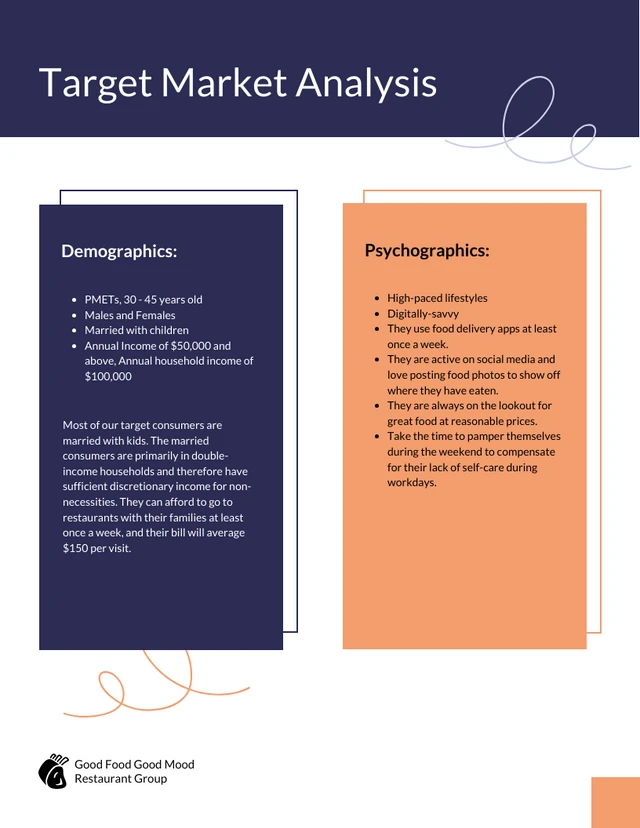
This business proposal template includes a cover page, executive summary, scope, target market analysis and pricing. Everything is editable, so you can swap in your own content, colors and visuals. It works well for marketing or consulting business proposals.
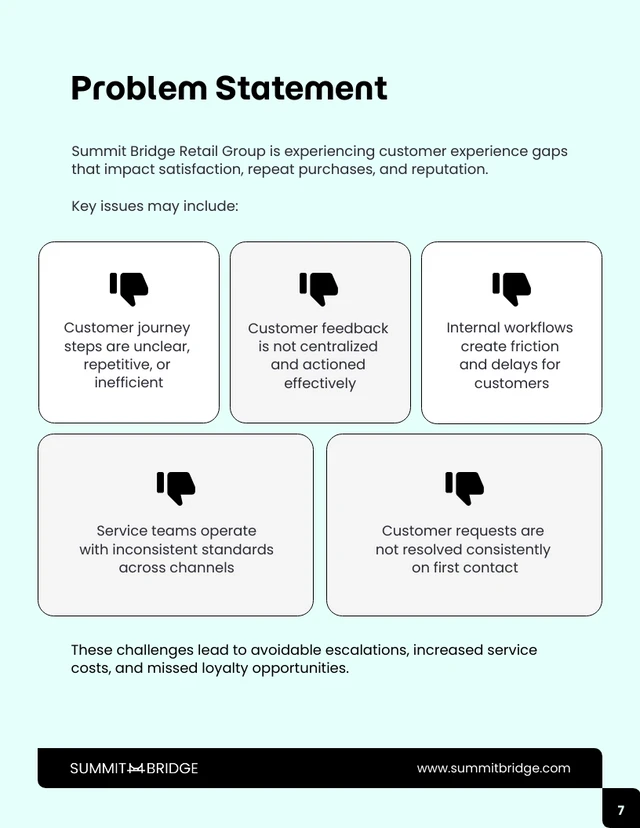
This 20-page business proposal template is designed for customer experience and CX-focused projects. It covers the standard sections like cover page, executive summary, strategy, and pricing, with extra space for analysis, case studies and visuals.
It works well for CX consultants, agencies, and service providers pitching long-form strategic projects.
Example #1 — a simple 1–2 page service business proposal
Here’s a 1-page business proposal for a freelance web designer pitching a small dental practice on a website redesign. The copy was drafted using the prompt pack above, then tightened by hand.
Copy each section into your own document and swap the placeholders for your client’s details.
Header
Website redesign proposal
Prepared for: Dr. Anna Patel, Bright Smile Dental Prepared by: [Your name], [Your business] Date: [Date]
The outcome
A faster, mobile-friendly website that helps Bright Smile Dental book more new patient appointments online. Live in 6 weeks.
Scope of work
- Custom 6-page website (Home, About, Services, Team, Reviews, Contact)
- Online appointment booking integrated with your existing scheduling tool
- Mobile-first design optimized for patients searching on their phone
- Basic on-page SEO so you rank for “dentist in [your area]”
- One round of revisions per page
- Two 30-minute training calls so your team can update content
Not included
Logo redesign, paid ad management, ongoing maintenance after launch, content writing (we’ll work from your existing copy). These can be added separately if needed.
Timeline
- Week 1: Discovery call, brand and content review
- Weeks 2-3: Design mockups and your feedback
- Weeks 4-5: Build and integrate booking system
- Week 6: Final review, launch and team training
Investment
$4,800 total.
Paid in three milestones: $1,600 at kickoff, $1,600 on design approval, $1,600 on launch.
Next step
Sign and return this proposal by Friday, [date] to lock the start date of Monday, [date].
After you sign, I’ll send the kickoff call invite and the first invoice within 24 hours.
Acceptance block
Accepted by:
Signature: ________________________
Name: ________________________
Date: ________________________
Example #2 — a detailed proposal (6-page equivalent) with scope + milestones
For higher-ticket projects, multi-stakeholder deals, or scope that needs detailed milestones, a longer proposal earns its length. Here’s a 6-page proposal for a freelance web designer pitching Bright Smile Dental on a multi-location website, booking system and local SEO package after their initial single-location redesign performed well.
Same client, bigger scope. Use this skeleton for any service-based proposal over ~$15,000 or with multiple phases.
Cover page
Multi-Location Website and Local SEO Proposal
Prepared for: Dr. Anna Patel, Bright Smile Dental Prepared by: [Your name], [Your business] Date: [Date] Proposal valid until: [Date]
Executive summary
Bright Smile Dental is opening two new locations in [City] over the next 6 months. The current website was built for a single location and isn’t structured to handle multi-location SEO, separate booking flows, or distinct location pages.
This proposal covers a rebuilt multi-location website, an integrated booking system that routes patients to the right location and a 90-day local SEO setup for all three locations.
Expected outcome: each location gets its own ranking pages, location-specific booking and the infrastructure to scale to more locations later without rebuilding. Timeline: 10 weeks from kickoff. Investment: $28,000, paid across four milestones.
Approach
The website is rebuilt on a multi-location template structure so adding a fourth location later is a content update, not a redesign. Each location gets its own page with local details (address, hours, team, reviews) and its own booking flow that connects to your existing scheduling tool.
Local SEO is set up location by location: Google Business Profile, location pages optimized for “[service] in [city]” searches, citation building and review collection workflow.
The work happens in four phases. Each phase ends with a check-in and approval before the next starts.
Deliverables
Milestones
Assumptions and exclusions
This proposal assumes:
- Your existing scheduling tool has API access for the booking integration. If it doesn’t, we’ll either switch tools or use a manual booking form (cost adjusts accordingly)
- Content for the location pages will come from your team (address, hours, team bios, photos). If you’d like us to write the copy, that’s an add-on of $1,200
- You have admin access to your domain registrar and the existing Google Business Profile
- Decisions and approvals are returned within 3 business days at each phase. Delays push the timeline week-for-week
Not included:
- Paid ad management (Google Ads, Facebook, etc)
- Ongoing SEO work after the initial 90-day setup
- Hardware, software licenses, or third-party tool subscriptions
- Content writing for blog posts or marketing material
- Logo or brand identity work
Proof
Bright Smile Dental’s single-location site (built by us in [month/year]) saw a 40% increase in online bookings within 90 days of launch. The multi-location approach is built on the same foundation, with infrastructure designed to scale.
Reference available on request: [Similar multi-location client], who launched 4 locations on the same template structure over 18 months without rebuilds.
Investment
Total project investment: $4,500
Paid across four project milestones tied to delivery and approvals.
Next step
Sign and return this proposal by [Date] to lock the kickoff date of [Date].
If you have questions before signing, reply to this email or book a 30-minute call here: [calendar link]. After you sign, I’ll send the first invoice and the kickoff agenda within 24 hours.
Acceptance block
Accepted by:
Signature: ________________________
Name: ________________________
Date: ________________________
Quality frameworks: The 3 C’s (and a practical 4th C for AI)
Proposal writing has a well-known rule of thumb: every proposal should be Clear, Concise and Compelling.
- Clear: The client understands what you’re offering, what they get, what it costs and what to do next. No ambiguity in scope or pricing
- Concise: Every sentence earns its place. No padding to look thorough. No company history when it isn’t relevant
- Compelling: The proposal connects what you’re offering to the client’s actual outcome. Not generic benefits. Their specific situation
When you’re using ChatGPT, add a fourth C: Correct.
- Correct. Every stat, case study, testimonial, client name and pricing number is real and verified. No hallucinated facts. No fabricated case studies. No invented client logos
Common mistakes when using ChatGPT for proposals (and fix prompts)
Mistake 1: Generic buzzwords
What it looks like: The proposal is full of phrases like “leveraging cutting-edge solutions,” “tailored to your unique needs,” “robust expertise,” and “synergistic approach.” Reads the same as every other agency proposal.
Why it hurts: Clients have seen this language a thousand times. It signals lazy AI use and zero customization. The proposal becomes interchangeable with the competition’s.
Fix prompt:
Rewrite this section in plain English. Cut every instance of: leverage, robust, synergy, cutting-edge, game-changer, tailored, comprehensive, world-class, best-in-class, industry-leading. Use words a client would actually say out loud.
Mistake 2: Leading with company history instead of the client’s outcome
What it looks like: The first paragraph opens with “We are a full-service agency with over 10 years of experience…” or “Founded in 2015, our team specializes in…” The client’s name doesn’t appear until paragraph three.
Why it hurts: The client opens the proposal to find out what they get. Front-loading your company history wastes the most important real estate in the document and signals you care more about yourself than the deal.
Fix prompt:
Rewrite the opening paragraph so it leads with the specific outcome the client wants. Use their name, their metric, and their timeline from the brief. Cut every sentence about our company history, years of experience, or excitement about the opportunity.
Mistake 3: Missing exclusions, leading to scope creep
What it looks like: The proposal lists what’s included but never says what isn’t. Three weeks into the project, the client asks for “small additions” that weren’t in the original scope, and now you’re working for free.
Why it hurts: Scope creep kills margins, breaks timelines and damages the client relationship when you eventually have to push back. The proposal is the only chance to set boundaries before the work starts.
Fix prompt:
Add an “Out of scope” section to this proposal. List the things the client might reasonably assume are included but aren’t. Be specific. Cover anything related to the deliverables that we are not doing.
Mistake 4: Vague pricing with no assumptions
What it looks like: “Investment: $5,000” with no breakdown, no payment schedule, and no statement of what the price assumes. Or worse: a range like “$3,000 to $8,000 depending on requirements” that gives the client no idea what they’re actually committing to.
Why it hurts: Vague pricing creates anxiety for the client and gives them a reason to delay signing. It also leaves you unprotected when the scope expands. Pricing without assumptions means every “small change” becomes a negotiation.
Fix prompt:
Rewrite the pricing section. Include: the total amount, the payment schedule (milestones, dates, percentages), and a short “this pricing assumes” list covering what the price covers, what triggers an adjustment, and how change requests are handled.
Mistake 5: Hallucinated stats or fabricated references
What it looks like: The proposal includes a stat like “87% of dental practices that redesign their website see a 40% increase in bookings” or a case study with a client name that doesn’t exist. ChatGPT generates these confidently when you ask for “proof” or “data to support the claim.”
Why it hurts: One fabricated reference, caught by a client doing a basic Google search, ends the deal. It also exposes you to reputational damage that travels faster than the proposal.
Fix prompt:
Review this proposal and flag every stat, percentage, case study, client name, and testimonial. For each one, mark whether it came from the brief I gave you or whether you generated it. Do not invent any facts. If I haven’t given you the source, mark the claim as [unverified – source needed] so I can replace it.
Is it okay to use ChatGPT for proposal ideas? (Ethics, privacy, compliance)
Yes, but with limits. ChatGPT is fine for structure, drafts and rewrites. It’s not fine for confidential data, unverified facts, or legal language you can’t review.
What not to tell ChatGPT
Don’t paste:
- Personally identifiable information (client names, emails, phone numbers, addresses)
- Confidential client data covered by an NDA
- Your proprietary pricing rules, margin structures, or rate cards
- Trade secrets, internal financials, or unreleased product details
- Credentials you can’t verify or testimonials you don’t have permission to use
Free and Plus versions of ChatGPT may retain your inputs and use them for model training unless you turn that off in settings. ChatGPT Team and Enterprise plans don’t train on your data, but the safer default is to use generic placeholders (“the client,” “Industry X”) when drafting.
Legal and commercial reality check
ChatGPT can draft terms and conditions, but the output isn’t legal advice and isn’t enforceable just because it’s written down. Before sending a proposal with binding terms, always consult a lawyer:
- The deal includes liability, IP transfer, or indemnification clauses
- You’re working in a regulated industry (healthcare, finance, legal, government)
- The contract value is large enough that a dispute would actually go to court
- The client is in a different country than you are
For low-ticket service work with returning clients, a short signed proposal is usually enough. For anything else, get a real lawyer to review the template once, then reuse the cleared version.
FAQs on creating business proposals with ChatGPT
1. What is the best format for a business proposal?
A standard business proposal includes a cover page, executive summary, problem statement, proposed solution and scope, deliverables, timeline, pricing and next steps. PDF is the most common file format. For visual proposals, a Venngage or similar-designed template works better than a plain Word doc.
2. How long should a business proposal be?
Most winning B2B proposals land at around 6 pages. Simple service work or repeat-client deals can be 1-3 pages. Complex or regulated deals can run longer, but always add a one-page executive summary at the front.
3. What are the three C’s of proposal writing?
Clear, concise and compelling. Clear means the client understands what they get. Concise means no padding. Compelling means tied to the client’s specific outcome, not generic benefits. When using ChatGPT, add a fourth C: Correct. Verify every fact before sending.
4. Is it okay to use ChatGPT for proposal ideas?
Yes. ChatGPT is useful for structure, first drafts, tone variations and summarizing discovery notes. It’s not safe for confidential client data, fabricated stats, or legal language without review. Treat every output as a draft, not a finished document.
5. What not to tell ChatGPT?
Don’t share personally identifiable information, client confidential information covered by NDA, proprietary pricing rules, trade secrets, or credentials you can’t verify. Free and Plus ChatGPT may use your inputs for model training unless you turn it off in settings.
Use ChatGPT for business proposals the right way
ChatGPT can cut your proposal writing time from hours to minutes, but the quality of the business proposal depends on the brief you give it and the editing you do after. A generic prompt produces a generic proposal. A detailed brief plus section-by-section drafting produces something closer to a real first draft, ready for design.
Once the content is locked, the next step is design. For short proposals, Google Docs or Microsoft Word templates work fine. For longer ones, an AI design tool saves hours. Venngage’s AI Proposal Generator builds a designed business proposal from a prompt or an uploaded draft and you can also edit Venngage’s business proposal templates with AI to fit your client and scope.