

Starting a new position in a new company can often seem overwhelming. New faces, new environment – you get it.
Having an employee handbook makes sure that new team members have all of the necessary information to efer to if they have any questions.
If you’re creating an employee handbook, or updating your existing one, read on. I’ll explain how you can build one with our HR report maker. I’ve also included premade employee handbook templates and lots of employee handbook examples.
What is an employee handbook?
An employee handbook is a document created by an employer (often the Human Resources team) to communicate employment and job-related information that employees must know. Sometimes known as an “employee manual”, “staff handbook”, “company policy manual” or even a “culture code”, employee handbooks are given to new hires after their acceptance of an offer letter.
Employee handbooks are a human resources essential, alongside HR reports, performance reviews, and incident reports, so it’s important to get right.

What is included in an employee handbook?
The contents of an employee handbook vary by company size, location, and industry. For example, a startup may emphasize remote work, flexible hours and culture guidelines, while a larger organization may focus more on formal compliance policies.
That said, most employee handbooks include a core set of sections that protect the company legally and shape everyday employee experience.
Here’s what typically goes in and why each part matters:
Welcome message for employees
A short introduction from leadership welcoming employees to the organization.
Why it matters: This sets the emotional and cultural tone from day one. It works as a “first handshake” that tells employees what the company stands for and how they fit into the bigger picture.
Company history, mission and values
An overview of where the company started, what it believes in, and where it’s headed.
Why it matters: This builds alignment and reinforces culture. It also gives context behind business decisions, helping employees connect their role to the organization’s long-term direction.
Company policies
Includes workplace rules on equal opportunity, diversity and inclusion, and anti-harassment.
Why it matters: These policies aren’t optional—they support legal compliance and protect the business from discrimination claims while setting expectations for respectful behavior.
Code of conduct
Outlines professional behavior, workplace ethics, attendance rules, and communication standards.
Why it matters: This section defines “acceptable behavior” in concrete terms. It helps prevent violations, supports fair discipline, and gives HR a reference point when issues arise.
Compensation and benefits
Details pay structure, insurance coverage, PTO and retirement plans.
Why it matters: Clear compensation policies reduce disputes and improve trust. Legally, they also help meet transparency requirements and protect against wage-related claims.
Leave policies
Covers vacation, sick leave, public holidays,and family or medical leave.
Why it matters: This section keeps the company compliant with labor laws while helping employees plan time off without confusion or conflict.
Performance evaluation guidelines
Explains how employee performance is reviewed and measured.
Why it matters: Clear evaluation criteria reduce bias, support fair promotion decisions, and strengthen documentation for performance management.
Professional development
Includes training programs, growth opportunities, and promotion pathways.
Why it matters: This signals that the company invests in its people. It strengthens retention and shows employees how they can grow long-term within the organization.
Disciplinary Procedures
Outlines how policy violations and performance issues are handled.
Why it matters: A documented process protects against legal risk and ensures consistency. It also reassures employees that decisions are structured, not personal.

Employee Handbook Examples (+ Free Templates)
Ready to get started creating your employee handbook? Check out these handbook examples for inspiration:
1. Amazon’s employee handbook

This simple employment handbook by Amazon comprises all the essential components, such as employment relationship, fair employment, wage benefits, time-off policies and general standards of conduct. The entire handbook is divided into clear sections for easy navigation.
2. Buffer’s employee handbook

Buffer’s employee handbook is published as a blog post on their website. It covers health benefits, leave policies, working benefits and other relevant details. This also makes potential employees aware of employee benefits and improves transparency.
3. Tesla’s employee handbook

Tesla’s employee handbook is different from the traditional ones. It follows the Anti-Handbook Handbook approach. You won’t the general rules and regulations mentioned in most employee handbooks. Instead, it lays down simple rules to promote trust, innovation and other company values.
4. Houston’s employee handbook

Houston took a comedic approach to their employee handbook with witty text telling their new employees “it will be ok”. This approach might not work for everybody, but if your company prides itself on its wit, sarcasm, and tongue in cheek approach to communications then this could work for you.
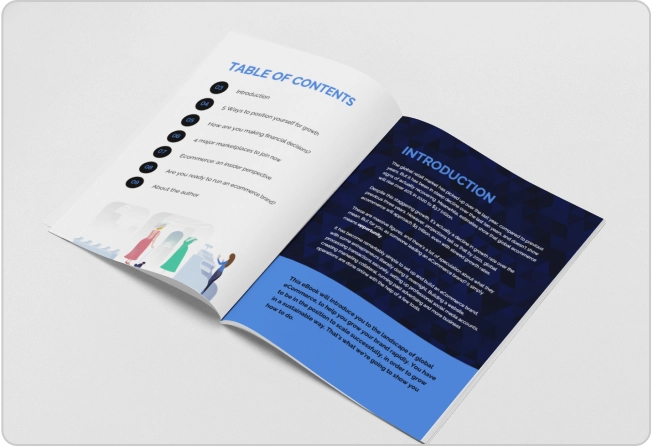
5. Software company employee handbook template

Less is always more in design, and your employee handbook should be no different. This employee handbook template for a software company uses a minimalist color theme for a professional look. It also has dark grey triangles and green accent elements to create a modern but eye catching design.
Plus, the handbook is neatly divided different parts so employees can find relevant information.
6. Bold company employee handbook
Your employee handbook is likely one of the longest documents you’ll create and whilst it’s important to include a lot of information, it’s also important to make sure you don’t waffle on. Keep your paragraphs short and concise, use simple language, and write in plain English.
In this employee handbook example the paragraphs are brief and written simply, so that everybody can understand the information being shared.

7. Agency employee handbook template
Here is a modern agency employee handbook template with a subtle design. Since agencies usually have a flexible culture, this template covers only relevant information, such as time-off policy and disciplinary action

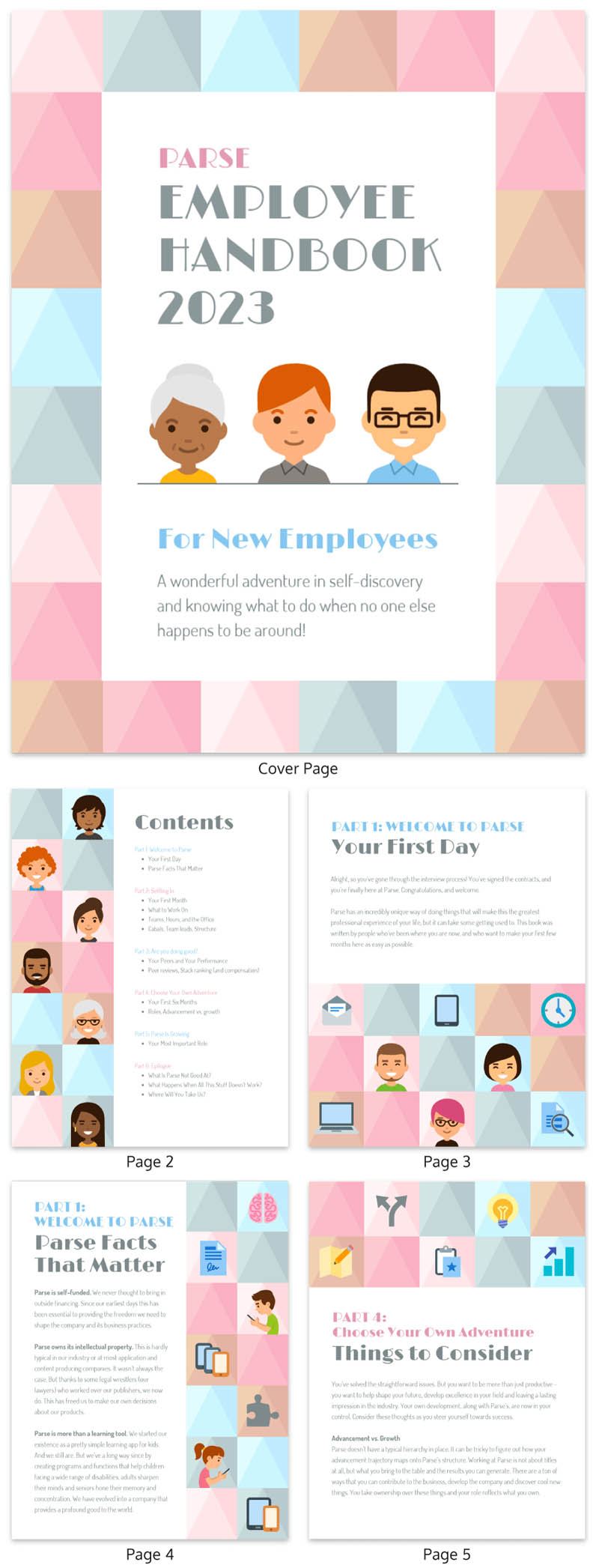
8. Colorful employee handbook template
Keep your employees in mind by highlighting the most important information foremost. Ask yourself, what would my new starter find the most helpful right now?
In this employee handbook example an entire page has been dedicated to what to expect on the employees first day. This allows the new starter to know exactly what to expect immediately without being overwhelmed with information.
Inspired by these employee handbook examples? Browse the Venngage employee handbook templates and get started creating your handbook today.
How to write an employee handbook?
- Step 1: Write the outline of your employee handbook
- Step 2: Draft compliance sections with zero ambiguity
- Step 3: Design your employee handbook using a template
- Step 4: Compile all of the information you have gathered into your employee handbook
- Step 5: Share your finished employee handbook
Step 1: Write the outline of your employee handbook
Every great employee handbook starts with a great outline. Make sure you take the time to preplan to contents of your employee handbook before diving in. This will ensure you include all necessary materials to make your handbook effective.

Employee handbooks are truly a choose your own adventure–no one size fits all scenario. Though the information included in every employee handbook fit into a set of common categories, the depth that companies will go into within each category is dependent on various factors such as company size, company industry, company location(s), company culture, etc.
See below for examples on what to include in your employee handbook. Feel free to pick and choose which topics are most relevant to your business, or go all the way and include the whole package.
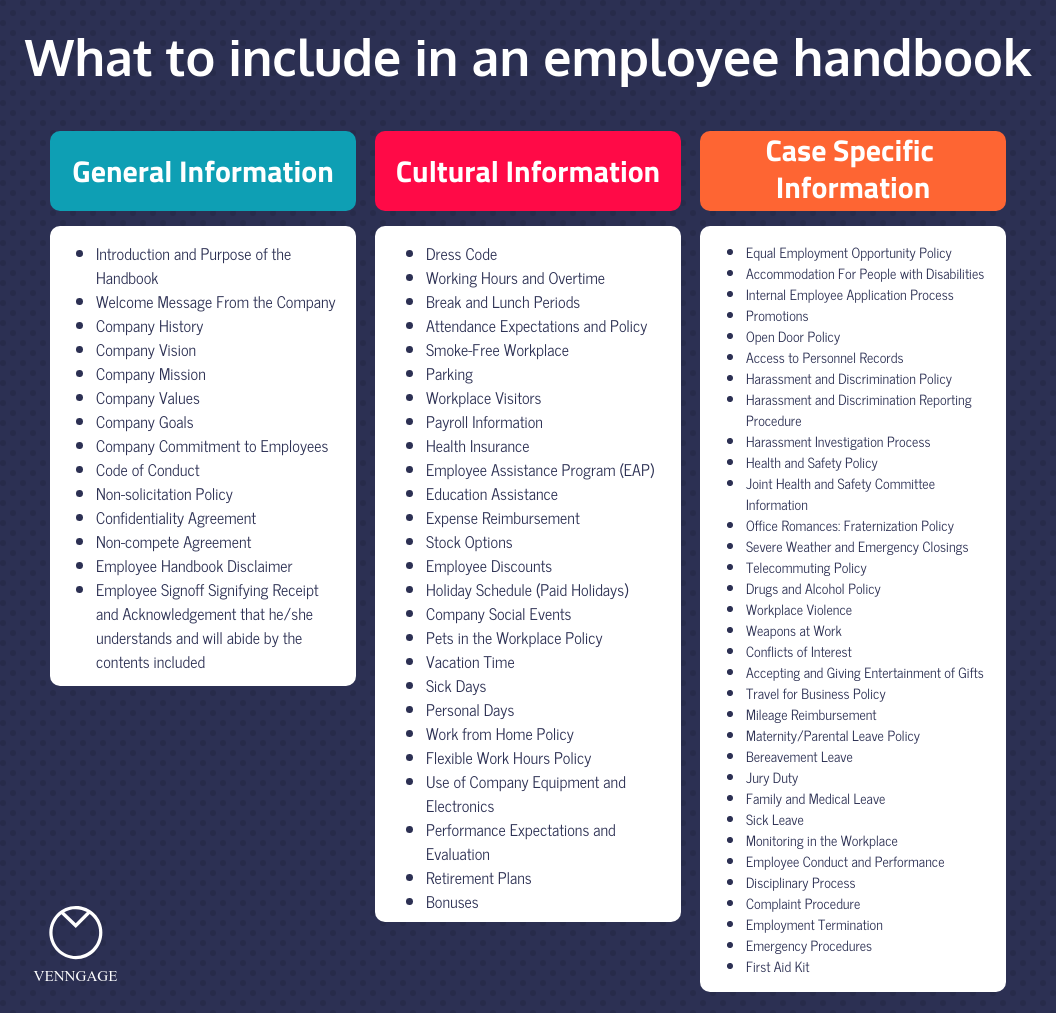
Once you have selected what to include, you can lay out a table of contents. This will help guide the rest of your employee handbook, and make sure that you don’t miss anything. A table of contents is also a great way for your employees to quickly skip to a section.
Step 2: Draft compliance sections with zero ambiguity
Before you think about layout or colors, focus on the writing itself. Your employee handbook and workplace policies aren’t just documentation, they’re part of your legal and HR compliance framework.
Anything covering conduct, attendance, remote work, or leave quietly doubles as legal protection, so this step deserves real attention.
Start by tightening your language.
Use clear definitions
When writing HR policies, define terms like “misconduct,” “harassment” and “remote work” clearly and in plain language. If a phrase can be misunderstood, it eventually will be and usually at the worst possible time.
Next, make your process impossible to miss.
Document the reporting flow
Explain exactly how employees report issues, who reviews them and what happens after a concern is raised. A transparent reporting process supports workplace compliance and prevents confusion when things get serious.
Finally, lock in the legal context.
Add the jurisdiction clause
Be specific about which labor laws and employment regulations apply. For remote teams and multi-location companies, this helps avoid compliance gaps and keeps policies enforceable across regions.
Step 3: Design your employee handbook using a template
Next you need to pick a design style for your employee handbook. Some larger organizations will have an in house design team, but if you’re faced with designing the company employee handbook by yourself a premade template can be a great place to start.
Venngage offers a variety of fully customizable employee handbook templates for you to use.

Step 4: Compile all of the information you have gathered into your employee handbook

Once you have picked a design style and have your outline and information locked down you can start to pull together your employee handbook. Using your table of contents, create a blank page in your document for each section and add the section header (check the employee handbook example below). This will help you visualize the structure of the employee handbook you are making.

The information should be communicated and displayed in a clear and easy to follow format. The terminology should be familiar to your audience and easy to understand. If there is complex information, consider adding a glossary to define concepts or terms. Make sure your table of contents is also clearly laid out.

Go through your blank employee handbook filling out information and adding sections. Some people prefer to work methodically writing pages from start to finish, whereas others prefer to jump about adding information as it enters their brain.
A good way to make sure you don’t miss anything is to use colors to indicate when a section still needs work, like in this employee handbook example:

Once you have an employee handbook first draft you may want to share it with other people within your company for feedback. If you’re a Venngage Business user, other people in your team can leave comments directly on the document using the private share link – making team collaboration so much easier.
At the end of the day, creating an in-depth and updated handbook is a collaborative process. Why not invite your team to help you create your company’s handbook with you? Our real-time collaboration feature (Business plans only) will help you collaborate with your team anytime, anywhere, in real-time:

Post the handbook in various locations. It is important to ensure the employee handbook is easy to find for everyone. Ours is included in all employment offer letters, in the onboarding process and pinned on Slack.

You could also email a copy to your staff and have hard copies around the office, just be sure to keep everyone updated when you update the handbook. To make keeping track of most current copies, you could use a version code for your handbooks.
You could even create your employee handbook as an interactive PDF and interlink between documents and websites, to make it easy for your employees to find all of the specific documents and sites that you reference within the handbook. Then, publish your employee handbook online.
Why every business should have an employee handbook?
Yes, an employee handbook is a very important document for any business with employees. It lays out the company’s policies, expectations and procedures for employees.
An employee handbook not only serves your new staff, but your old staff as well. At all levels and stages within your company, employee handbooks can be beneficial in:
Creating a positive workplace culture
Employee handbooks are incredibly effective in maintaining a positive workplace culture and integrating newcomers into the team. An employee handbook sets clear expectations for all employees to ensure everyone within the organization can remain on the same page. In doing so, employee handbooks help to establish a culture where issues can be dealt with fairly and consistently.

Improving compliance
As mentioned, handbooks can provide newcomers with an introduction to your company and its internal structure.
Employee handbooks can paint a clear understanding of what their supervisors expect of them. They can ensure that policies, procedures and working practices are enforced fairly and rigorously, thus eliminating confusion and misalignment within your team.
Making new team members feel welcome
Handbooks can be a handy tool for your company to show how important your employees are to you–this is displayed through the information you deem as important in your manual (think support initiatives and inclusivity efforts).
Making sure everyone’s on the same page
Lastly, handbooks operate as an information communication vehicle to facilitate the integration of employees within the company while committing to fostering a feeling of belonging across teams.

FAQs on employee handbook
1. What is the difference between an employee handbook and a policy manual?
An employee handbook tells your employees what to expect, and should be written in easy to understand language. A policy manual, on the other hand, is a document that tells your employees how to do things, and may include more technical information.
2. How often should you update your employee handbook?
You should update your employee handbook every time something within your workplace changes, such as business expansion or introduction of new policy. Companies should review their employee manual annually at the very least to ensure it is reflective of society’s unavoidable changes.
Every year, businesses should schedule a time to sit down and consider how your jurisdiction and industry has changed in the past year to determine if your policies are still current, how they can be updated and what policies need to be added.
Items can change for an overwhelming amount of reasons.
3. Do small businesses need an employee handbook?
Yes, small businesses benefit from having an employee handbook as it sets clear expectations for employees and helps protect the business from legal risks. Even with a smaller team, a handbook outlines key policies like attendance, behavior, benefits and safety, ensuring consistency and transparency. It also serves as a reference for addressing workplace issues and reinforces the company’s values and culture.
4. How can I make my employee handbook more engaging?
To make your employee handbook more engaging, focus on a clear and friendly tone that reflects your company culture. Use visuals like infographics, charts and illustrations to break up text and highlight important sections. Incorporate real-life examples or scenarios to make policies more relatable. You can also make it interactive with digital formats that include clickable links, videos, or quizzes.
Get started with your employee handbook today!
Ready to create an engaging and clear employee handbook? Start today by outlining key policies and expectations to ensure consistency and transparency in your workplace. A well-designed handbook helps foster a positive work environment and keeps everyone on the same page.
With Venngage, you can easily customize professional-looking templates for your employee handbook, adding visuals, charts, and branding elements. Our intuitive design platform allows you to create a handbook that’s not only informative but visually engaging, making it easier for employees to navigate and retain important information.
Browse all of our employee handbook templates.
More Human Resources Design Guides: