

Most corporate governance reports are supposed to show how a company is directed, controlled and held accountable. Regulators, investors and boards rely on them heavily to evaluate risks, oversights and decision-making.
But most corporate governance reports I’ve come across fail to make an impression because poor structure hides what matters the most and makes critical disclosures easy to overlook.
I’ve spent years writing about clear business communication and effective report writing. I also recently reviewed 20+ filings from companies like Microsoft and Unilever.
After mapping them against frameworks from OECD and the U.S. Securities and Exchange Commission, I am sharing a format that highlights key information clearly and helps you draft a strong corporate governance report. This guide breaks down each section and shows you how to use it effectively.
Corporate governance report format structure
Corporate governance reports follow a defined structure because global frameworks require specific disclosures on board composition, oversight, risk and transparency.
According to the OECD Principles of Corporate Governance, companies should present clear information on governance frameworks, shareholder rights, risk management and board responsibilities so stakeholders can make informed decisions.
Guidance from the U.S. Securities and Exchange Commission also stresses structured, comparable disclosures. For instance, Regulation S-K outlines how companies should report governance matters like executive roles, board committees and risk oversight in a consistent format.
In practice, this means your report should not read like a free-writing narrative. It should follow a logical flow from governance framework to oversight, then risk and disclosures. This structure helps investors and regulators scan and verify claims without digging through dense text.
Here’s a clear breakdown of what a standard corporate governance report typically includes.
1. Governance framework overview
Purpose: To set the context for how the company is governed and what standards it follows.
This is where you set the foundation for the corporate governance report. You need to give your readers a clear view of how governance works before they evaluate risk or oversight. A well-structured opening reduces ambiguity and builds trust early.
This section usually includes:
- Governance philosophy or code
- Structure of the board and committees
- Key policies and guiding principles
2. Board composition and structure
Purpose: Show who is responsible for oversight and how the board is structured.
Once the framework is clear, readers want to know who is in charge. This section should make the board easy to evaluate at a glance, with no guesswork around roles or independence.
Here’s what’s included:
- List of directors and roles
- Independence and diversity mix
- Number of meetings and attendance
3. Roles, committees and responsibilities
Purpose: Clarify how governance actually works in practice, not just on paper.
Structure alone is not enough. You need to show how your organization makes decisions and who handles what. It’s where governance shifts from theory to execution.
This section includes details related to:
- Audit, nomination and remuneration committees
- Responsibilities and scope of each
- Delegation of authority
4. Risk management and internal controls
Purpose: Demonstrate how the company identifies and manages risk at a governance level.
After roles are clear, the next question is risk. Readers want to see how the company prevents failures and responds to issues at a governance level.
For instance, this section usually includes:
- Key governance risks
- Internal control systems
- Compliance mechanisms
5. Performance and board evaluation
Purpose: Show accountability and how board effectiveness is measured.
Governance without evaluation lacks accountability. This section shows how the board measures its own effectiveness and addresses gaps over time. And it includes:
- Board performance review process
- Director evaluation methods
- Conflict of interest disclosures
6. Remuneration and compensation
Purpose: Provide transparency into how leadership is rewarded and aligned with company goals.
Pay structures reveal priorities. Readers look here to understand how leadership incentives align with long-term company performance and governance standards.
This section includes:
- Director compensation structure
- Incentives and performance linkage
- Disclosure of benefits or stock options
7. Stakeholder communication and compliance
Purpose: Reinforce transparency and trust with stakeholders.
Strong governance includes clear communication. This section shows how the company engages stakeholders and meets regulatory expectations without gaps.
It includes:
- Shareholder engagement practices
- Regulatory disclosures
- Code of conduct adherence
8. Future outlook and governance priorities
Purpose: Show how governance will evolve with strategy and risk.
Governance is not static. Readers want to see how the company plans to adapt to new risks, regulations and strategic shifts.
This section covers:
- Upcoming governance initiatives
- Changes in policy or structure
- Long-term oversight priorities
Ready-to-use corporate governance report template
It’s frustrating to keep a tab on what to include every time you sit down to create a corporate governance report.
Instead, you can use the copy-and-paste template below to create a report based on global governance frameworks like OECD and the U.S. Securities and Exchange Commission.
The template forces clarity, keeps disclosures consistent and makes your report easier to review and audit.
Copy it, paste it into your doc and start filling it section by section per your requirement.
Corporate Governance Report – FY[20XX]
Prepared by: [Department / Company Secretary]
Date: [Filing Date]
Regulatory Body: [SEC / FCA / Other]
(Define your governance philosophy, code andguiding principles.)
Governance Code Followed: [OECD / Internal Code / Other]
Board Structure: [Unitary / Dual Board]
Key Policies: [List major governance policies]
(List directors and disclose independence clearly.)
Board Members: [Name, Role, Independence, Tenure]
Diversity Metrics: [Gender, skills, experience]
Meetings Held: [Number]
Attendance Record: [Per director]
(Show how governance operates in practice.)
Audit Committee: [Members, responsibilities, meetings]
Nomination Committee: [Details]
Remuneration Committee: [Details]
Delegation Of Authority: [Explain decision hierarchy]
(Disclose key governance risks and mitigation clearly.)
Top Governance Risks: [List 3–5]
Internal Control Systems: [Describe frameworks]
Compliance Mechanisms: [Audits, policies, monitoring]
(Show how performance is measured and reviewed.)
Evaluation Process: [Internal / External review]
Director Assessments: [Method used]
Conflict Of Interest Disclosures: [Details]
(Explain how leadership incentives align with performance.)
Compensation Structure: [Fixed / Variable]
Performance Metrics: [KPIs linked to pay]
Equity Or Stock Options: [Details]
(Document how you engage stakeholders and meet regulations.)
Shareholder Engagement: [AGMs, voting]
Regulatory Disclosures: [List filings]
Code Of Conduct: [Adherence and enforcement]
(Show how governance will evolve.)
Upcoming Initiatives: [Policies, reforms]
Planned Changes: [Board or structure updates]
Long-Term Oversight Goals: [Strategic governance focus]
(End with verifiable proof.)
Audit Statements: [Internal / External]
Compliance Certifications: [Signed declarations]
Source References: [Board minutes, reports]
Venngage corporate governance report templates
A copy-paste template gets you started, but it often locks you into rigid formatting and manual, sometimes painstakingly long, edits. For example, you spend more time fixing the layout than improving clarity.
That’s where Venngage templates stand out. They give you structure, visual hierarchy and flexibility without breaking the flow of your report.
You can start with a structured layout from Venngage’s corporate report template library.
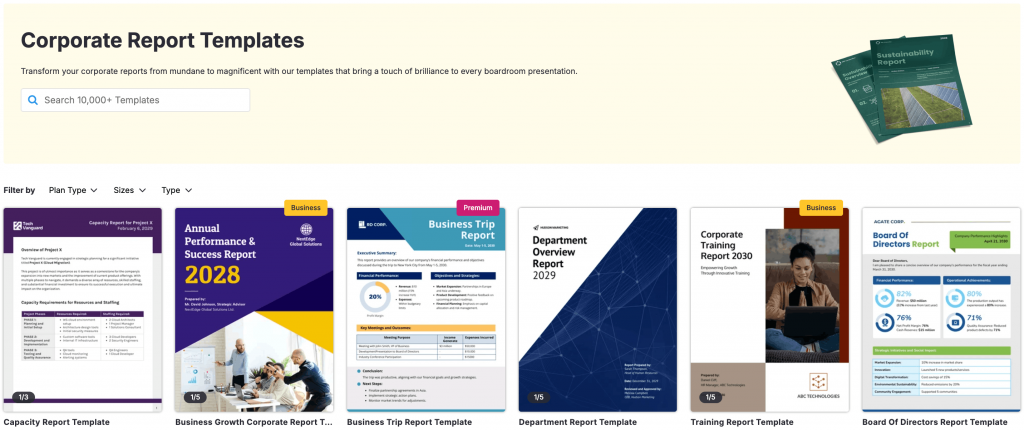
Each template mirrors how governance reports are read in real life. They come with clear sections for board composition, risk oversight and compliance disclosures. You don’t start from a blank page.
Take a look at this corporate governance report template, for instance:
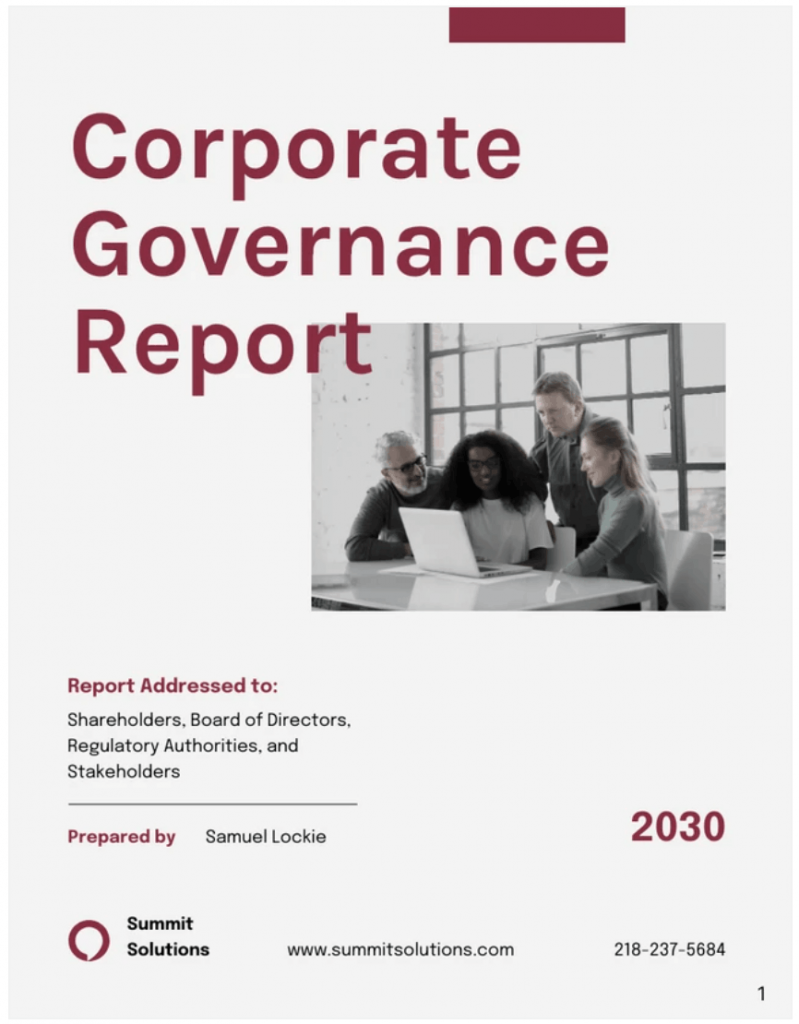
It follows a clear, sectioned layout that separates governance framework, board structure and risk disclosures, which makes the report easy to scan and verify.
The bigger advantage is how Venngage’s templates bring visual thinking by default.
For instance, most of Venngage’s report templates carry charts, icons and layout hierarchy that can turn any complicated governance data into something readable. It helps readers understand a report’s findings and recommendations faster when you present the data visually.
If you want to dive deeper into this topic, read our practical guide on how to create a clear and compelling data report.
Presenting data visually improves retention and reduces misinterpretation. Research shows people remember far more information when it’s visual rather than text-only.
Templates also solve consistency. Governance reports often involve legal, finance and compliance teams.
Venngage lets your teams collaborate on the same file and keep branding consistent across sections. For example, you can use Venngage’s Brand Kit feature to preset colors, fonts and logos so every report is on-brand.
With Venngage’s report templates, you also unlock flexibility in your report design without any chaos. You can adjust layouts, add charts and apply brand colors without breaking structure. That balance matters when you need both compliance and clarity.
Why this corporate governance report structure works
I didn’t pull this structure from just one template. I mapped it against the OECD governance principles and cross-checked how real companies present disclosures.
Good reports follow a logic that mirrors how investors process risk, trust and control. And most Venngage templates follow the same pattern.
Here are a few reasons why this corporate governance report structure works like a charm:
1. Starts with the governance framework, not performance
Most reports open with financial highlights, but that approach misses the point. You need to show how the company is governed before you show what it achieved, which aligns with global standards that prioritize governance first.
The opening section sets the context by outlining board structure, committees and authority lines. This helps readers understand who makes decisions, how oversight works and where accountability sits, so they can evaluate results with the right lens.
2. Clarifies roles, then shows oversight
Governance works as a system of relationships between management, the board and stakeholders. You cannot explain oversight clearly unless you define roles first.
This structure separates board composition, committee roles and leadership responsibilities into clear sections. That clarity reduces ambiguity, which is often where governance issues arise and makes it easier for readers to scan and understand responsibilities.
3. Puts risk and controls before outcomes
Many companies bury risk disclosures in the middle of the report, which makes it harder for readers to assess context early. You should bring risk and controls forward.
This structure places risk oversight and compliance mechanisms before performance summaries. Investors tend to evaluate downside first, so this order answers the key question early and gives meaning to everything that follows.
4. Ends with transparency and proof
Strong claims need clear evidence. You need disclosures, policies and measurable indicators to support what you present.
The final sections focus on compliance statements, audit details and ESG disclosures. Readers often remember the closing sections most, so ending with verifiable information reinforces trust and strengthens the overall credibility of the report.
The psychology behind the layout
This structure follows a simple cognitive flow:
Context → Control → Risk → Proof
- You first orient the reader
- You then show who is in charge
- You surface what could fail
- You close with evidence
That order minimizes friction and reflects how people usually evaluate trust in high-stakes decisions.
Most governance reports don’t make an impression because they mix this or miss parts of it entirely. But this structure keeps them clean, logical and defensible.
Pro tips for writing a corporate governance report
These are patterns I saw across high-quality filings. You can apply them today without changing your entire report.
1. Write each section for one reader
Imagine the ideal person who will benefit after reading this report. Example: audit committee for controls, investors for risk, regulators for compliance.
How to apply:
Add a one-line intent at the top of each section. Keep the content focused on that reader only.
2. Replace paragraphs with proof blocks
Long text weakens governance claims.
Your readers might ignore a two-paragraph explanation of board independence, but they might read and easily process a simple line that states “72% independent directors; source: nomination committee report.”
How to apply: Turn disclosures into small blocks with:
- Statement
- Evidence
- Metric
Example: “Board independence: 70% independent directors. Source: Nomination committee report.”
3. Show structure with visual hierarchy
Most readers scan before they read a report thoroughly. But a poor layout and structure can bury critical details and make key insights easy to overlook.
If you want to improve your report’s visual structure, read our detailed guide on using visual hierarchy in business communications.
How to apply: Use icons for committees, charts for board composition and callouts for key risks.
This is where a structured template helps you avoid clutter.
4. Put risk in plain language
Most risk sections sound legal. That hurts clarity.
The SEC Plain English Handbook emphasizes that legal jargon and complex wording can overwhelm readers and discourage them from continuing, which reduces understanding of critical disclosures.
To quote Warren Buffett, who wrote the preface for the handbook:
“For more than forty years, I’ve studied the documents that public companies file. Too often, I’ve been unable to decipher just what is being said or, worse yet, had to conclude that nothing was being said. If corporate lawyers and their clients follow the advice in this handbook, my life is going to become much easier.”
How to apply: Write each risk as one clear sentence. Then follow it with a short line on its impact and another on how you plan to mitigate it.
Keep the language simple so anyone reading can understand it without getting stuck on jargon.
5. End every section with a verifiable source
Unverified claims reduce credibility fast.
Research from IJIRD shows that citations allow readers to verify information and assess validity, which directly strengthens trust in the content.
How to apply: Add a source line under each major disclosure.
Example: “Source: Internal audit report FY2025” or “Source: Board minutes Q4.”
6. Keep version control tight
Governance reports usually involve multiple teams working at the same time, which often leads to version conflicts and avoidable errors if changes aren’t tracked carefully.
How to apply: Lock final sections before review. Use one shared file for edits. Templates with collaboration features make this easier to manage.
FAQs about the corporate governance report format
Here are the four most commonly asked questions about creating a corporate governance report:
1. What should a corporate governance report always include?
A corporate governance report should include board structure, committee roles, risk management, internal controls, compliance disclosures and audit details. Regulators expect clear accountability, transparency and verifiable data across each section.
2. How do you disclose governance failures without legal risks?
Stick to the facts and leave opinions out. Describe the issue clearly, explain its impact, and outline the corrective action you took, then back it up with internal reports or audit references so you stay transparent while keeping legal risk in check.
3. How do you structure a governance report for investors and regulators?
Start with the governance framework, then roles, followed by risk oversight and end with disclosures. This sequence aligns with OECD principles and helps stakeholders evaluate trust, control and accountability quickly.
4. What are the most common mistakes when creating corporate governance reports?
Common mistakes include vague disclosures, poor structure, missing risk details and lack of evidence. Many reports fail because they prioritize narrative over clarity, which reduces credibility with investors and regulators.
Related reporting formats
If you regularly work on governance or compliance reports, you’ll likely need adjacent formats too. Venngage offers a wide range of report templates you can use as a starting point, many of them free.
Here are a few formats closely related to corporate governance reports:
- Free Annual Report Templates
- Free Corporate Presentation Templates
- Free Corporate Mind Map Templates
- Free Government White Paper Templates
If you want a faster way to build structured, professional reports, Venngage templates give you a solid starting point without having to figure out layout on your own.