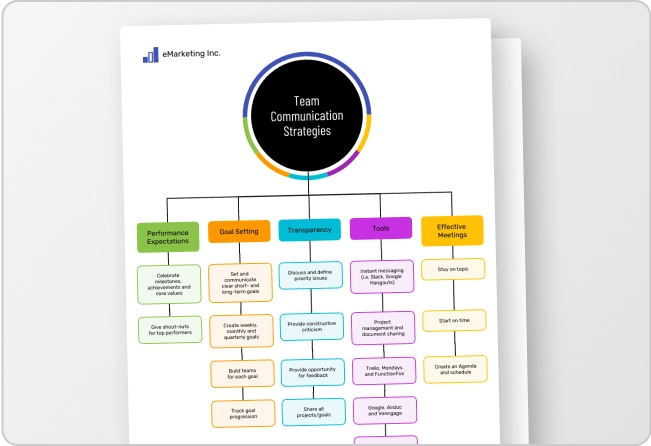


In any organization, making decisions involves balancing any number of factors to arrive at the wisest course of action. A decision tree can help businesses make tough choices, so we wanted to examine the best decision tree makers out there.
Decision tree software helps you map complex choices into clear, visual paths so teams can make better decisions faster. From business workflows to customer support logic and strategic planning, the right tool can turn messy decisions into structured, actionable outcomes.
A mistake I frequently see is teams choosing a decision tree tool based on familiarity rather than how they actually plan to use it. The result is often diagrams that look fine at first but fall apart once decisions become more complex or collaborative.
Decision tree software at a glance
| Use case | Best tools | Why they stand out |
|---|---|---|
| Easiest for beginners | Venngage, MindMeister, Draw.io | Simple interfaces, low learning curve, and templates that work out of the box |
| Best for teams | Lucidchart, Creately, MindMeister | Real-time collaboration, comments, and shared editing for group decisions |
| Best for data or spreadsheet integration | Lucidchart, Excel | Strong support for importing, linking, or working directly with structured data |
| Best free or low-cost option | Draw.io, GitMind | Free plans that are usable for real decision trees without heavy restrictions |
Methodology
To make this list as evidence based as possible, I assessed 12 leading decision tree platforms using five objective criteria:
- Ease of use and interface
- Template availability
- Data integration and import
- Collaboration features
- Cost and overall value
When we tested this internally, I focused on how quickly someone could go from a blank canvas to a usable decision tree without relying on documentation or tutorials. Ease of use mattered just as much as feature depth.
| Tool | Ease of use | Templates | Data integration | Collaboration | Cost and value |
|---|---|---|---|---|---|
| Venngage | 5 | 5 | 3 | 4 | 4 |
| Lucidchart | 4 | 4 | 5 | 5 | 3 |
| Creately | 4 | 4 | 4 | 5 | 3 |
| MindMeister | 5 | 3 | 2 | 4 | 4 |
| EdrawMax | 3 | 4 | 3 | 3 | 4 |
| SmartDraw | 3 | 3 | 3 | 3 | 3 |
| ZingTree | 3 | 3 | 4 | 4 | 3 |
| Excel | 2 | 2 | 5 | 2 | 5 |
| Draw.io | 4 | 3 | 2 | 3 | 5 |
| GitMind | 4 | 3 | 2 | 3 | 4 |
I noticed a clear pattern while reviewing the scores. Tools that perform well on ease of use tend to simplify data handling, while tools strong in data integration often introduce more friction for first time users. This tradeoff is worth keeping in mind as you evaluate which tool fits your actual workflow.
1. Venngage Decision Tree maker
Best for visually polished decision trees for business and education

With Venngage’s Decision Tree Maker, you can take advantage of drag-and-drop functionality that not only makes it easy to visualize the decision at hand but also ensure the decision tree follows your branding guidelines.
Simply use one of our templates or create one from scratch, adding your big choice at the top, then the branches and finally the leaves. With just a few clicks, you can create something to help your organization make data-driven decisions to elevate your organization.

Venngage is free to start, and business account users can access even more features like real-time collaboration to create more effective decision trees.
Venngage business users also get access to priority support and multiple export options that will allow you to add your decision tree to just about any existing presentation.

Plus, you can use the My Brand Kit feature to add your logos, colors, and fonts to decision trees with the click of a button.
When I was creating a diagram intended for stakeholders rather than analysts, I noticed Venngage made it easier to keep the decision flow readable and visually balanced. The AI assisted design tools helped speed up layout decisions, especially when refining spacing, hierarchy, and visual emphasis.
Strengths
- Drag-and-drop interface that helps you build decision trees quickly without technical skill.
- Templates can be branded easily with your colors, fonts, and logos, supporting consistent visual design for presentations or reports.
- Real-time collaboration on business plans is possible on paid plans, helping teams iterate together.
- AI design and diagram generation tools help speed up visual creation.
Tradeoffs
- Not designed around structured data import or automated logic evaluation (decisions are visual, not data-driven).
- Focuses on design quality over analytical depth, so advanced tree logic features are limited.
Pricing:
- Free Plan: Create your first 5 designs for free
- Premium Plan: $19 per month or $10 per month when billed annually
- Business Plan: $49 per month or $24 per month when billed annually
- Enterprise: Custom pricing
People also read:
- 11 Types of Charts and How Businesses Use Them
- 10+ Types of Diagrams and How to Choose the Right One
2. EdrawMax
Best all-in-one diagramming suite

EdrawMax offers a wide array of pre-designed templates for decision trees and dozens of other types of diagrams, including user-generated ones, making it ideal for businesses looking to save time and maintain consistency across projects. Like other diagram-drawing tools, what you can create leans toward the technical and utilitarian side, but that may be appropriate for your uses.
Creating nodes and branches is simple and intuitive, though shapes containing text don’t auto-scale as you modify the type. This could be a challenge for those who need to create large and complex decision trees.
Strengths
- Large template library supports formal, documentation focused decision trees.
- Offers a broad range of export formats and professional styles.
- Desktop application handles large files and complex diagrams reliably.
Tradeoffs
- Templates and features lean utilitarian rather than polished for presentation audiences.
- Shapes do not auto-scale with text as you build, which can make editing clunky.
Pricing:
- Semi-annual plan: $69
- Annual plan: $99
- Lifetime Plan: $198
- Lifetime Bundle Plan: $245
3. SmartDraw
Best for process-driven decision trees

SmartDraw is another robust design and sketch tool that’s user-friendly and intuitive. With many diagram options, including one of the few to offer decision tree templates, SmartDraw’s library is extensive.
Like most other diagram tools, the assets created with SmartDraw are functional and utilitarian, rather than being all that visually appealing.
Strengths
- Automatic layout reduces manual alignment work as trees grow.
- Templates enforce consistent structure across diagrams.
- Integrates well into document based workflows.
Tradeoffs
- Visual output tends toward functional over engaging or branded aesthetics.
- Collaboration features are not built around real time co-editing (more traditional shared files).
Pricing:
- Single user: $9.95 per month, billed annually
- Multiple users [3+ users]: From $8.25 per month, billed annually
4. Lucidchart
Best for collaborative, logic-heavy decision trees

Lucidchart is a collaborative diagramming tool that supports complex workflows and integrations.
When I was creating a diagram with multiple conditional branches, I noticed Lucidchart handled scale well, but small visual inconsistencies started to appear as the tree became denser. This is not a deal breaker, but it is something to be aware of for presentation heavy use cases.
The platform’s free offerings are also among the best of the bunch when it comes to making decision trees, though the visual style leaves a bit to be desired. Still, with a couple of free decision tree templates, you might luck into just what you’re looking for.
Strengths
- Strong collaboration tools for multiple contributors on the same decision tree.
- Templates and shape libraries let you start quickly or build from scratch.
- Supports linking data structures and formulas to deepen analysis.
Tradeoffs
- Node auto-resize sometimes produces awkwardly shaped boxes, distracting in tight layouts.
- Visual style is functional and professional, not highly expressive by default.
Pricing:
- Free Plan: Create 3 editable Lucidchart documents
- Individual Plan: $7.95 per month
- Team Plan: $9 per month/user
- Enterprise Plan: Contact Lucidchart sales team for more information
5. ZingTree
Best for enterprise-grade decision documentation

ZingTree was designed with call centers in mind, which makes its utility limited for uses outside of creating scripts for agents. While it would be possible to create a decision tree, and ZingTree does offer some templates you may find helpful.
Because ZingTree was designed for creating call center scripts, it’s light on the visual appeal offered through Venngage and other design-heavy tools. There are other baked-in aspects that relate to call center scripts that also limit flexibility.
Strengths
- Built specifically for interactive decision logic rather than static diagrams.
- Supports conditional paths, outcomes, and scoring.
- Suitable for operational and support workflows.
Tradeoffs
- Visual presentation is functional rather than design focused.
- Large trees require careful structuring to remain readable.
Pricing: Reach out to the ZingTree sales team for a demo or request for free a trial for both their Enterprise & Enterprise AI+ plans.
6. Sketchboard
Best for brainstorming-driven decision trees

Sketchboard offers a freeform drawing environment, which is perfect for businesses that prefer a more flexible and creative approach to decision-making processes. Several of the built-in shapes also have the look of something hand-sketched, and the virtual whiteboard tool is ideal for remote teams.
That said, creating a coherent decision tree or flowchart is a bit of a challenge, but if you’re looking for the sketched style, Sketchboard is an excellent option. One limitation is that when dragging and dropping shapes, the containers scale with the length of the text, making certain things appear more important than others that are of comparable importance.
Strengths
- Built for scripted decision logic (e.g., call center or guided workflows).
- Includes templates relevant for operational decision scripting.
Tradeoffs
- Limited visual design support, the UI is practical rather than polished.
- Features and templates are skewed toward support scripting, so flexibility is constrained for other use cases.
Pricing:
- Solo [for individual users]: $9 per month/user or $8 per month/user when billed annually
- Team [for 2+ users]: $8 per month/user or $7 per month/user when billed annually
- Business [for 5+ users]: $10 per month/user or $9 per month/user when billed annually
- Enterprise [for 25+ users]: Contact Sketchboard sales team for more information
7. Creately
Best for structured diagrams with collaboration

Creately is largely a collaboration tool, but the platform also offers several utilitarian charts, mind maps and more. While no decision tree templates are available yet, users can create from scratch or update a flowchart template to get the functionality they need.
Users with free accounts have limited options, so starting from scratch may be a challenge. However, working off templates can also be a challenge if your goal design doesn’t match the template.
Strengths
- Real time multi cursor editing supports collaborative decision building.
- Templates balance freeform exploration with structured documentation.
- Works well for live workshops and group planning sessions.
Tradeoffs
- Data import options are limited to basic formats.
- Interface density increases as diagrams grow in complexity.
Pricing:
- Free Plan: Create up to 3 canvases for free
- Personal Plan: $8 per month or $5 per month when billed annually
- Team Plan: $8 per month or $5 per month when billed annually
- Business Plan: $149 per month or $89 per month when billed annually
- Enterprise Plan: Contact Creately sales team for more information
8. MindMeister
Best For Idea-Driven, Brainstorm-Friendly Decision Trees

MindMeister is one of the best tools specializing in creating mindmaps, which can be adapted for decision trees, making it a good fit for business brainstorming sessions and creative decision-making processes.
While it can be used to create decision trees, it’s not exactly an intuitive process. Because the product is geared toward mind maps, its built-in systems make it tough to do anything else.
Still, for organizations that like the organic, freewheeling look of a mind map, using MindMeister to create a decision tree could be effective.
Strengths
- Fast setup for turning ideas into simple decision paths.
- Interface minimizes friction for first time or non designer users.
- Real time collaboration works smoothly during brainstorming.
Tradeoffs
- Limited control over structured decision logic.
- Visual customization options are constrained for formal documentation.
Pricing:
- Free Plan: Create up to 3 designs for free
- Personal: $6 per month, billed annually
- Pro: $10 per month/user, billed annually
- Business: $15 per month/user, billed annually
9. Excel
Best free decision tree maker

For organizations that use data to drive decision-making, it can be tempting to try creating decision trees in Microsoft Excel, the default data-processing platform for thousands of organizations all over the world.
While it’s technically possible, there aren’t many great options for going about making an engaging decision tree in Excel. The easiest way is to use SmartArt diagrams, but these built-in options, while easy to work with, tend to be rigid.
Strengths
- Familiar tool for data centric decision logic exploration.
- SmartArt and formulas allow structured breakdowns of decisions.
Tradeoffs
- Rigid diagramming options make it labor-intensive to layout trees visually.
- Not optimized for iterative design or rapid visual editing.
Pricing:
- Purchase the Microsoft Excel license at $159.99 or subscribe to Microsoft365 starting at $6.99 per month
10. GitMind
Best For Free, Flexible Diagramming with Basic Decision Trees

GitMind offers both free and paid versions, but the tool doesn’t yet have much capability for decision trees. It was designed for mind maps, and that’s where it’s best used. We didn’t find it simple to attempt to recreate our decision tree using GitMind, but with some extra time, it would certainly be possible.
A yearly subscription of about $50 gets you access to added features like unlimited file exports and dedicated support, though if you’re in the market for a decision tree maker, GitMind likely won’t fit the bill.
That said, the simple, utilitarian style of the mindmaps and flowcharts you can create using GitMind have a certain appeal.
GitMind
Strengths
- Free and browser based with a simple entry point.
- Supports multiple diagram types that can be adapted to decision trees.
Tradeoffs
- Not optimized for decision tree workflows.
- Requires extra effort to structure and label branches clearly.
Pricing:
- Basic: Create 10 designs for free
- Monthly subscription: $19 per month
- Annual subscription: $5.75 per month
How can I create a decision tree?
While you can go super-analog (another tree pun) in creating your decision tree by simply drawing it on a whiteboard or piece of paper, we recommend using digital tools to make your decision tree. This is an excellent way to gather feedback and buy-in on decision-making from your entire team.

Here’s a quick breakdown of how to do it:
- Start with the big objective or decision to be made
- Draw arrows outward for every possible course of action, including costs associated and likelihood for success (if applicable)
- Add leaves representing the results of each course of action (remember that square leaf nodes denote another decision to be made, while circular ones indicate the outcome is uncertain)
Learn more about how to make an effective decision tree to help visualize your options.
In summary: Decision trees can help organizations visualize options and make tough choices
Choosing the right decision tree software depends on your needs.
A mistake I frequently see is treating decision trees as static diagrams rather than living tools that need to evolve as decisions change. The right software should support that evolution, not slow it down.
Using Venngage for Business to create your decision trees lets you focus more on the possibilities for your business than developing a useful and engaging decision tree. Add your brand identity with one click, and encourage team collaboration.