

Remember the days of agonizing over bullet points and battling wonky clip art? The presentation landscape has shifted, thanks to a game-changer: AI.
AI presentation tools making presentations easier, more engaging, and—dare I say—actually fun to build. But the issue is finding an AI presentation generator generates quality decks without requiring a ton of manual effort.
As part of my own dog food testing, I’ve tested several tools using the same prompt. In this article, I’ll list the best AI presentation generators in 2026, their use cases, features, pros, and pricing.
TL;DR — the best AI presentation makers (Top picks)
- Venngage: Best for automated branding and turning complex data into professional infographics.
- Canva: Best for high-end creative visuals and access to a massive library of stock assets.
- Gamma: Best for instant, web-ready presentations and rapid-fire brainstorming from a single prompt.
- Plus AI: Best for converting long-form documents and PDFs into structured Google Slides.
- Microsoft Copilot: Best for referencing internal company data and staying within the Office 365 ecosystem.
- Beautiful.ai: Best for hands-off formatting with smart templates that auto-resize as you type.
- Prezi: Best for cinematic, non-linear storytelling using a zooming infinite canvas.
- Pitch: Best for team collaboration and tracking how recipients interact with your shared links.
- SlideModel.ai: Best for generating decks that remain 100% editable as native PowerPoint shapes.
- Slidesgo: Best for combining AI structure with a massive catalog of niche-specific design templates.
Comparison table: Best AI presentation makers
Here’s a quick overview of the best AI presentation makers and their features, pricing, limitations, etc.
| Tool | Best for | Key features | Limitations | Pricing (approx.) |
|---|---|---|---|---|
| Venngage | Brand-heavy data storytelling | Automated brand kit from URL; high-quality infographics | Limited free downloads; steep learning curve for complex charts | Free; Pro $19/mo |
| Canva | Creative visual variety | Massive stock library; easy drag-and-drop; Magic Studio AI | Basic data tools; repetitive templates; AI can be generic | Free; Pro $15/mo |
| Gamma | Rapid-fire structured drafts | Fast AI deck generation; web-first card layout; responsive design | Poor PPT export; non-traditional slide format; limited manual control | Free; Plus $10/mo |
| Plus AI | Document-to-slide conversions | Works inside Google Slides; summarizes long docs; clean layouts | No standalone editor; requires Google account; simple design options | 7-day trial; $10/mo |
| Microsoft Copilot | Ecosystem integration | Uses your internal Office files; native PowerPoint features | Expensive; requires M365 license; basic visual design | $30/user/mo |
| Beautiful.ai | Automatic layout management | Smart slides auto-resize; interactive charts; consistent margins | Rigid formatting; no free plan; buggy PPT exports | $12/mo (billed annually) |
| Prezi | Non-linear storytelling | Zooming infinite canvas; cinematic motion; video overlay | No PPT export; no charts; can cause motion sickness | Free; Plus $15/mo |
| Pitch | Collaboration and tracking | Viewer analytics; pitch rooms; real-time team editing | Minimum seat costs; internet dependent; static exports | Free; Pro $20/mo |
| SlideModel.ai | Native PowerPoint editing | 100% editable PPT shapes; document-to-deck; reliable format | Basic web editor; generic templates; no smart resizing | $99/year |
| Slidesgo | Template-based customization | 15,000+ templates; AI text-to-slides; school-friendly themes | Attribution required for free; manual branding; generic AI text | Free; Premium $3/mo (billed annually) |
How we tested these AI presentation makers
To keep this objective, I used the same prompt for every generator. I wanted to see how each tool handled a standard business request without any extra hand-holding.
The benchmark prompt we used
“Create a presentation to show quarterly business review for a remote marketing agency. Include slides for key achievements, client growth metrics, current challenges, and goals for the next quarter. Use a clean, professional design with a data-driven layout.”
Scoring rubric (quality, editability, exports, value)
Here are the factors I used to compare different AI presentation generators:
- Time-to-first-draft: I timed the process from entering the prompt to having an editable deck. Anything over 5 minutes is too slow.
- Export options: I checked how well the AI-generated slides converted to PPTX, Google Slides, and PDF. I specifically looked for broken layouts or formatting issues that would require manual fix-ups.
- Editing and customization: I tried changing the theme, adjusting slide counts, and updating chart data. I wanted to see if the tool offered smart layout adjustments.
- File uploads: I checked if the tools could build presentations from PDFs or Word documents instead of just text prompts.
- Output quality: I evaluated the AI writing and visual design. I checked for robotic copy and whether the layouts looked like modern professional decks or outdated templates.
- Narrative flow: I checked if the AI maintained a logical story and visual consistency across the entire deck.
10 Best AI presentation makers (Hands-on reviews)
As a content marketer, I’ve seen how AI tools for presentations can completely change the game. These smart platforms are built to make the entire process—from brainstorming ideas to designing compelling presentations and even practicing delivery—a whole lot easier.
Whether you’re prepping for a big client pitch, a webinar, or an internal meeting, these generative AI tools can help you show up with confidence and make a bigger impact.
1. Venngage

Venngage is an excellent AI presentation generator to create professional, data-driven presentations. When I tested it with a prompt for a remote marketing agency’s quarterly business review, it delivered a structured layout with data and text arranged neatly.
I like that the tool supports creating presentations in two ways: providing a text prompt to the AI Presentation Generator to create a presentation from scratch, or customizing a predesigned presentation template using AI.
This dual approach makes the job much easier; if I have a specific visual theme in mind, I can get better results with AI customization. Plus, Venngage allows for uploading documents or syncing data directly from spreadsheets. This helps transform raw metrics into polished visuals without the manual grunt work. Once the foundation is set, the drag-and-drop editor allows me to swap icons, add images, or refine the copy in seconds.
While Venngage can works best to create business presentations in minutes, it might not work great for creative decks.
Features:
- DesignAI: Add infographics into presentations with ease. With our free AI Infographic Generator and an extensive collection of professional, creative templates, crafting the perfect infographic is a task anyone can master.
- Diverse templates: There is a variety of free and accessible templates that meet different purposes that you can browse through to actualize your ideas.
- Easy customization: Customize colors, fonts and pictures by using the simple drag and drop tool that helps to make customization faster and easier.
- Brand kit feature: Apply brand logo, colors, fonts and images in one click.
- Collaborative design: Easily share and edit designs with your team members to promote productive and pleasurable teamwork.
Limitations:
- It lacks creative presentation templates.
- The editor doesn’t support advanced animations or slide transitions, which might feel limiting if you want a highly dynamic, cinematic pitch.
Pricing:
- Free plan: Get started with your first few designs for free.
- Premium plan: $19/month per user or $10/month per user when billed annually.
- Business plan: $49/month per user or 24/month per user when billed annually.
- Enterprise plan: $499 for 10+ seats, billed annually.
2. Canva

Source: Canva
Canva AI is a great starting point for those who prioritize aesthetic variety and ease of use. Once I added the prompt, it let me choose the theme (minimalist, playful, digital, etc. ) purpose and even the length of the presentation. The tool then created a presentation outline for review and shared three designs to choose from.
However, the final presentation focused much more on text and didn’t provide many data placeholders. It even added a graph image that was uneditable, so I had to manually replace it with an actual chart to reflect my numbers.
If you are looking for more control over your presentation copy, Canva works best, but be prepared for some manual work. It tends to create text-heavy slides that can feel a bit boring without enough visuals or numbers to break them up. You might end up manually changing the layout to make it less dense, though you can easily add animations to your slides to make the overall delivery more engaging.
Features:
- Magic Design for Presentations: Instantly generate a presentation draft from a short text description.
- Massive Library: Access millions of templates, stock photos, and graphics to supplement AI drafts.
- Brand Kit: Maintain consistency by storing logos, colors, and fonts that can be applied to any design.
- Magic Animate: Automatically add cinematic transitions and animations to slides with one click.
- Collaboration Tools: Share, comment, and edit in real-time with team members.
Limitations:
- AI presentations have more text over visuals.
- Some AI-generated charts can be static images rather than editable data widgets.
- You might need significant manual effort is often required to fix layout spacing and add data metrics.
Pricing:
- Free Plan: Access to basic templates and limited AI uses (approx. 10 Magic Design uses per month).
- Canva Pro: $15/month (or $120/year). Unlimited premium content and full access to all Magic Studio AI tools for one person.
- Canva Teams/Business: $10/month per person (minimum 3 people). Includes advanced brand controls and team approval workflows.
- Canva Enterprise: Custom pricing.
3. Gamma

Source: Gamma
Gamma’s process is very similar to Canva. You enter the prompt, select the theme and length of the presentation, and then review the outline before it builds the slides. The best part is that it adds both visuals and text right away, making the first draft feel substantial. I could easily edit the charts and text, swap the images, or even change the entire theme if I wasn’t feeling the first choice.
One feature I found really helpful is the ability to add presenter notes for each slide. If you are presenting using Gamma, this is a lifesaver for staying on track. Plus, it lets you embed live links, which is great if you want to add CTAs or direct your audience to a landing page.
However, Gamma has its limitations. The card layout can feel a bit like a vertical webpage, which is cool and modern but might not suit professional setups. Plus, a lot of fonts and visual effects that you see in Gamma slides are not supported in PDF or PPT formats, which restricts presentations.
Moreover, while Gamma allows for basic theme customization, its branding features are quite limited on the free and lower-tier plans. Unlike Venngage, where you can instantly pull your entire brand identity from a URL, Gamma requires more manual setup for colors and fonts.
Features:
- Flexible card system: Instead of rigid slides, Gamma uses “cards” that auto-resize to fit your content perfectly.
- Interactive embeds: You can drop in live websites, YouTube videos, or even Figma prototypes directly into the deck.
- AI design partner: Use a chat-style box to ask the AI to “make this more professional” or “add a three-column layout” on the fly.
- Built-in analytics: You can see who viewed your shared link and how much time they spent on each slide.
Limitations:
- The webpage-like scroll doesn’t always translate well to a classic 16:9 presentation feel.
- Converting a Gamma card to a standard PowerPoint file can result in messy layouts and cut-off text.
- Advanced brand controls and custom fonts are restricted to the Pro plan, making it harder for small teams to stay consistent for free.
Pricing:
- Free Plan: Includes 400 one-time credits and a “Made with Gamma” watermark.
- Plus Plan: $10/month (or $8 billed annually). Removes the watermark and provides unlimited AI creations.
- Pro Plan: $20/month (or $15 billed annually). Unlocks advanced AI models, custom fonts, and detailed branding tools.
4. Plus AI
Source: Plus AI
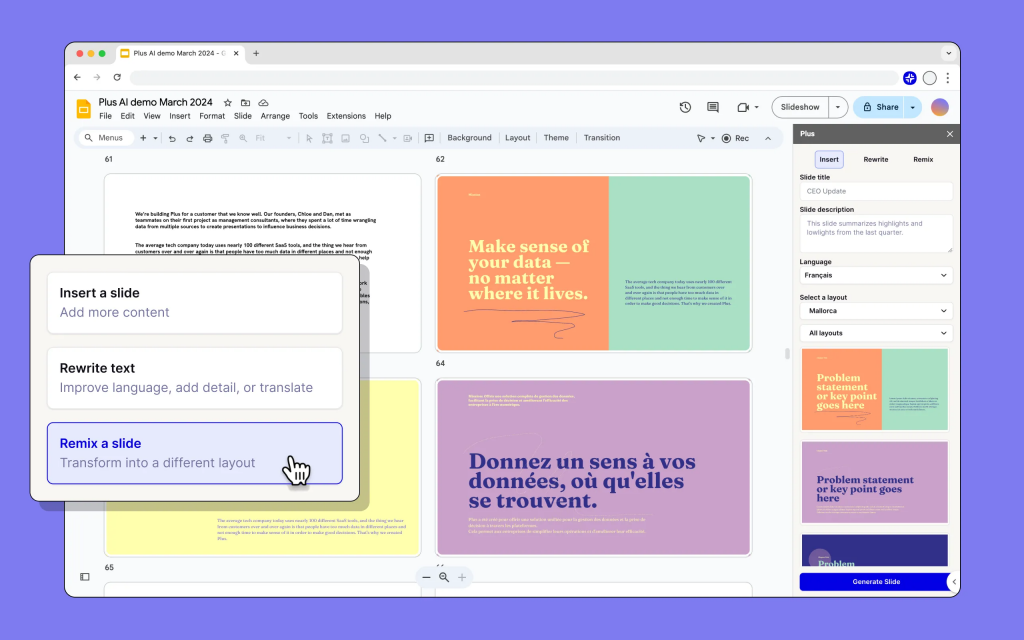
Plus AI makes working inside Google Slides a lot smarter. It brings AI directly into one of the most popular presentation tools, helping you build polished, engaging slides without having to start from scratch. I loved how it felt like a natural upgrade rather than a separate app. You don’t have to deal with the hassle of exporting and importing files; you just open the extension and start building.
Plus AI lets you generate a full deck from a simple text prompt or even convert a long document (like a PDF or Word file) into a structured presentation. This is a huge time-saver if you already have your research and just need it visualized. The tool even offers a ‘Remix’ feature that lets you reformat a single slide into different layouts—like turning a wall of text into a clean three-column comparison—with one click.
It’s a solid choice for marketers, educators, and teams who already love Google Slides but want an AI boost to create better presentations, faster. Once you’re ready, you can easily continue editing in Google Slides with full control over the final look and feel.
However, Plus AI is strictly an add-on for Google Slides and Microsoft PowerPoint; it doesn’t have a standalone editor, so you’re tethered to Google Slides or PowerPoint’s native (and sometimes clunky) formatting rules.
Features:
- Effortless presentations: Quickly generate full decks or update existing slides without starting over.
- Simple edits and remixing: Add new slides, refresh layouts, or let AI rework your presentation for a better flow.
- Custom themes: Generate unique color palettes and font styles just by typing a theme idea.
- Co-creation with AI: Collaborate with your team and AI together, getting real-time suggestions to improve slides.
- Consistent designs: Create branded templates and use custom-trained AI models to keep every presentation on-brand.
Limitations:
- The AI focuses more on structure than visual storytelling, often resulting in basic or “bland” corporate layouts.
- You have to manually input your brand hex codes and fonts, which feels slow compared to tools that pull this data automatically.
Pricing
- Free Trial: 7-day trial available (requires a credit card).
- Basic Plan: $10/user/month (billed annually) or $15 (billed monthly). Includes unlimited AI generations.
- Pro Plan: $20/user/month (billed annually) or $25 (billed monthly). Unlocks document-to-presentation and AI image tools.
- Team Plan: $30/user/month (billed annually) or $40 (billed monthly). Best for teams needing shared brand kits and custom templates.
5. Microsoft 365 Copilot
Source: Microsoft 365 Copilot
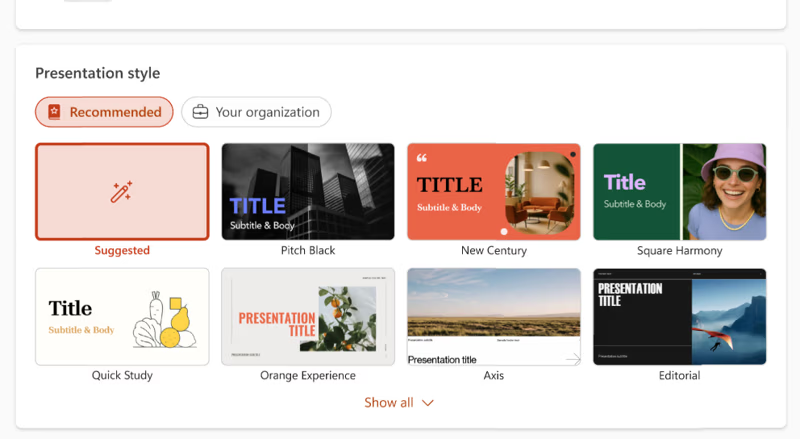
If you’re already using Microsoft Office, Copilot in PowerPoint feels like an instant upgrade to how you build and present your ideas.
It uses AI to turn rough notes or documents into polished, professional presentations — without having to dig through files or start from scratch. It’s fully integrated with Microsoft 365, so it feels less like an extra tool and more like a built-in assistant that just gets what you’re trying to do.
Copilot is perfect for professionals and teams who work in PowerPoint regularly and want to speed up content creation, design, and editing. It’s also brilliant for the boring stuff like summarizing a 50-slide deck into five key bullet points or generate detailed speaker notes for you in seconds.
While Copilot is great at text and structure, it’s surprisingly basic when it comes to visual storytelling. It often relies on repetitive layouts, such as a stock image on the left and a text box on the right. You’ll have to spend more time manually polishing the design here than you would in a more design-focused AI tool.
Features:
- Natural language prompts: Type in a short prompt or question, and Copilot generates slides based on your input and past files.
- Smart meeting assistance: Integrated with Microsoft Teams, it supports note-taking and action items during virtual meetings.
- Real-time writing support: Copilot suggests improvements to grammar, structure, and clarity as you work.
- Workflow insights: It learns how you work and offers suggestions to streamline repetitive tasks.
- Data visualization: Helps you transform complex data into easy-to-understand charts, graphs, and dashboards within your presentation.
Limitations
- The layouts can feel very templated and repetitive, often requiring manual tweaks to look truly high-end.
- It’s one of the most expensive options because it requires a qualifying Microsoft 365 subscription on top of the Copilot fee.
Pricing:
- Copilot Pro (Individual): $20/month. Best for solo creators and freelancers.
- Microsoft 365 Copilot (Business): $30/user/month (billed annually). This is the standard for teams and requires a Business Standard or Premium license.
- Enterprise: Custom pricing for large organizations, including advanced security and “Copilot Studio” for building custom AI agents.
6. Beautiful.ai

Source: Beautiful.ai
Beautiful.ai is a lifesaver if you struggle with slide design but still want your decks to look like they were made by a professional agency. The process is straightforward: you pick a ‘Smart Slide’ template, and as you add text or data, the AI automatically adjusts the layout, margins, and alignment in real-time.
However, that smart automation is also where the limitations kick in. The layouts can be rigid. for example, if you want to move a specific icon or text box to a spot the AI hasn’t cleared, you’re out of luck. It lacks the creative freedom of a drag-and-drop editor.
Features:
- Audio recording: Add voiceovers to your slides to guide your audience through key takeaways.
- Real-time communication: Share edits, comments, and ideas instantly within your presentation workspace.
- Smart templates: AI-powered templates automatically adjust when you update or add content.
- Company branding: Quickly apply your brand’s fonts, colors, and logo across your presentations.
- Customization: Use pre-built templates and an intuitive drag-and-drop editor to tailor every slide to your needs.
Limitations:
- You cannot test the AI generation features or Pro tools without signing up for a trial that requires payment info upfront.
- You can’t manually override the layout if you want an element in a different spot.
- Exporting to PowerPoint often turns smart slides into static images or broken text boxes, making further edits in PPT difficult.
Pricing:
- Pro Plan: $12/month (billed annually). Includes unlimited AI content generation and custom branding.
- Team Plan: $40/user/month (billed annually) or $50 (billed monthly). Adds collaborative workspaces, shared asset libraries, and advanced brand controls.
- Enterprise Plan: Custom pricing. Includes advanced security (SOC 2, SSO), dedicated onboarding, and unlimited team resources.
7. Prezi

Source: Prezi
Prezi is a presentation platform that focuses on visual storytelling. It creates one big canvas with different blocks or frames where your content goes, using cinematic zooming and panning to move between them. If you want a creative presentation with smooth animations, this is a solid choice.
The editor works similarly to other presentation generators. You can easily replace text, swap images, and edit the layout. If you use the AI features, it can help build the structure and flow for you, which is great for brainstorming.
However, Prezi can feel overwhelming, especially for first-time users who are used to standard slides. A major limitation is that it doesn’t let you export your work to PowerPoint or Google Slides, so you have to present directly within the platform. It also doesn’t support charts, which means it might not work well for data-heavy presentations where you need to show specific metrics or growth.
Features
- Infinite canvas: Instead of rigid slides, you get a massive workspace where you can arrange content in any direction.
- Prezi video: This feature lets your content appear right next to you on screen during a video call, which is great for remote pitches.
- Zooming transitions: The “zoom and pan” motion connects your ideas visually rather than just clicking to the next page.
- Prezi AI: You can enter a prompt to get a full outline and structured frames built for you automatically.
Limitations
- You are locked into presenting through the Prezi app or a browser. PDF exports are static and lose all the movement.
- The lack of built-in chart tools makes it difficult to present complex numbers or business metrics.
- Too many animations can be distracting or even a bit dizzying for the audience if not used carefully.
Pricing
- Basic Plan: $0/month. You can create up to 5 projects on the web editor.
- Standard Plan: $5/month. This gives you unlimited projects and better privacy controls for individual use.
- Plus Plan: $15/month. This unlocks the desktop app for offline presenting and the ability to export your work to PDF.
- Premium Plan: $59/month. Aimed at businesses, this includes brand kits and detailed analytics to see who viewed your deck.
8. Pitch

Source: Pitch
Pitch is a complete pitching platform designed for teams that need to create professional decks and track how clients interact with them. It feels more like a modern collaboration hub than a traditional slide app. When I tested it, the standout feature was the ability to create “pitch rooms” — dedicated links where you can share your deck along with other files and even track exactly which slides a client viewed.
However, Pitch has some specific limitations. While it offers a desktop app for offline work, it is primarily built for the web, so your experience depends on a solid connection. The pricing is also a bit steep for small teams, as the Pro plan requires a minimum number of paid seats even if you only have one or two power users. And while it allows for PowerPoint exports, the most interactive features—like live data embeds and pitch room tracking — only work if you present directly through their platform.
Features:
- Pitch Rooms: Create a personalized, branded space to share your presentations and other resources with clients.
- Real-time Collaboration: Multiple people can edit, leave comments, and assign tasks within the same deck simultaneously.
- AI Presentation Generator: Turns a prompt into a 10-12 slide deck with structured layouts and relevant images.
- Detailed Analytics: See who opened your deck, how many times they viewed it, and which slides caught their attention most.
Limitations:
- Paid plans often require a minimum of 2 or 5 seats, which can be expensive for solo freelancers or very small teams.
- Most of the powerful collaboration and tracking features require you to be online.
- If you export to PDF or PowerPoint, you lose the “live” elements and the valuable tracking data.
Pricing:
- Free Plan: Includes unlimited presentations, AI creation, and up to 5 team members.
- Pro Plan: $25/month (billed monthly) or $20/month (billed annually). Includes 2 seats, unlimited storage, and unbranded exports.
- Business Plan: $100/month (billed monthly) or $80/month (billed annually). Includes 5 seats, advanced analytics, and SSO (Single Sign-On).
9. SlideModel.AI

Source: SlidesModel.AI
As someone who’s spent a lot of time building decks from scratch, I can say SlideModel.AI is a serious time-saver. It brings AI into the presentation world by helping you create complete decks just from a simple prompt. Instead of spending hours figuring out structure and content, SlideModel.AI suggests layouts, slide flow and initial text to get you started.
It’s a great option for professionals, educators, and teams who want to spend less time formatting and more time refining their message. Once you’re happy with the draft, you can easily export your presentation into PowerPoint or Google Slides for final edits.
Features:
- AI-powered content generation: Automatically generates structured content based on your prompts, helping you move from blank slide to full draft faster.
- Content suggestions: Offers layout ideas and flow suggestions to strengthen your storytelling.
- Themes and customization: Adjust fonts, colors, and styles to fit your brand or personal style easily.
- Export options: Seamlessly export to PowerPoint or Google Slides for additional edits and final touches.
Limitations:
- The web-based editing tools are minimal; you’ll need to export to PowerPoint to make significant design or color changes.
- Because it relies on a fixed set of templates, the AI can sometimes produce repetitive designs for different topics.
- Unlike Beautiful.ai, the slides don’t automatically adjust their layout if you add more text or data.
Pricing:
SlideModel usually bundles its AI tool with its main template library subscription.
- Basic Plan: $24.90 for a 3-month “Essentials” plan (limited to 100 downloads).
- Pro Plan: $99.90/year. This is the most popular and offers 50 downloads per day plus full access to the AI generator.
- Business Plan: $199.90/year. Designed for teams, this allows for multiple users and unlimited downloads.
10. Slidesgo

Source: Slidesgo
Slidesgo is a powerful resource for creating visually stunning presentations. With its user-friendly AI Presentation Maker, it simplifies the creation process, helping you design professional presentations in just a few clicks. Whether you’re a teacher, student, or business professional, Slidesgo offers an extensive collection of templates that make it easy to convey your ideas clearly and effectively without having to start from scratch.
Slidesgo is particularly helpful for teachers and students because of its “Slidesclass” resources and academic themes. When I used the AI generator, it provided a solid structure with relevant images and icons already in place. Since the files are native to Google Slides or PowerPoint, you don’t have to learn a new editor — you just download the file and finish the work in the software you already know.
On the free plan, you have to keep an attribution slide in your presentation, which can look unprofessional in a business setting. The AI content can also be a bit generic; it’s great for a basic outline but usually needs a heavy edit to add specific data or a unique voice
Features:
- Massive Template Library: Access to over 15,000 professional designs across every category from marketing to medicine.
- AI Text-to-PPT: Enter a prompt and the AI will create a 7-28 slide presentation with a structured narrative and visuals.
- Multi-Format Downloads: Unlike many web-only tools, you can download every deck as a fully editable PPTX file or a PDF.
- Online Editor: If you don’t want to use PowerPoint, you can make quick changes to text and images directly on the Slidesgo website.
Limitations:
- Mandatory Attribution: Unless you pay for a subscription, you must credit Slidesgo in your final presentation.
- Repetitive Designs: Because Slidesgo is so popular, you might find other people using the exact same “unique” template for their projects.
- Manual Branding: It doesn’t have an automated brand kit. You’ll have to manually change colors and fonts to match your company’s style.
Pricing:
- Free Plan: $0/month. Includes 5 downloads per month and access to basic AI tools (attribution required).
- Premium Plan: Around $24/month (or $3/month if billed annually). This removes the attribution requirement and gives you unlimited downloads and AI usage.
- Education Plan: Approximately $15/year for students and teachers. This is a highly discounted version of the Premium plan for academic use.
How to choose an AI presentation maker?
Start with your workflow
Before looking at features, check where you usually do your work. Using a tool that doesn’t fit your existing setup will just create more manual tasks like exporting and reformatting.
- Microsoft PowerPoint users: If your company relies on Office 365, tools like Microsoft Copilot or Plus AI are the best fit. They live directly inside the app, so you don’t have to worry about your layout breaking when you save the file.
- Google Slides users: If you collaborate in Google Workspace, look for add-ons like Plus AI. These let you use AI features without leaving the Google Slides interface you’re already used to.
- Web-first users: If you prefer sending links instead of attachments, standalone apps like Gamma or Canva are great. They offer more creative freedom because they aren’t tied to traditional slide rules.
Choose based on your biggest constraint
Once you know your platform, pick a tool based on what you need most, whether that’s speed, brand consistency, or data visualization.
- For speed: Gamma is one of the fastest for turning a single prompt into a full, visually impressive deck.
- For brand accuracy: Venngage stands out here because it can pull your logos, fonts, and colors directly from your website URL with one click.
- For data-heavy slides: Beautiful.ai uses smart templates that automatically resize charts and grids as you add data, keeping everything perfectly aligned.
- For a low budget: Canva has the best free plan, giving you access to thousands of assets and basic AI tools without an upfront cost.
Red flags to avoid
Not every AI tool is professional-grade. Watch out for these common issues that can make your presentation look amateur.
- Watermarks: Some tools let you build a deck for free but add a ‘Made with’ logo that you can’t remove unless you pay. This is a dealbreaker for client-facing work.
- No PowerPoint export: Modern tools like Gamma use a card style that looks like a webpage. If they don’t support a clean PPT export, you’ll be stuck using their platform to present.
- Non-editable charts: A big red flag is when the AI generates a graph as a flat image. If you can’t click in and change the numbers manually, the tool isn’t actually helping you with data.
- Text-heavy slides: If the AI just fills a slide with five long paragraphs, it’s not designing—it’s just copying and pasting. Good AI should use bullet points and visuals to make the information digestible.
Can ChatGPT make a presentation?
ChatGPT cannot create a .pptx file directly, but it is an incredible tool for the preparation stage. It acts as a researcher and copywriter, helping you turn a rough idea into a structured narrative.
The fastest workflow
To get the best results, use ChatGPT to handle the text and then pair it with an AI presentation tool for the design.
- Generate the outline: Ask ChatGPT for a slide-by-slide plan. Be specific about your goal and audience.
- Refine the content: Ask it to write the bullet points and speaker notes for each slide.
- Automate the design: Copy the outline and paste it into a tool like Gamma or Beautiful.ai. These apps will take your text and automatically build a formatted deck with images and charts in seconds.
Canva vs Prezi vs PowerPoint vs Google Slides: What to choose
Canva vs PowerPoint
The choice here depends on whether you need speed or deep data control.
- Choose Canva if you want trendy, visually striking slides quickly. It’s perfect for social media assets or internal team updates where you don’t need complex data visualization.
- Choose PowerPoint if you are doing a high-stakes business review or investor pitch. It has better tools for managing complex charts and ensuring your deck looks perfect when shared as a file.
Prezi vs PowerPoint
This comparison is about the style of your storytelling.
- Choose Prezi if you want a non-linear, zooming presentation that connects ideas on a giant canvas. It’s great for workshops or classrooms where you want to keep the audience’s attention with movement.
- Choose PowerPoint if you need a traditional, slide-by-slide flow. It’s the standard for professional settings because everyone knows how to open and edit the file.
Canva vs Prezi
Both of these tools are more creative than traditional software, but they serve different purposes.
- Choose Canva for its massive library of templates and ease of use. It follows a standard slide format that is very intuitive for beginners.
- Choose Prezi if you want to break away from slides entirely. Its unique zooming interface makes it better for storytelling and showing the big picture.
Pros and cons of AI presentation makers
Using AI to build presentations can save you hours of work, but it isn’t perfect.
Pros
- Speed: You can go from a blank page to a full draft in under two minutes.
- Brainstorming: AI helps you see different ways to structure your story that you might not have thought of.
- Design assistance: Tools can suggest color palettes and images that make your deck look professional even if you aren’t a designer.
Cons
- Accuracy: AI can sometimes hallucinate or invent facts. Always double-check your data and sources.
- Privacy: Be careful about pasting sensitive company data into an AI tool, as that information might be used to train future models.
- Export issues: One of the biggest problems is that many web-based AI tools don’t export well to PowerPoint. You might find that your fonts change or your images overlap once you download the file.
FAQs: AI presentation makers
What is the best AI presentation tool?
The best AI presentation tool really depends on what you need. If you’re looking for a fast, easy way to create professional-looking slides, Venngage’s AI Presentation Generator is a strong option. It helps you go from idea to finished presentation in just a few clicks.
Other popular tools like Beautiful.ai, Tome, and Canva’s AI features also stand out for their smart design support. The “best” tool is the one that fits your workflow, project goals, and how hands-on you want to be with the design process.
Are there free AI tools to make slides?
Yes! Several AI presentation tools offer free plans or trials. Venngage’s AI Presentation Maker, for example, lets you start for free, with access to a range of templates and design features.
Canva, Gamma, and Simplified also offer free versions with some AI-driven slide design capabilities. While free plans often have a few limitations, they’re a great way to test the waters before upgrading to a paid plan.
What are the benefits of using AI for presentations?
Using AI to build presentations can seriously save time and take the pressure off. Instead of getting stuck brainstorming or fiddling with slide layouts, AI tools help you quickly organize your ideas, design clean visuals and create a clear, engaging message. It’s a huge boost for busy professionals who want to deliver polished presentations without needing advanced design or writing skills.
Is AI better than PowerPoint for creating decks?
It depends on what you’re looking for. PowerPoint remains a powerful tool, especially for detailed, highly customized presentations. But if you want a faster, easier way to create clean, visually appealing decks with minimal effort, AI tools can be a strong alternative.
Conclusion
AI presentation tools are completely changing how I think about building decks. They make it faster and easier to design polished, engaging presentations without getting stuck on the little details. The 10 tools I shared here show just how much AI can streamline the process—and honestly, the technology is only getting better from here.
If you’re ready to spend less time stressing over slides and more time nailing your message, I highly recommend trying Venngage’s AI Presentation Maker. It’s an easy way to turn your ideas into professional, standout presentations with just a few clicks.