


Most decision-makers will never read your full report. They will read your executive summary, and that is where they will decide whether your findings are worth acting on.
Getting the format right matters more than most people realize.
After analyzing 20+ executive summaries across consulting, government, and corporate reporting, and using the BLUF (Bottom Line Up Front) framework alongside communication standards from the Association of Proposal Management Professionals (APMP), I’ve identified exactly what belongs in an executive summary and why the order of information makes or breaks how it lands.
Executive summary report format structure
An executive summary is not a condensed version of the full report. It is a standalone document that gives the reader everything they need to make a decision without reading further.
The sections below follow the logic of how senior readers actually process information: conclusion first, context second, evidence third.
1. Header and document information
Before the reader processes a single word of your summary, they need to know what they’re looking at and who produced it.
Keep this section clean and factual.
Include:
- Report title
- Prepared by (name, team, or organization)
- Date and version number
- Intended audience or recipient
- Document classification (if applicable)
2. Purpose statement
This is the first thing the reader sees after the header. It should answer one question in two to three sentences: why does this document exist?
State the problem, decision, or situation the report addresses. Do not explain the methodology yet. Do not summarize findings yet.
A strong purpose statement sounds like: “This report evaluates three vendor proposals for the company’s CRM migration and recommends the option that best meets cost, timeline, and integration requirements.”
Weak purpose statements bury the point in background context. Readers disengage immediately.
3. Key findings
This is the core of the executive summary. Present your most important findings in descending order of significance.
Each finding should be one to two sentences. Lead with the insight, then support it with the single most relevant data point.
Do not list every finding from the full report. Three to five findings is the standard for most professional summaries.
4. Recommendation
State your recommendation plainly. One paragraph, no hedging.
This is where most executive summaries fail. Writers soften the recommendation to avoid accountability, and the reader is left without a clear direction.
If your analysis supports a course of action, say so. If the data is genuinely inconclusive, say that instead and explain what additional information is needed.
The recommendation should connect directly to the key findings above. If it doesn’t, the reader will notice the gap.
5. Business Impact
Translate your recommendation into concrete terms.
What happens if the organization acts on it? What happens if it doesn’t? Frame this in the language the reader cares about: cost, revenue, risk, efficiency, or timeline.
This section does not need to be long. Two to four sentences is usually enough.
Example:
- Financial impact: “Implementing Option B reduces projected onboarding costs by 23% over 18 months.”
- Risk impact: “Without action by Q3, the organization faces regulatory exposure under the updated compliance framework.”
6. Next steps
Close with a short, numbered list of the specific actions required and who is responsible for each.
This is not a project plan. It is a decision prompt. The goal is to make the path forward obvious enough that the reader can approve, challenge, or redirect it in a single conversation.
Include:
- Action required
- Owner (person or team)
- Deadline or decision date
Executive summary template
Executive Summary
Prepared by: [Name / Team]
Date: [Date]
Prepared for: [Audience / Decision-Maker]
Version: [Draft / Final]
(State in 2–3 sentences why this document exists. Name the problem, decision, or situation it addresses. Do not include background context or methodology here.)
[Write purpose statement here…]
(List 3–5 findings in descending order of importance. Each finding should be one to two sentences. Lead with the insight, then support it with one data point. Do not list every finding from the full report.)
| # | Finding | Supporting Data |
| 1 | [Primary insight] | [Stat or evidence] |
| 2 | [Secondary insight] | [Stat or evidence] |
| 3 | [Supporting insight] | [Stat or evidence] |
| 4 | [Add finding] | [Stat or evidence] |
| 5 | [Add finding] | [Stat or evidence] |
(State your recommendation plainly in one paragraph. No hedging. Connect it directly to the key findings above. If the data is genuinely inconclusive, say that and explain what information is still needed.)
[Write recommendation here…]
(Translate the recommendation into concrete terms. Frame it in the language the reader cares about: cost, revenue, risk, efficiency, or timeline. 2–4 sentences maximum.)
Financial Impact: [e.g., Implementing this reduces projected costs by X% over 18 months…]
Risk Impact: [e.g., Without action by Q[X], the organization faces exposure to…]
Operational Impact: [Write here…]
(List the specific actions required, who is responsible for each, and the deadline. This is a decision prompt, not a project plan.)
| # | Action Required | Owner | Deadline |
| 1 | [Action] | [Name / Team] | [Date] |
| 2 | [Action] | [Name / Team] | [Date] |
| 3 | [Action] | [Name / Team] | [Date] |
| 4 | [Add action] | [Name / Team] | [Date] |
Venngage executive summary template
A text-only executive summary can work. But when the audience includes multiple stakeholders with different priorities, visual formatting does real work.
It signals hierarchy. It separates findings from recommendations. It makes the document scannable in 60 seconds.
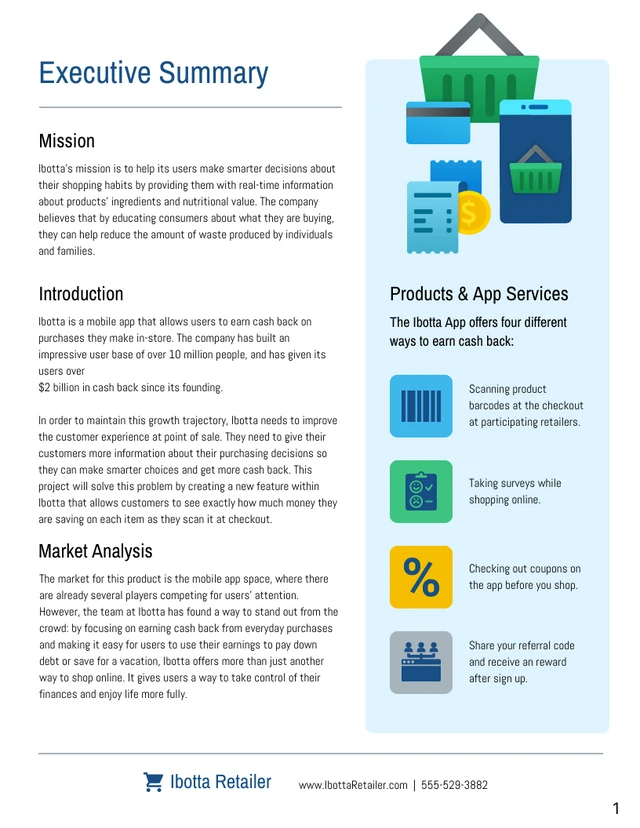
Venngage’s executive summary templates are built around this section structure. They include pre-formatted finding blocks, impact tables, and recommendation panels you can fill in directly. You can customize any template using Venngage’s AI Report Generator, including brand colors, fonts, and logo, in one step.
Why this executive summary structure works
Matches how senior readers actually read
Senior stakeholders read executive summaries in a specific pattern. They scan the purpose statement to decide if the document is relevant, read the recommendation to understand the ask, then review the findings to evaluate whether the recommendation is justified.
The structure above is built around that pattern. Putting the recommendation before the full findings section respects the reader’s priority: they want the conclusion before the evidence, not after it.
Forces the writer to commit to a position
This structure makes that evasion visible. The recommendation section sits between findings and impact, which means the logic chain is exposed. If the recommendation doesn’t follow from the findings, or the impact doesn’t follow from the recommendation, the gap is obvious.
Separates information from analysis
The key findings section reports what the data shows. The recommendation section says what to do about it. The business impact section explains why it matters.
Keeping these three functions in separate sections prevents the most common drafting mistake: mixing observation with opinion in a way that makes both harder to evaluate.
Gives every audience what they need
A CFO will read the business impact section first. A project lead will go straight to next steps. A board member will read the purpose statement and recommendation and nothing else.
The modular structure means each reader can enter at the section most relevant to them without losing the argument.
Pro tips for writing an effective executive summary
Use single data point per finding
Each finding in your key findings section should be anchored to a single data point. Not a range, not a trend description, one specific number or fact. “Customer satisfaction dropped 14 points in Q2” is a finding. “Customer satisfaction has been declining” is an observation. Readers act on findings.
Add owner for each recommendation
A recommendation without a named owner is a suggestion. Before finalizing the summary, confirm who is accountable for the recommended action. If the answer is unclear, that is a stakeholder alignment problem to solve before the document goes out.
Read it aloud before sending
Executive summaries are often read under time pressure, sometimes skimmed during a meeting. If you cannot read it aloud in under two minutes and have the argument hold together, it is too long or too complex. Cut until it does.
FAQs on Executive Summary Report Format
1. How do I write an executive summary when my findings don’t support a clear recommendation?
This is more common than people admit, and the temptation is to write around the ambiguity with hedge language that satisfies no one.
The honest approach: state explicitly what the findings show, identify what additional data or conditions would produce a clear recommendation, and frame the next step as a decision about how to get that clarity. “The data is insufficient to recommend Option A over Option B at this stage” is a more credible executive summary than one that recommends both options with caveats
2. How long should an executive summary actually be?
The standard professional guidance is one page for every ten pages of the full report, with a hard ceiling of two pages for most business contexts.
In practice, the length depends on the audience. Board-level summaries should rarely exceed one page. Summaries for technical committees or regulatory bodies can run to three pages if the methodology requires it. If you are struggling to get below two pages, the problem is usually that you are summarizing the report rather than distilling it. The purpose statement, findings, recommendation, and next steps are the only required components.
3. How do I handle negative findings in an executive summary without derailing the meeting?
Present the negative finding as a data point, connect it immediately to its business implication, and follow it with what the organization can do in response. “Customer retention fell 18% in the North region. The primary driver was onboarding delays, which the proposed service model directly addresses.” That sequence keeps the reader moving toward a solution rather than fixating on the problem
4. What is the difference between an executive summary and an abstract?
An abstract describes what a document contains. An executive summary replaces the need to read it. They tell readers the scope, methodology, and type of findings in a paper. An executive summary in a business context is a decision document. It presents findings, makes a recommendation, and specifies next steps. A reader who only reads the executive summary should be able to act on it. A reader who only reads an abstract still needs to read the full paper.