

Most teams know they need buyer personas but get stuck on what to include and how detailed to get. The result is usually a half-finished document that sits in a folder and never gets used.
With this in mind, I highly recommend creating buyer persona guides before launching a business or a marketing campaign. This is a great practice for your next social media, content or web campaigns as well.
But before anything else, let’s talk about what a buyer persona is. Haven’t tried creating buyer personas before? With Venngage for business, you can design and download buyer persona templates that make the process easier, even without design experience.
Free buyer persona templates
Buyer persona templates come in different formats depending on your use case. Some focus on demographics and goals, others go deeper into pain points, buying triggers and decision-making. Here are some of the best options for different business needs.
B2B buyer persona example template
Before browsing the visual examples below, here is a plain-text version of a B2B buyer persona template you can copy and fill out straight away:
Buyer Persona Example: HR Hannah
| Persona name | HR Hannah |
| Role / job title | HR Manager |
| Industry / company size | Professional services, 100 to 500 employees |
| Age range or life stage | 32 to 42, established mid-career |
| Goals | Reduce time to hire, improve employee retention and streamline onboarding for a growing team |
| Top pain points | Too much admin work, inconsistent communication across departments and no centralized system for tracking employee performance |
| Motivations | Wants to build a people-first culture and be recognized as a strategic partner to leadership |
| Buying triggers | Headcount grows rapidly, employee turnover spikes or leadership asks for a people strategy report she can’t produce with current tools |
| Common objections | Our IT team needs to approve this, we tried something similar before and it didn’t stick, I’m not sure we have the budget this quarter |
| Decision-making process | Researches independently, consults with IT and finance, shortlists two to three options and presents a recommendation to the HR Director |
| Preferred channels | LinkedIn, HR communities like SHRM and word of mouth from peers |
| Preferred content formats | Checklists, templates, webinars and case studies from similar sized companies |
| Key message that resonates | Less admin, more impact |
| Quote | “I spend more time on paperwork than on the people I’m supposed to be supporting.” |
Simple buyer persona profile template
You can think of buyer persona templates as a type of resume. It lists customer pain points and solutions to ensure marketing messages are more impactful.

This template focuses on a 35-year-old program coordinator who is extrovert and empathic. Note how the template includes personality traits, as well.
These are vital details that businesses can use in tailoring their campaigns toward actual customers.
You can customize this buyer persona template in the Venngage editor for your existing customers. Swap out images, change the text, and add relevant charts and graphs.
Related: Growth Strategy Checklist: Plan Your Business Goals With These 5 Templates
Ideal user persona guide template
For a more grid-style template that looks casual and minimalist at the same time, this buyer persona report works well.

The buyer persona focuses on a student who is searching for the perfect place to study quietly while enjoying a coffee. A small business owner can develop their marketing messages around these customer pain points.
You can change the fonts, alignment, and layout of this buyer persona template and adapt the preset categories for your own business.
You can still include the motivations, frustrations, and goals of the ideal customer but change the final section to reflect your products or services.
Related: 20+ User Persona Examples, Templates, and Tips For Targeted Decision-Making
Marketing persona template
Add a pop of color to your buyer persona templates to draw the eye to your marketing reports. This Venngage template is perfect for highlighting your brand alongside your target customer.

This buyer persona lists her personal information, such as occupation, archetype, and personality.
Note how this example uses diagrams and charts to showcase the user’s personality, interests, and motivations.
A good marketing plan will consider personality and the customer’s pain points as a focal point for marketing efforts.
Colorful buyer persona template
Here’s another bold way to present your buyer personas. Yellow is a strong color that works for this brand. It also makes this report stand out.

The template displays the same information as the buyer personas in this post, but the yellow theme is prominent. The wider format also makes it easier to space out the sections.
Change the image, colors, and text according to your branding guidelines. With Venngage, you can upload your own images to personify your target customers.
Or use one of the free stock photos available in the Venngage editor to represent your ideal customers.
Customer journey infographic template
This is one of Venngage’s most popular customer journey maps. It’s a simple design that uses icons and lines to visualize how a customer will move from a single sign-up to becoming a loyal business user.
Related: 15+ Creative People Infographics and Diverse Person Icons
Basic persona template
Mind mapping is an excellent tool for businesses to illustrate their strategies, competitor analyses, and SWOT analysis. It’s just as helpful for creating ideal user personas, like the one below.
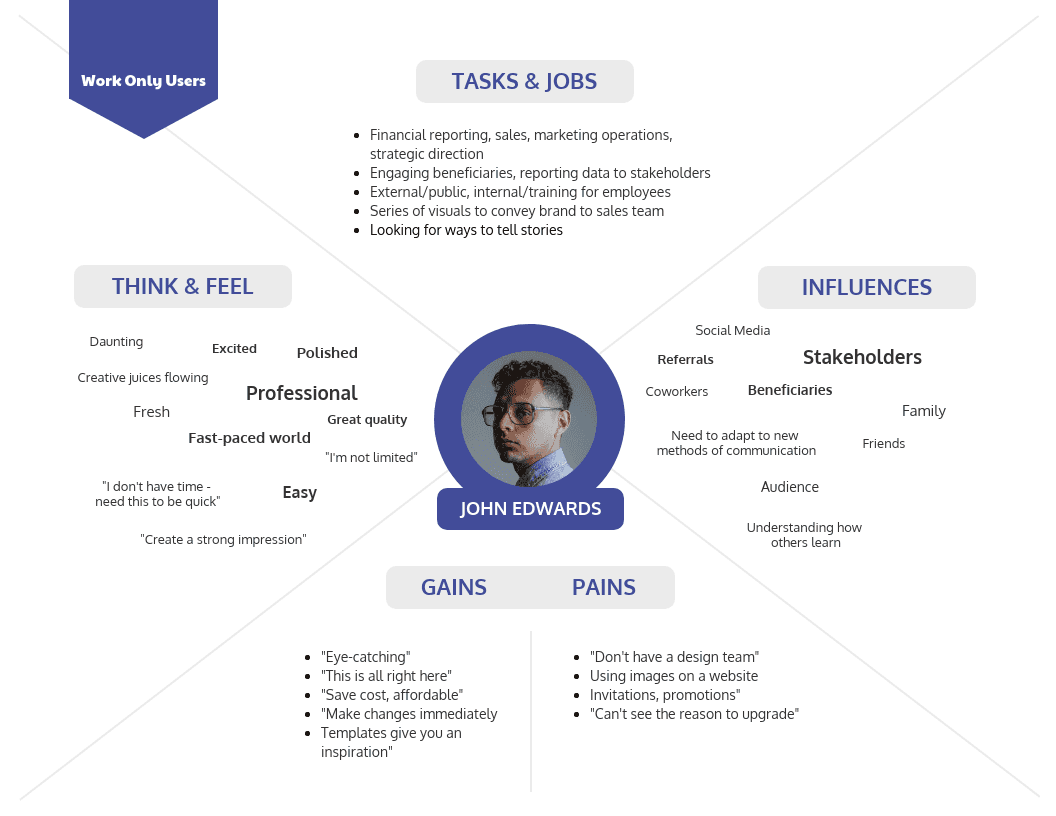
This template is easy to customize and just as simple to understand. It lists the customer’s traits in a circular form, creating a basic flow that readers can follow.
Note the use of word clouds for two of the sections. This is a great way of showing the customer pain points without having to design a list.
The mind map buyer persona examples above will mostly require text changes, which you can quickly make in the Venngage editor.
Dark buyer persona marketing report template
This dark-themed buyer persona template uses colors to distinguish each section: the user profile, customer strengths, frustrations, and goals.

The separate blocks make the report easier to follow. This is a very succinct document. It’s short and to the point. Perfect for executives with little time and a lot to do.
You don’t want to lose your audience’s interest. Creating a report like this template, which presents only the most important facts is the best way to get your message across.
Iconic buyer persona report template
A chart can get so much information across in a single glance. Most business reports include charts because of this fact.
It isn’t surprising that a buyer persona would be greatly helped by adding in a few charts, like this example that includes donut charts.

Note the use of icons in the daily activities section. These icons are a great way to tell the reader exactly what the user spends their time doing, without having to use too many words.
Related: 11 Types of Charts and How Businesses Use Them
Colorful persona guide report template
Executives have little time to read through massive reports. A succinct and attractive report that distills information is what they’re looking for.
This buyer persona guide presents key insights such as demographics, goals, frustrations, personality traits and brand preferences, all in an easy-to-read format.
Why use this template?
- Clear customer insights: Identify what motivates your audience and what challenges they face.
- Tailored marketing strategies: Develop messaging that speaks directly to your ideal customer.
- Product & service alignment: Ensure offerings align with user needs and expectations.
- Stronger brand connection: Understand the brands your audience trusts and how to position yourself effectively.
If you’re looking to fine-tune your marketing efforts and build stronger relationships with your audience, this template provides the clarity and structure needed to create an impactful buyer persona.

Adapt the various sections for your own products and services. Changing the colors in the template takes seconds. Pick from the color wheel in the Venngage editor menu to suit your aesthetics.
Create your own buyer persona by adapting this template for your brand. The Venngage My Brand Kit feature makes it easy to add your brand logo, colors, and fonts.
Add your website to the editor and it automatically downloads all your brand details.

Then you can use the Autobrand function to apply your branding to all designs with a single click.

What is a buyer persona?
A buyer persona is a semi-fictional representation of your ideal customer based on real market research, customer interviews and behavioral data. It captures who your customer is, what they are trying to achieve, what gets in their way and how they make buying decisions.
This is different from a broad audience segment. A segment groups people by shared demographics like age, location or job title. A persona goes deeper and focuses on goals, pain points, objections and buying triggers.
It’s useful for writing better messaging, running more targeted campaigns and having more effective sales conversations.
If you’re confused about the difference between buyer personas and target audience, here’s how Rock Content explains it.

Buyer personas are a tool to help you connect with potential customers. They also equip your marketing and sales team to make better, more informed decisions.
A buyer persona is necessary to better understand your target audience. Knowing who you are targeting is important to ensure your marketing campaigns reach the right people.
What to include in a buyer persona template
A useful persona goes beyond basic demographics. Here is what each section should cover:
- Demographic and firmographic details: For B2C include age range, location and life stage. For B2B add job title, seniority, industry and company size.
- Goals and motivations: What does this person want to achieve and what does success look like for them.
- Pain points and challenges: What is getting in their way and what frustrates them about their current solution.
- Buying behavior and decision criteria: How do they research purchases, who else is involved and what criteria matter most: price, ease of use, integration or brand reputation.
- Preferred channels and content formats: Where do they spend time and what do they actually read or watch. This shapes where and how you show up.
- Messaging cues: What language do they use to describe their problem. Pull these from customer interviews and reviews and reflect their words back in your marketing.
- Optional humanizing details: A name, photo placeholder and one-line quote make the persona easier to reference in team meetings and help it feel like a real person rather than a spreadsheet row.
What is a buyer persona template used for?
A buyer persona template gives your team a shared, structured reference for who you are selling to. Here is how different teams use it:
- Marketing: Informs campaign targeting, content topics, channel selection and ad copy
- Sales: Helps reps anticipate objections, tailor their pitch and qualify leads faster
- Product: Guides feature prioritization and helps teams understand which problems matter most to real users
- Customer success: Helps teams understand what the customer expected when they bought and what success looks like for them
- Leadership: Provides a common language for who the business is building for across departments
A persona is most useful when it is shared across teams, not just stored in a marketing folder.
Buyer persona vs. User persona
A user persona on the other hand is a detailed and fictional representation of a typical user of a product, service or system.
Similar to buyer personas, user personas are created based on research, data and insights about the actual users to capture their needs, goals, behaviors and characteristics.
User personas help designers, developers and product teams better understand and empathize with their target audience, guiding the creation of user-centered products and experiences.
These personas often include demographic information, preferences, pain points and scenarios that reflect the diversity and nuances of the user base.
How to create a buyer persona
A strong B2B buyer persona requires real data, thoughtful analysis and ongoing refinement. Here’s how you can build one effectively:
Step 1: Gather real customer data
A strong persona starts with research, not assumptions. The more data sources you combine, the more accurate the persona will be. Useful sources include:
- CRM data and purchase history
- Website and email analytics
- Customer interviews and surveys
- Support tickets and live chat logs
- Online reviews and social listening
- Sales team feedback
- Industry reports
The goal is to find what your customers actually say, not what you think they mean.
Step 2: Find patterns and segment your audience
Once you have your data, look for shared traits across customers. Group them by job title, company size, key challenges or buying behavior. Each distinct group becomes a separate persona.
A common mistake is creating too many personas. Most businesses need two to four. More than that and the personas become too niche to act on. Focus on the segments that represent your most valuable or most common customers.
Step 3: Fill in the buyer persona template
Now bring the persona to life using a structured template. Prioritize fields that are actually actionable for marketing and sales:
- Name and job title
- Company size and industry
- Goals and challenges
- Pain points and buying triggers
- Common objections
- Decision-making process
- Preferred channels and content formats
Skip fields that are interesting but don’t change how you communicate, like generic demographic trivia that has no bearing on messaging or positioning.
Step 4: Validate with sales, marketing, and support teams
A persona is only useful if it reflects real customer behavior. Share the draft with the teams who talk to customers every day.
- Sales can confirm whether the objections and decision-making process ring true
- Marketing can check whether the channel and content preferences match campaign data
- Support can flag pain points or frustrations that didn’t come up in initial research
Use their feedback to refine the persona before sharing it more broadly.
Step 5: Update your personas regularly
Personas go out of date. Markets shift, products evolve and customer needs change. Build a review cadence into your workflow: quarterly is a good starting point, or after any major campaign, product launch or shift in your target market.
Buyer persona vs target audience, user persona, and customer persona
These terms might sound similar, but they focus on different people in the buying process. Here’s a simple way to break it down:
Understanding the difference helps businesses target the right people with the right message, whether they’re selling, marketing, or designing products.
B2B vs B2C buyer persona templates
B2B and B2C personas look different because the buying process works differently.
In B2B, the decision rarely involves one person. There are multiple stakeholders, longer sales cycles and more emphasis on ROI, integration and risk. A B2B persona needs to capture job title, company size, decision-making authority and common objections from different roles in the buying committee.
In B2C, the buyer and the user are usually the same person. The decision is faster and more emotionally driven. A B2C persona focuses more on lifestyle, values, motivations and the triggers that push someone from consideration to purchase.
Use a B2B template when your sale involves multiple decision makers or a longer evaluation process. Use a B2C template when you are speaking directly to the end user and the decision is personal.
Common buyer persona mistakes to avoid
Building personas on assumptions
A persona that reflects what you think your customer looks like rather than who they actually are will produce messaging that misses the mark. Always start with real data from interviews, CRM records and customer feedback.
Creating too many personas
More personas does not mean better targeting. Most businesses need two to four. Beyond that the profiles become too niche to act on and teams stop using them altogether.
Over-indexing on demographics
Age and job title tell you who someone is but not how they buy. Goals, objections and buying triggers are far more useful for sales and marketing teams trying to have better conversations and write sharper copy.
Never updating them
A persona built two years ago may no longer reflect your current customer base. Review personas quarterly or after major product launches, market changes or shifts in who is actually buying from you.
Buyer persona FAQs
How do I identify my target persona?
Start by analyzing your current customers. Look at demographics, job roles, pain points and buying behaviors. You can also conduct surveys, interviews and market research to understand their needs, challenges and decision-making processes. This helps create a clear profile of your ideal customer.
How many buyer personas should a business create?
Most businesses need two to four personas. More than that becomes difficult to act on. Start with the segments that represent your highest value or most common customers and expand only when you have enough data to justify a new profile.
Can AI help create a buyer persona?
Yes, but it should support your research rather than replace it. AI tools can summarize interview transcripts, cluster patterns across large datasets and draft initial persona language quickly. The inputs still need to come from real customer data. A persona built entirely on AI assumptions will reflect what sounds plausible, not what is actually true.
Should buyer personas be updated regularly?
Yes. A quarterly review is a good starting cadence. Also update personas after major product changes, new market expansion or shifts in who is actually buying from you. Personas that haven’t been reviewed in over a year are often no longer accurate.
Create your buyer persona template
With buyer personas and customer journeys, you can create the best messaging, positioning, and products that appeal to your target audience. Customize these buyer persona templates for your business presentations.
Presenting your buyer persona template layouts requires time to plan and produce. With Venngage’s buyer persona templates, you can start creating for free, without any prior design experience.