


Imagine I ask you to build me a house. Would you start the process by laying the bricks or painting walls right away? Surely not! Rather, you’d probably create a blueprint first based on my requirements.
Wireframing is no different except that it’s a basic structure of a webpage or app without any of the other goodies like text, colors, and on-page graphics.
To make wireframes, you can use pencil and paper (slow way) or use digital wireframing tools to make them fast and with more detail.
In this post, I’ll reveal 15+ best online wireframe tools you can use to create a wireframe regardless of skill level and share some wireframe templates for inspiration.
The best wireframing tools at a glance (category winners)
Here’s a quick overview of the top pick in each category across all 15+ tools I reviewed. I’ve covered each one in detail below.
- Figma: Best overall for most teams. Use it when you need multiplayer editing, components and a smooth path from lo-fi to hi-fi to prototype.
- Venngage: Best template-first tool for non-designers. Use it when you want drag-and-drop templates and quick share/export without a steep learning curve.
- Balsamiq: Best for fast low-fidelity wireframes. Use it when you want “sketchy” wires that keep stakeholder feedback focused on structure, not visuals.
- Moqups: Best for beginners who want simple wireframes and diagrams. Use it when you want stencils, templates and a gentle learning curve.
- Justinmind: Best for interactive wireframe prototypes. Use it when you need wireframes that behave like real screens, with inputs, dropdowns and interactions.
- UXPin: Best for code-aware and production-aligned prototyping. Use it when you want components tied closer to real implementation with more advanced interaction logic.
- Visily: Best AI-first tool for quick drafts and Figma handoff. Use it when you want prompt or screenshot to editable screens quickly, then polish in Figma.
Wireframe tools comparison
Picking the right wireframing tool comes down to a few key factors: what fidelity you need, whether you’re working solo or with a team and how much you’re willing to spend. I’ve pulled the most important details across all 15 tools into one table so you can compare them side by side.
How we evaluated these wireframing tools
Here are the key factors I considered while testing:
- Speed to first draft: How fast can you get from a blank canvas to something shareable? I looked at the quality of built-in templates and stencils, and where AI generation was on offer, how much it actually reduced manual work.
- Fidelity path: Can you move from a rough lo-fi sketch to a high-fidelity mockup inside the same tool, or do you need to export and start over in Figma? I noted which tools support that full journey and which ones stop at one end of the spectrum.
- Collaboration: I tested real-time multiplayer editing, commenting and annotation, permission controls and version history. Design work involves PMs, designers and developers who all need to stay aligned in the same file.
- Handoff and export: I evaluated shareable link options, export formats (PDF, PNG and SVG), Figma handoff quality and whether developers get anything useful like specs or annotated flows.
- AI usefulness (where applicable): For tools with AI features, I tested prompt quality, how much control you have over the output and whether the generated wireframes are actually editable after generation.
Related: 10+ Wireframe Examples To Spark Your Inspiration.
15+ best wireframe tools
1. Venngage Wireframe

When it comes to wireframing, Venngage is the go-to choice whether you’re a beginner with little to no design skills or a seasoned pro.
With a intuitive drag-and-drop interface, Venngage’s Online Wireframe Tool allows anyone to create wireframes effortlessly.
Venngage is made for people like marketers and project managers who need a quick and easy way to communicate their ideas to developers.
It can also be used by a design team who want to collaborate on wireframe projects together in real-time.
Key features:
- Intuitive drag-and-drop interface.
- Customizable wireframe templates.
- Collaboration tools for team projects.
- Export options for seamless integration with design workflows.
Pricing:
- Free Plan: Basic tools for individual users at no cost.
- Premium Plan ($10/month per user): Includes advanced tools for individual users.
- Business Plan ($24/month per user): Ideal for teams with additional collaborative tools and support.
- Enterprise Plan (Starting at $499/month for 10+ seats): Tailored for larger organizations who need. advanced customization options and support.
Best suited for:
Venngage best suits designers, developers, project managers, and marketers seeking an easy-to-use wireframing tool that fosters collaboration and creativity.
If you don’t want to create a wireframe from scratch, Venngage also offers wireframe templates to help you bring your visions to life.
2. Figma Wireframe
Source: Figma
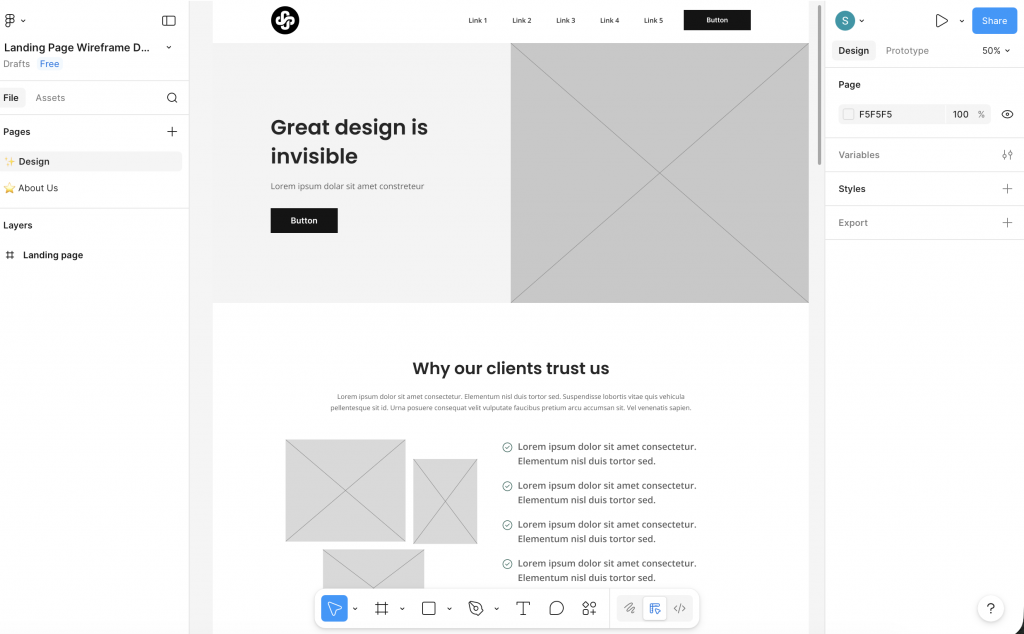
Figma is a cloud-based design tool tailored for UI/UX designers who require a design platform with powerful features. It is meant for expert designers who know how to use complex tools.
If you’re looking for a beginner-friendly wireframing tool, give this one a pass.
Key features:
- Real-time collaboration.
- Browser-based accessibility.
- Contextual feedback through comments.
- Easy transformation from basic to detailed components.
Pricing:
Figma offers many plans. These include free and paid options.
- Free Plan
- Individual Subscription: $12/month.
- Team Subscription: $45/month.
Best suited for:
Figma’s wireframe tool is best for individuals and teams who work in web design and/or development.
3. Adobe XD Wireframe

Source: Adobe XD
Adobe XD is another professional wireframing tool that you can use to outline the layout of a web page or mobile app.
Adobe targets designers who want more control when creating wireframes from scratch. Again, don’t expect the interface to be intuitive or beginner-friendly.
What’s great about Adobe XD though is it gives collaboration features like real-time co-editing and shared prototypes.
Key features:
- Adjustable components and templates.
- Optimized grid systems for pixel-perfect layouts on different devices.
- Free web fonts to enhance the visual appeal of text elements in designs.
- Predefined text styles to uphold brand consistency.
Pricing:
- Starter Plan (Free): Basic features for individual users.
- Single App Plan ($9.99/month): Includes Adobe XD and 100GB of cloud storage.
- All Apps Plan ($52.99/month): Access to the full Adobe Creative Cloud suite.
Best suited for:
Adobe XD is awesome for designers who need to create detailed sketches, interactive prototypes that can be clicked through, and designs that look great on all devices.
4. Sketch Design

Source: Sketch
Sketch is a premier and lightweight wireframing tool that’s been around since 2010.
Right off the bat, this is only for Mac users so if you like Windows, skip right ahead.
However, if you do use a Mac and are interested, Sketch is a great way to build powerful wireframes by using kits that other designers have created. It also a great, crisp layout (as is expected for Apple-related products).
Though Sketch doesn’t offer a library of UI components (you’ll have to create wireframes from scratch!), you can download wireframe kits which include buttons, icons, and other design elements created by others.
Key features:
- Allows for creating reusable components, similar to Smart Objects in Photoshop.
- Provides a range of keyboard shortcuts for smart guides.
- Offers a feature called “Create grid” for easy and clean grid creation.
- Provides presets for artboards, allowing for quick organization of work.
Pricing:
- Basic Plan (Free): Entry-level features for individual users.
- Standard Plan ($9.99/month): Includes Sketch Design with ample cloud storage.
- Complete Plan ($52.99/month): Full access to the comprehensive Sketch Creative Suite.
Best suited for:
Sketch is perfect for designers who specialize in designing websites and/or apps who want to make detailed and realistic designs quickly and easily.
5. Justinmind
Source: Justinmind
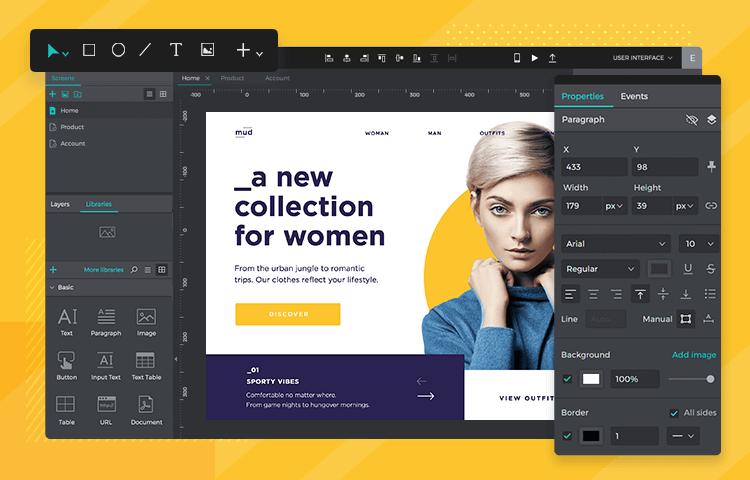
Justinmind is a versatile wireframing tool which focuses on helping you can create interactive prototypes (ability to add text inputs, radio buttons, and more to wireframes).
So if you want wireframes that give you a in-depth look of a design right from the get-go, you can’t go wrong with Justinmind.
Key features:
- Prototypes work for web and mobile apps.
- Support for various platforms, like websites, iOS, and Android.
- Facilitates team collaboration on projects, enhancing communication and workflow efficiency.
- Allows for capturing screens within the tool for reference or documentation purposes.
- Provides tools for presenting prototypes effectively to stakeholders or clients.
Pricing:
- Free Trial: Allows users to test the tool for a limited period.
- Starter Plan: $19/month for individual users.
- Professional Plan: $49/month for teams of up to 5 users.
- Enterprise Plan: Custom pricing for larger teams.
Best suited for:
Justinmind is great for people with varying design skills like project leaders, and marketers, who need a good tool for making web and mobile app sketches.
It works well for websites and both iPhone and Android apps, making it a go-to choice for all kinds of projects.
6. Uizard
Source: Uizard
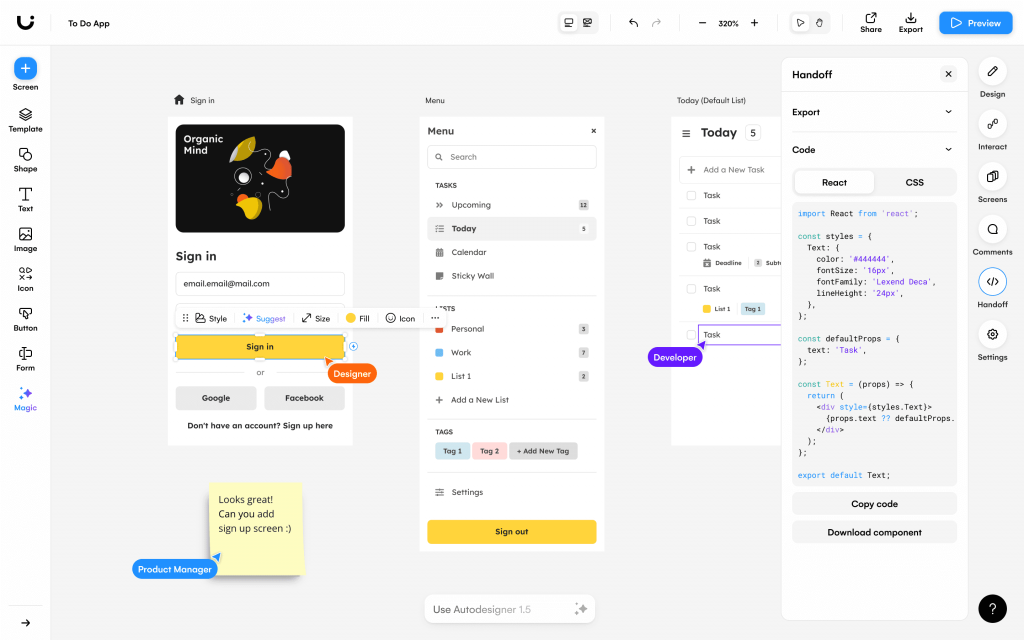
If you want a tool that has an AI assistant to help you create wireframes from a prompt, Uizard is your best friend. (Did you really think I’d leave AI out of this list?).
While the wireframe will likely be useable, like most AI-generated content, you’ll probably want to edit and improve the design to bring it up to human standards.
Key features:
- AI-driven design capabilities.
- Seamless platform for web and mobile app prototypes.
- User-friendly interface for effortless design creation.
- Simplified workflow with AI-powered tools.
Pricing:
- Free Trial: Allows users to experience the AI-driven design tools.
- Starter Plan: Affordable pricing for individual users starting at $15/month.
- Professional Plan: Tailored for teams with advanced tools starting at $25/month.
- Enterprise Plan: Customized solutions for larger organizations with pricing based on specific needs.
Best suited for:
Uizard is a great pick for designers, developers, project managers, and marketers who want wireframes instantly (or as fast as AI can create it).
7. Moqups
Source: Moqups
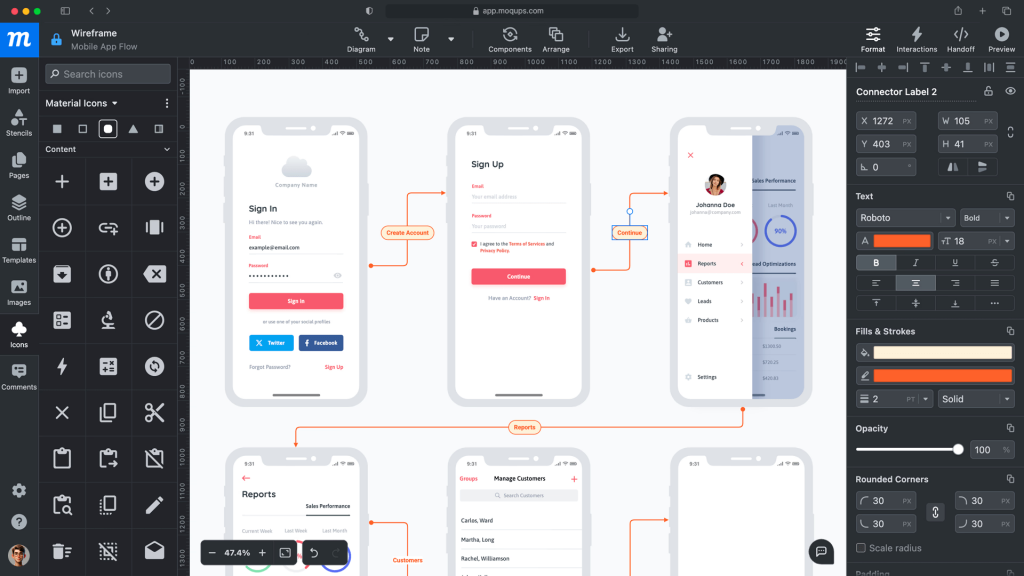
If you’re no designer (like me), Moqups is another great option since it lets you create wireframes using templates of landing pages or an ecommerce dashboard.
The UI is pretty easy to figure out too so it won’t take you long to learn how how to add shapes, images, and icons to customize a wireframe to your liking.
Key features:
- The platform covers not only wireframes but also prototypes.
- It is compatible on the Cloud and supports all devices.
- Has a built-in library for icons and stencils.
- Has whiteboard functionality for team collaboration.
Pricing:
- Free Plan: Basic tools available at no cost.
- Pro Plan: Enhanced tools for individual users starting at $16/month.
- Team Plan: Collaboration tools for teams starting at $49/month.
- Enterprise Plan: Custom solutions for larger organizations with tailored pricing.
Best suited for:
Moqups is ideal for non-developers, particularly business owners, project managers, and freelancers.
8. Balsamiq

Source: Balsamiq
Balsamiq is a low-fidelity UI wireframing tool that replicates the experience of sketching on a notepad or whiteboard while using a computer.
This makes it a great choice for anyone who wants an easy way to create wireframes or just wants a rough version without being super detailed.
Key features:
- It offers over 75 user interface control types.
- It supports real-time collaboration.
- It provides symbols for quick and easy customization of wireframes.
Pricing:
- Free Plan: Basic tools available at no cost.
- Pro Plan: Enhanced tools for individual users starting at $15/month.
- Team Plan: Collaboration tools for teams starting at $25/month.
- Enterprise Plan: Custom solutions for larger organizations with tailored pricing.
Best suited for:
Balsamiq is perfect for founders, data analysts, product managers, marketers, developers, and UX designers.
Choose it if you want to quickly make simple wireframes that focus on the initial UI or layout and content.
9. UXPin
Source: Zapier
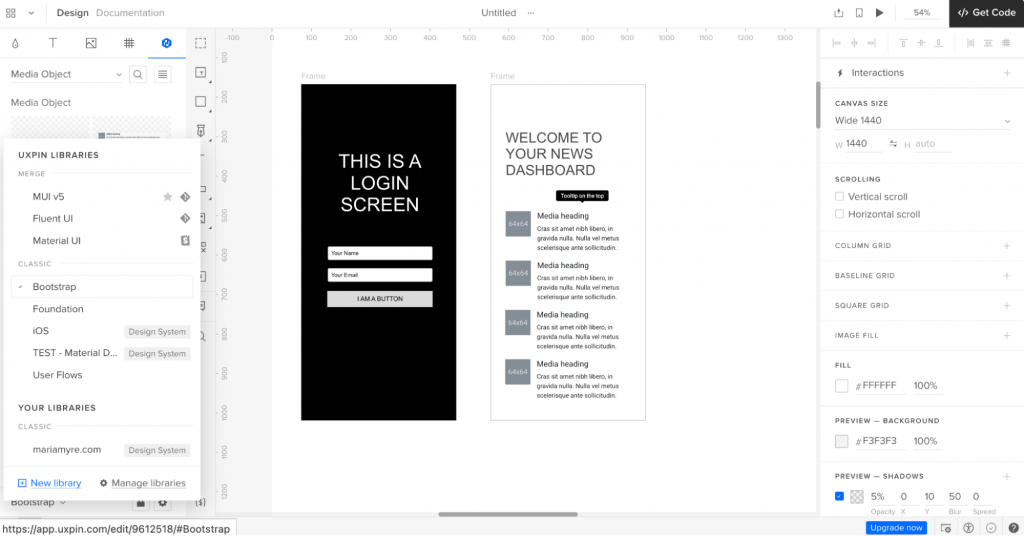
UXPin is one of the most recommended wireframe tools for designers just starting out. If you don’t mind a slight learning curve, this tool can be a great option.
With UXPin, you can create wireframes by dragging and dropping different elements onto the canvas.
This functionality allows you to focus more on flow and functionality rather than fine-tuning design.
Key features:
- Advanced design collaboration capabilities.
- Versatile platform for wireframes, mockups, and prototypes.
- Intuitive interface for seamless design creation.
- Enhanced teamwork and communication tools powered by technology.
Pricing:
- Free Plan: Basic tools available at no cost.
- Pro Plan: Enhanced tools for individual users starting at $20/month.
- Team Plan: Collaboration tools for teams starting at $50/month.
- Enterprise Plan: Custom solutions for larger organizations with tailored pricing.
Best suited for:
UXPin is an exceptional choice for designers, developers, and project managers. It’s also great for teams looking for an innovative design tool.
10. Miro
Source: Miro
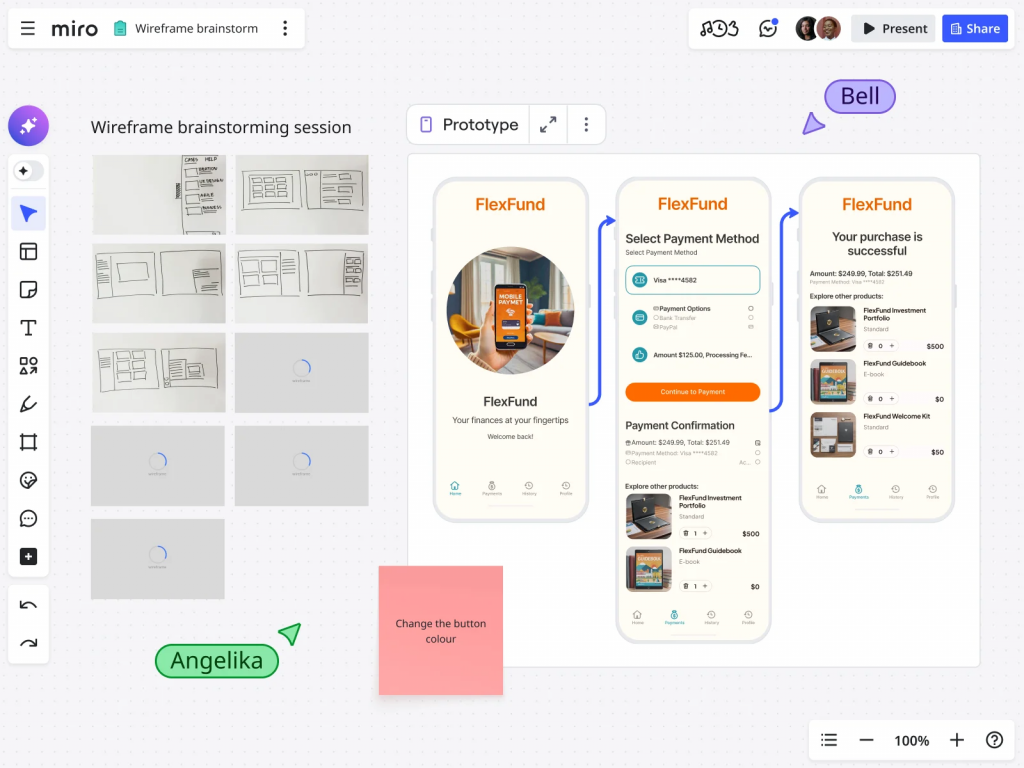
Miro is a wireframe design tool that enables users to easily create simple low-fidelity wireframes quickly, even if they don’t have any design experience.
This makes it a great choice for companies focused on productivity.
Key features:
- Collaborative design capabilities.
- It integrates with over 130 tools, including Jira, Azure DevOps, Asana, Zoom, Teams, and Slack.
- It offers a drag-and-drop interface.
- It provides communication tools such as chat, comments, and notifications.
Pricing:
- Free Plan: Basic tools available at no cost.
- Pro Plan: Enhanced tools for individual users starting at $8/month.
- Team Plan: Collaboration tools for teams starting at $16/month.
- Enterprise Plan: Custom solutions for larger organizations with tailored pricing.
Best suited for:
Miro is for remote teams of any size.
11. Lucidchart
Source: Lucidchart
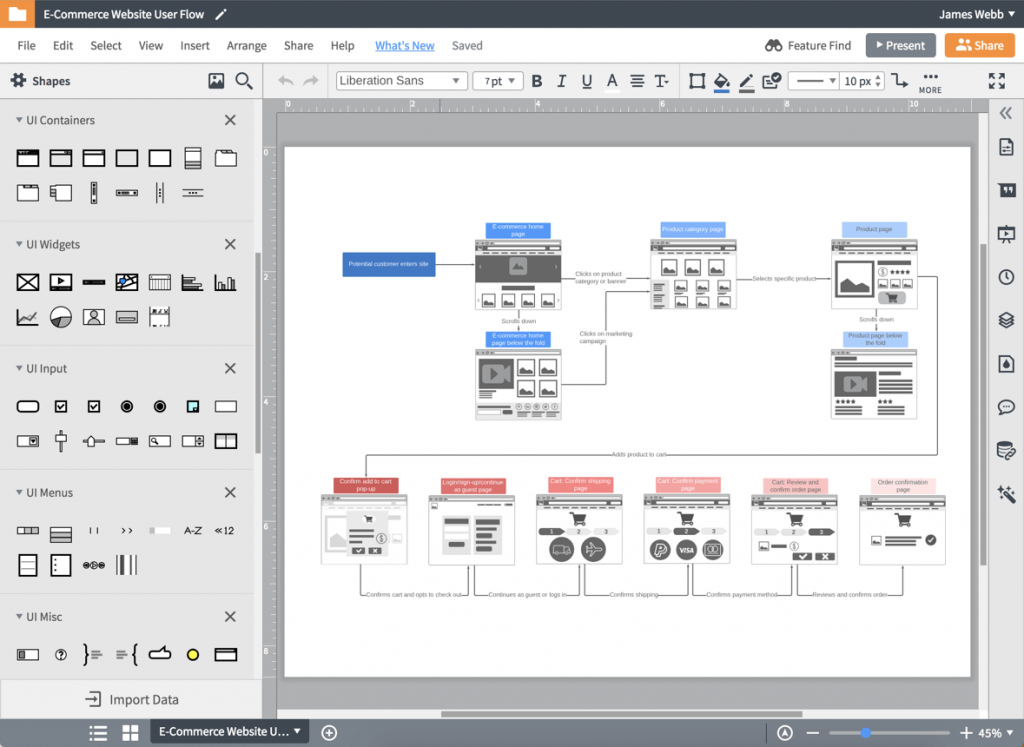
Lucidchart is a diagramming tool but you can also use it to create wireframes.
It provides a drag-and-drop interface and UI shape library that you can insert (think search boxes, site map icons and more) to create a basic structure.
Lucidchart also offers wireframe templates you can customize but your choice will be limited wireframing isn’t the primary focus.
Key features:
- It provides real-time updates from places like Google Sheets.
- It integrates with tools like Google Sheets, Excel, CSVs, Salesforce and Zapier.
- Users can create visual account maps.
- It has a presentation mode to turn visuals into a slide-deck presentation.
Pricing:
- Free Plan: Basic tools available at no cost.
- Pro Plan: Enhanced tools for individual users starting at $7.95/month.
- Team Plan: Collaboration tools for teams starting at $15.95/month.
- Enterprise Plan: Custom solutions for larger organizations with tailored pricing.
Best suited for:
Lucidchart’s wireframe tool is perfect for individuals and teams looking to create simple designs quickly.
It’s especially handy for non-designers who need a straightforward method to design and share their work online, regardless of their design skills.
12. Whimsical
Source: Whimsical
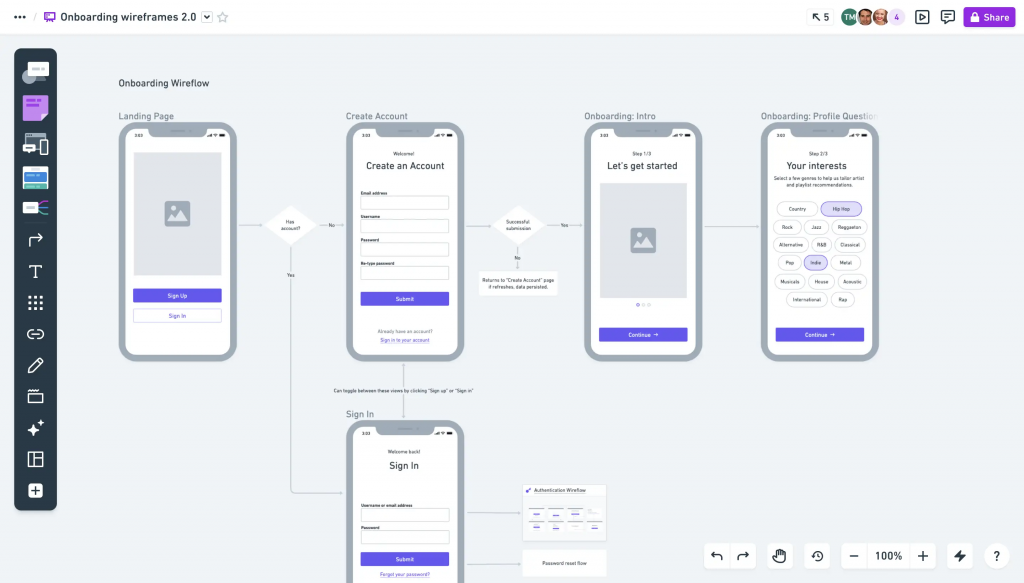
Whimsical is a great way to make low-fidelity wireframes which makes it a great option for teams looking to find ways to quickly agree on functionality.
Key features:
- Drag-and-drop functionality for easy arrangement of elements.
- Quick state changes and other features for creating wireframes.
- A variety of frames and elements to choose from for building wireframes.
- Collaboration tools for real-time editing and commenting.
Pricing:
- Free Plan: Basic features available at no cost.
- Pro Plan: Enhanced features for individual users starting at $12/month.
- Team Plan: Collaboration tools for teams starting at $24/month.
- Enterprise Plan: Custom solutions for larger organizations with tailored pricing.
Best suited for:
Whimsical is great for people and groups who want to draw complicated ideas, share thoughts, and get their projects done faster thanks to its creative tools.
13. Marvel
Source: Marvel
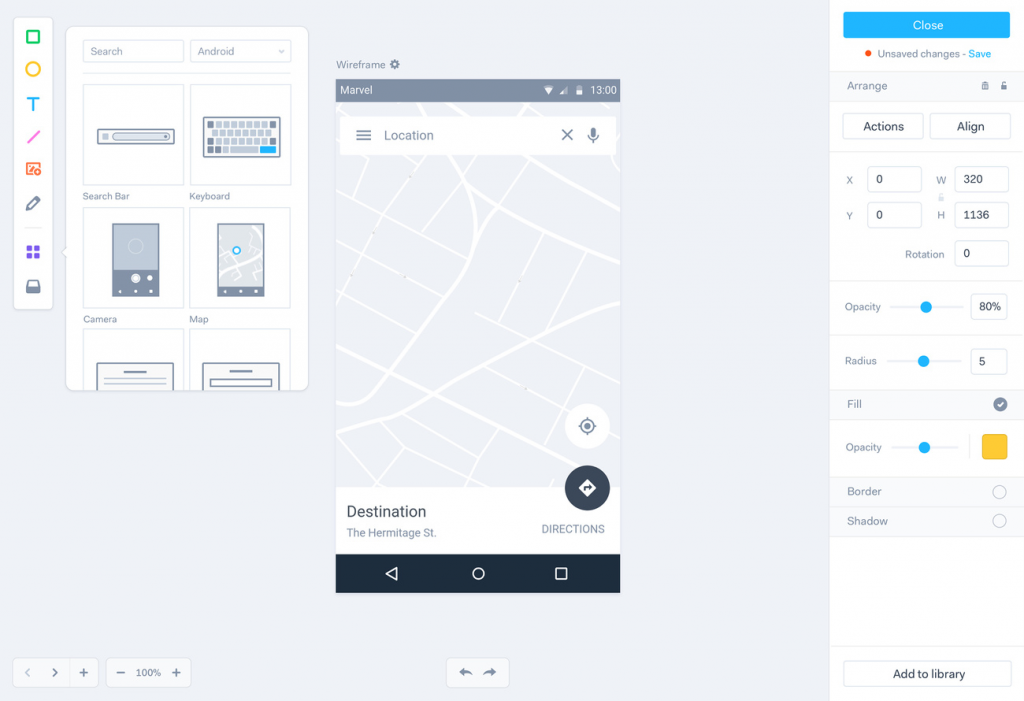
Marvel is a no-code tool that you can use to make wireframes and prototypes.
It’s easy to use, works well, and has many cool features, making it perfect for small design teams with a lot of work to do together smoothly.
However, if you’re after dynamic prototypes and wireframes, Marvel might not be up to task.
Key features:
- Prototyping capabilities.
- Real-time collaboration tools.
- Versatile platform for wireframes, mockups, and prototypes.
- Intuitive interface for seamless design creation.
Pricing:
- Free Plan: Basic features available at no cost.
- Pro Plan: Enhanced features for individual users starting at $12/month.
- Team Plan: Collaboration tools for teams starting at $24/month.
- Enterprise Plan: Custom solutions for larger organizations with tailored pricing.
Best suited for:
Marvel wireframe tool is great for web designers, freelancers, and small design teams who want to put together designs for websites fast and effectively.
It’s especially good for making wireframes or designs right in the app, using the prototype feature, and sharing them with others to get their thoughts.
14. MockFlow
Source: Mockflow
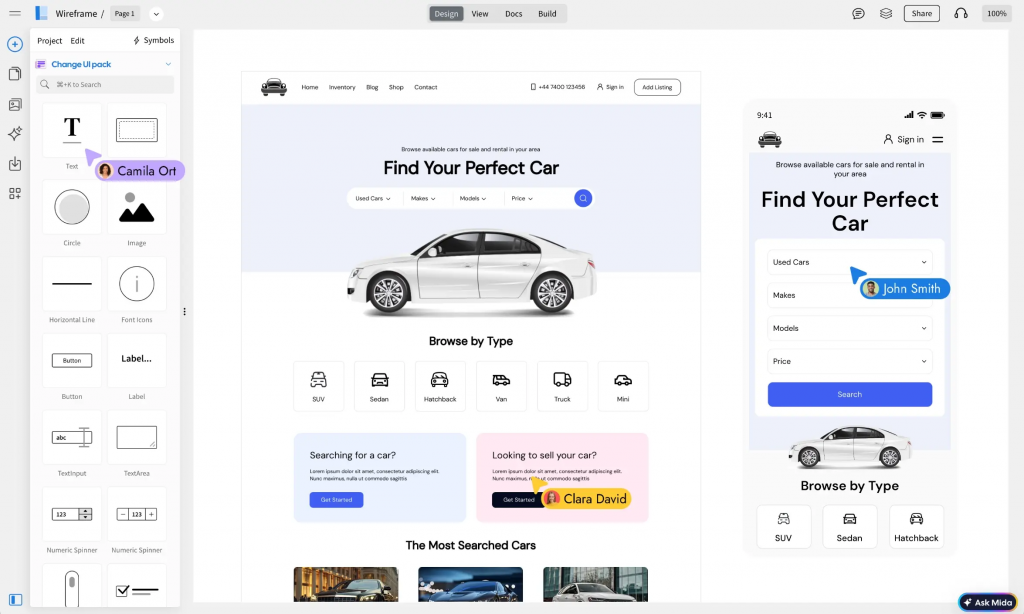
Mockflow is a wireframing tool that focuses on speed, design, and real-time collaboration. It has a clean interface so anyone can pick it up quickly.
Key features:
- Professional designs designed for quick and easy iteration.
- Easily build attractive UI design specifications and brand pages like any professional designer.
- Streamline design review and collaboration process with the team.
- Highly efficient and feature-rich development platform.
Pricing:
- Free Plan: Basic features available at no cost.
- Pro Plan: Enhanced features for individual users starting at $15/month.
- Team Plan: Collaboration tools for teams starting at $25/month.
- Enterprise Plan: Custom solutions for larger organizations with tailored pricing.
Best suited for:
MockFlow is perfect for people who design websites, create mobile apps, students, and anyone looking for a good tool to sketch out and test their projects.
15. Visily
Source: G2
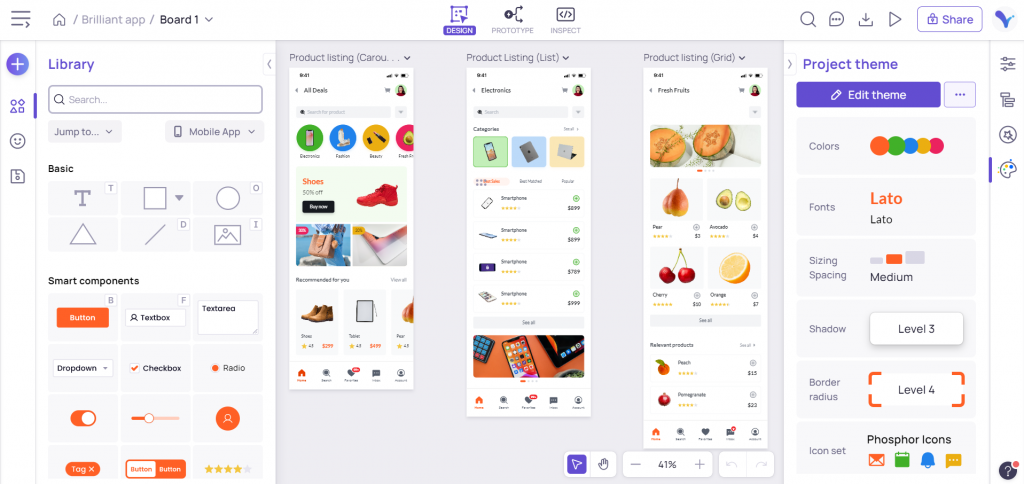
Visily is built for people who want to go from idea to editable wireframe fast, without needing to know their way around a design tool. It sits in an interesting middle ground: it can generate both lo-fi wireframes and high-fidelity UI from the same prompt, which means you’re not locked into one mode the way you are with something like Balsamiq.
Key features:
- Generate lo-fi and hi-fi wireframes from a single text prompt or image upload
- Switch between wireframe and high-fidelity mode without rebuilding your layouts
- Collaborate in real time with comments, version history and shared boards
- Export to Figma with layers intact for handoff or further refinement
Pricing:
- Free plan: Basic features available at no cost with 3 AI generations per month
- Pro plan: Full AI features for individuals starting at $11/month (billed annually)
- Business plan: Collaboration tools for teams starting at $39/seat per month (billed annually)
Best suited for:
Visily is perfect for founders, product managers and non-designers who want to go from a rough idea to a shareable wireframe quickly without a steep learning curve.
16. Banani (AI)
Source: Banani
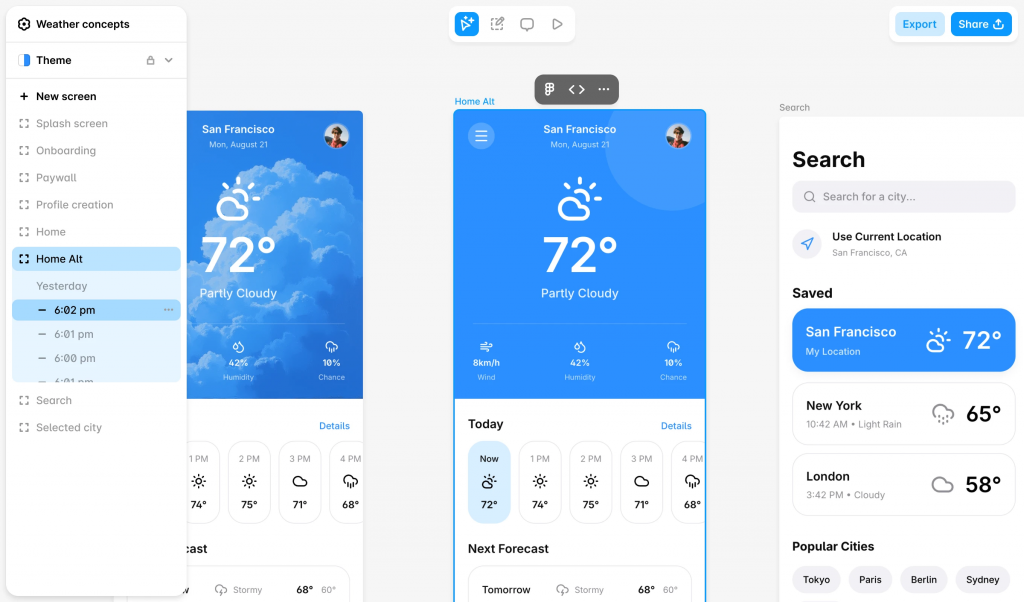
Banani is an AI wireframing tool that generates high-fidelity screen variations from a text prompt and lets you refine them through a chat interface, with direct export to Figma.
Key features:
- Generate three hi-fi design variations per prompt.
- Accepts text prompts, screenshots and Figma frames as input.
- Refine any part of a design through follow-up chat prompts without redrawing.
- Copy designs directly into Figma with layers and structure intact.
Pricing:
- Free plan: Unlimited design generations with core features at no cost.
- Pro plan: Expanded project and collaboration features starting at $20/month.
Best suited for:
Banani is perfect for PMs, non-designer founders and early-stage teams who want realistic hi-fi mockups fast before handing off to a designer or developer.
17. Mokkup.ai
Source: Mokkup.ai
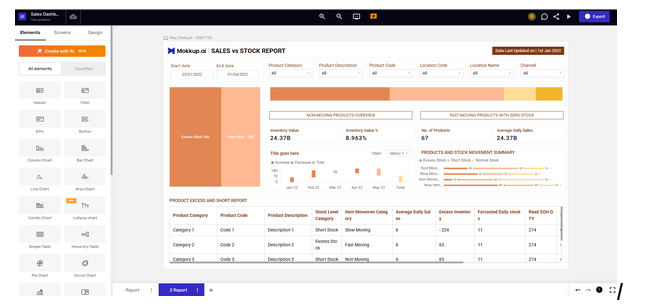
Mokkup.ai is a wireframing tool built specifically for BI dashboards rather than general web or app screens. Instead of building a dashboard mockup out of generic boxes and lines, you drag in pre-built charts, KPIs, tables and filters, or describe the dashboard you want and let its AI generate a first draft. Then export the whole layout directly into Power BI or Tableau as a ready-to-build template.
Key features:
- AI-generated dashboard wireframes from a text prompt or uploaded file/data
- A library of industry-specific dashboard templates (finance, sales, marketing, operations, customer insights)
- One-click export to Power BI and Tableau, with a Semantic Layer that pre-configures metrics, measures and formulas on Tableau exports
- Real-time collaboration with comments and shared links for stakeholder feedback
Pricing:
- Free Plan: Core wireframing tools, AI prompts and a limited number of projects
- Pro Plan: $10/month per user, billed monthly; $8/month per user billed annually
- Enterprise Plan: Custom credit-based pricing for larger teams needing 100+ BI export credits.
Best suited for:
Mokkup.ai is best suited for BI developers, data analysts, and product/ops managers who need stakeholder buy-in on a dashboard’s layout before building it in Power BI or Tableau, skipping the usual back-and-forth of mocking it up in a generic design tool and rebuilding it later.
How to choose the best wireframing tools?
Picking the right wireframing tool depends your needs, design experience, and whether you work alone or with a team.
For example, if you’re a design pro who wants advanced features, pro wireframing tools like Adobe XD and Figma should be on the top of your list.
But what if you’re just starting out or a project manager or other professional that needs a quick and easy way to communicate a design visually to a developer or client?
In that case, you need a tool like Venngage.
Venngage is an ideal wireframing tool for anyone who wants to tweak templates to communicate their vision or create a wireframe from scratch without a steep learning curve.
Here are a few examples of wireframe templates you can customize on Venngage.
This example is a great mockup for a page designed for lead generation and content marketing purposes.

This example shows the structure of lead magnet page you can use as inspiration to drive a conversion goal (in this case email sign-ups).

This example is a wireframe of a webpage where the goal is to convert viewers into users by highlighting an app’s simplicity and the immediate benefit.

This example is a mockup of a promotional or informational page that outlines various features and benefits of an and is likely meant for a website or an app store description.

Conclusion: The best wireframing tool depends on your workflow
There is no single right answer here. The tool that works for a solo founder validating an idea is not the same one a cross-functional product team should be using, and the one a UX designer uses to hand off to developers is different again.
If you are just getting started and want to move fast without a learning curve, Balsamiq or Moqups will get you to a shareable wireframe in minutes. If your team needs real-time collaboration and a path all the way to hi-fi, Figma is the obvious choice. If you are building something with complex interactions and form logic, Justinmind or UXPin will serve you better than anything else on this list.
And if you want a tool that balances ease of use with genuinely customizable templates, especially if you are not a designer by trade, Venngage is worth trying. You can get started with our wireframe templates today.